
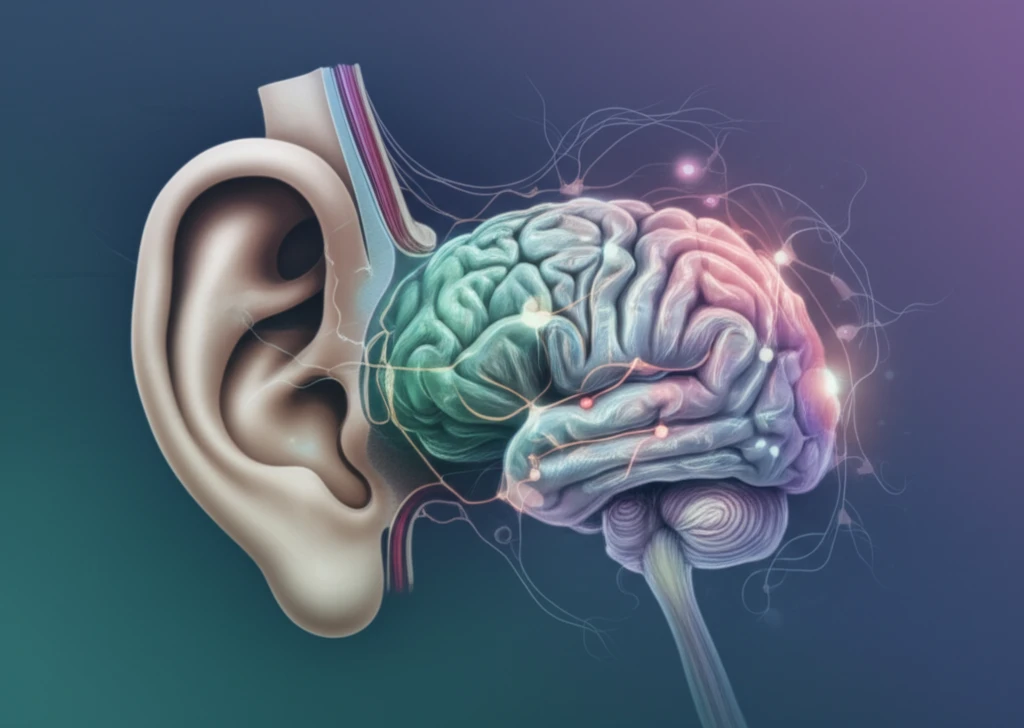
Tinnitus and Your Brain: Remodeling Cholinergic Pathways After Noise Exposure

"New research uncovers how noise-induced tinnitus may be linked to changes in the brain's hippocampus, offering potential insights into treatment."
Tinnitus, that persistent ringing, buzzing, or hissing in your ears, affects millions worldwide. While some adjust, many experience depression and emotional distress, highlighting the urgent need to understand and treat this condition effectively. Recent research sheds light on a surprising connection: changes in the brain's hippocampus after noise exposure might play a significant role in tinnitus.
Traditionally, tinnitus research has focused on auditory pathways, from the cochlea to the auditory cortex. However, accumulating evidence suggests non-auditory systems, including the limbic system (responsible for emotions and memory), are also involved. The hippocampus, crucial for memory and learning, is increasingly recognized as a potential key player in the tinnitus puzzle.
This article delves into a study investigating how noise exposure remodels cholinergic inputs—the communication pathways using the neurotransmitter acetylcholine—in the hippocampus, and how these changes relate to the development of tinnitus.
The Scale of Tinnitus and Noise Exposure
CDC/NIOSH reports that approximately 8% of U.S. workers have tinnitus, while about 11% have hearing difficulty. Among noise-exposed workers, 53% report not wearing hearing protection. Other reported estimates identify occupational noise exposure as a major modifiable risk factor, with approximately 25% of American workers experiencing hazardous noise levels and 22 million exposed to very loud noise annually. These figures point to workplace noise and hearing damage as important contributors to tinnitus risk.
Clinical Measurement and Individual Variation
Standard tinnitus assessment commonly includes clinical matching of tinnitus pitch and loudness. A case series compared the one-month reproducibility of the standard two-alternative forced-choice method with a patient-centered tinnitus loudness rating approach, highlighting that measurement approach can affect individual reliability. The 2024 VA/DoD guideline emphasizes that practice appropriately varies with patient needs, available resources, and institutional limitations. Research on daily auditory environments also indicates that people with tinnitus have characteristic real-world noise exposure patterns that may not be fully captured by a single clinical session.
From Description to Mechanism
For much of recorded history, tinnitus was described through sounds such as buzzing, whistling, or roaring before its cause could be explained. In the sixth century, Alexander de Tralles proposed that tinnitus resulted from increased irritability of the auditory sense. Early theories were primarily peripheral, emphasizing cochlear lesions and other hearing-system involvement. In noise-induced tinnitus, these models linked the pattern of hearing loss with the pitch of the perceived tinnitus.
The Noise-Tinnitus-Hippocampus Connection: What the Study Revealed
Researchers at the University of Michigan explored these changes in guinea pigs, a common animal model for tinnitus studies. They exposed guinea pigs to noise and then examined their brains for changes in vesicular acetylcholine transporter (VACHT), a protein crucial for cholinergic neurotransmission. The team used varied methods to induce tinnitus and evaluated how animals with and without tinnitus differed.
- Noise Exposure and VACHT Reduction: Initial noise exposure led to a significant decrease in VACHT density in the hippocampus within two weeks.
- Tinnitus-Specific Changes: Animals that developed tinnitus showed a persistent reduction in VACHT density, especially in key hippocampal areas.
- Correlation with Tinnitus Severity: The degree of VACHT density reduction was negatively correlated with the severity of tinnitus.
An Evolving Research Field
Recent tinnitus research is increasingly examining how auditory, neural, and behavioral systems interact after noise exposure. Reviews and newer studies suggest that the condition is unlikely to have a single explanation for every patient. Work in this area remains active, so proposed mechanisms and treatments should be interpreted as developing rather than definitive. The field continues to refine how tinnitus is measured and how individual differences shape clinical care.
Why One Explanation Falls Short
Clinical reviews describe tinnitus as potentially attributable to hearing loss, somatosensory dysfunction, or auditory-cortex dysfunction, challenging any account that treats it as exclusively a cochlear problem. In a retrospective analysis of 678 patients at a tinnitus and hyperacusis clinic, researchers identified 18 distinct domains in which tinnitus caused problems. Years of work-related noise exposure correlated with increasing tinnitus prevalence, but subjective severity varied: 7.2% called tinnitus a big or very big problem, compared with 41.6% who called it a small problem. These findings show why exposure history alone does not fully predict an individual's experience.
Comparing Tinnitus Experiences
Comparative research suggests that tinnitus differs substantially across individuals in its perceived severity, associated symptoms, and relationship to noise exposure. Some people report tinnitus as a minor concern, while others experience it as a major problem. This variability supports comparing patients across multiple dimensions rather than ranking them by loudness alone. It also cautions against assuming that similar noise histories produce identical tinnitus outcomes.
Implications and Future Directions: Can We Rewire the Brain to Silence Tinnitus?
This research provides compelling evidence for the involvement of the hippocampus in tinnitus, particularly the role of cholinergic signaling. The discovery that tinnitus-specific changes occur in synapse-rich layers of the hippocampus suggests that synaptic processing in this area may be a critical factor in the pathophysiology of tinnitus.
Noise, Hearing Loss, and Neural Change
Evidence links prolonged noise exposure and hearing-loss severity with tinnitus prevalence among noise-exposed workers. A 2025 study reported that hearing protection tended to reduce tinnitus prevalence in workers with high-frequency hearing loss, but had a limited effect in those with standard-frequency hearing loss. Reviews also describe tinnitus as a phantom sound that can follow noise exposure while noting that its underlying mechanisms remain limited in understanding. Research into neural processes may therefore help guide future treatments.
Forecasting Burden and Improving Management
The Expert Market Research tinnitus epidemiology forecast through 2035 describes a substantial disease burden across major markets, driven by aging populations and increasing exposure to noise-related risk factors. It identifies hearing loss as a key condition associated with tinnitus. A separate 2026-2033 market forecast projects a positive outlook for tinnitus management because of aging, rising noise exposure, and advanced digital technologies. Real-world sound-exposure research is also raising questions about lifestyle and sound tolerance in managing tinnitus.
A Complex Public-Health Challenge
Tinnitus presents a broad public-health challenge because its causes, severity, and consequences can vary across people. Noise exposure and hearing loss appear repeatedly as important concerns, but the condition cannot be reduced to one pathway or one treatment. Effective responses may need to combine prevention, assessment, and individualized management. Continued research is needed to clarify which approaches work best for different patients.
Living With Variable Symptoms
The real-world impact of tinnitus is highly individual. For some people it may be a small problem, while for others it can become a major source of distress or interfere with daily life. Patients' sound environments, hearing status, and tolerance can shape how they experience and manage the condition. This variability makes patient-centered assessment important.
These findings open new avenues for potential tinnitus treatments. Future therapies might focus on modulating cholinergic activity in the hippocampus to restore normal function and reduce tinnitus symptoms. Understanding the precise mechanisms by which noise exposure alters cholinergic signaling could lead to targeted interventions.
Further research is needed to explore the long-term effects of noise exposure on the hippocampus and to identify other potential therapeutic targets. Investigating the interactions between cholinergic, glutamatergic, and GABAergic systems in the hippocampus could provide a more comprehensive understanding of the neural circuits involved in tinnitus and pave the way for more effective treatments.