
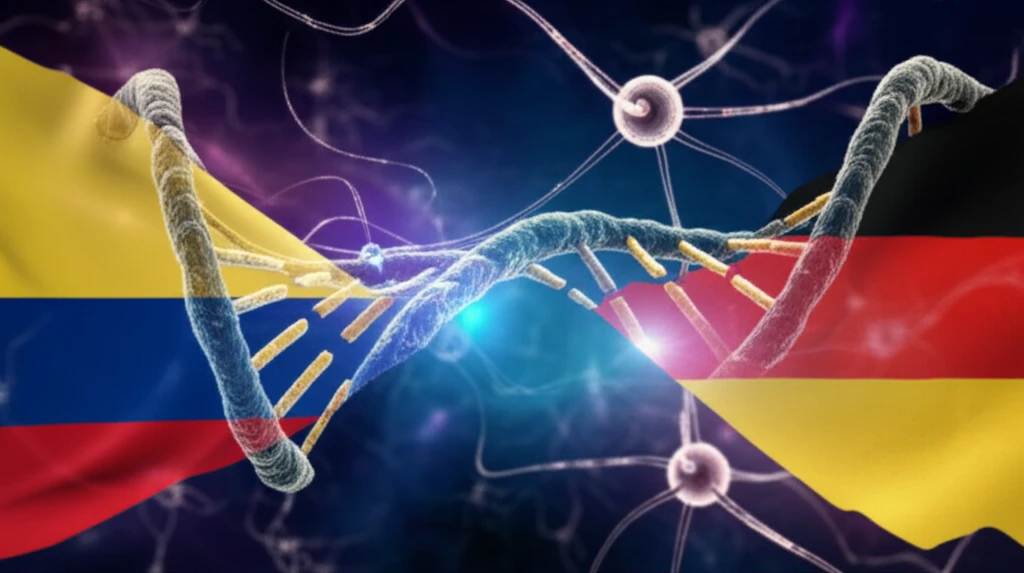
Colombian and German flags intertwined with DNA and neurons, symbolizing Alzheimer's research collaboration.

Unlocking Alzheimer's: How a Colombian-German Network is Pioneering Research

"Discover how the UndoAD project is bridging continents to combat neurodegenerative diseases through innovative research and international collaboration."


In an era where global collaboration faces increasing challenges, the international scientific community recognizes that progress is heavily dependent on cooperation across borders. This is especially critical in translational research, where diverse expertise and comprehensive patient cohort assessments are essential.

This article sheds light on UndoAD, a groundbreaking initiative that aims to raise awareness within the South American neurological community. By focusing on hereditary neurological diseases, particularly in the mountainous region surrounding Medellín, Colombia, UndoAD leverages unique resources to combat Alzheimer's disease.

Medellín, Colombia, is home to numerous families affected by hereditary neurological diseases. Over the past three decades, researchers have identified disease-associated mutations, established unique clinical cohorts, and created a clinical registry with thousands of patient records. These efforts have also led to the establishment of a brain bank, which now includes donations from over 300 individuals.

The Power of Collaboration: Uncovering Alzheimer's Mechanisms

Colombian and German flags intertwined with DNA and neurons, symbolizing Alzheimer's research collaboration.

UndoAD focuses on a rare form of familial Alzheimer's disease caused by an autosomal dominant presenilin mutation. This patient population is invaluable for clinical research, exemplified by an ongoing key prevention trial involving an international research team from the USA and Colombia. This trial is testing crenezumab, an investigational drug, to delay the onset of the disease in carriers of presenilin mutations (NCT01998841).

Another fruitful collaboration has developed between Colombian and German institutions to understand the mechanisms of neurodegeneration. By studying brains collected from a cohort of presenilin mutation carriers, this collaboration has already provided critical insights into the pathophysiology of familial Alzheimer's disease. The UndoAD project aims to pinpoint the molecular mechanisms underlying the heterogeneity observed in the clinical presentations of patients from the Colombian familial Alzheimer's disease cohort.

  • Scientific Exchange: UndoAD facilitates the exchange of scientific knowledge, promoting collaborative research environments.
  • Knowledge Transfer: By transferring expertise and innovative techniques, UndoAD strengthens research capabilities.
  • Infrastructure Development: Investments in infrastructure ensure long-term advancements in neurological research.
  • Summer Schools: UndoAD sponsors summer schools in Medellín, Colombia, offering comprehensive lectures and workshops. The first of these took place on September 12-13, 2018.
In addition to unraveling the complexities of Alzheimer's, UndoAD aims to foster further international collaborations. The project plans to organize meetings focused on brain banking, inviting scientists from other brain banks in Latin America to participate. The goal is to encourage sample exchange, standardize protocols, and improve data management to broaden neuropathological research in Latin America.

Building a Future of Collaborative Research

The German Federal Ministry of Education and Research supports the UndoAD project, as part of their initiative to promote research structures in Latin America. The goal is to build long-term collaborations with research institutions in partner countries, ensuring that the fight against neurodegenerative diseases is a global effort.

About this Article -

This article was crafted using a human-AI hybrid and collaborative approach. AI assisted our team with initial drafting, research insights, identifying key questions, and image generation. Our human editors guided topic selection, defined the angle, structured the content, ensured factual accuracy and relevance, refined the tone, and conducted thorough editing to deliver helpful, high-quality information.See our About page for more information.

Everything You Need To Know

1

What is the UndoAD project?

The UndoAD project is a collaborative initiative between Colombian and German scientists dedicated to combating Alzheimer's disease. It leverages unique patient cohorts and advanced research methods, focusing on hereditary neurological diseases, particularly in the mountainous region surrounding Medellín, Colombia. The project aims to raise awareness within the South American neurological community and foster international collaborations to further the understanding of Alzheimer's and develop effective treatments.

2

How does the UndoAD project utilize the resources available in Medellín, Colombia?

UndoAD capitalizes on the unique resources in Medellín, including families affected by hereditary neurological diseases. Over the past three decades, researchers have identified disease-associated mutations, established unique clinical cohorts, and created a clinical registry with thousands of patient records. Additionally, the project benefits from a brain bank with donations from over 300 individuals, providing invaluable resources for studying the mechanisms of Alzheimer's disease.

3

What specific research areas does UndoAD focus on?

UndoAD focuses on a rare form of familial Alzheimer's disease caused by an autosomal dominant presenilin mutation. This patient population is crucial for clinical research, including a key prevention trial testing crenezumab, an investigational drug, to delay the onset of the disease in carriers of presenilin mutations. The project also studies the mechanisms of neurodegeneration by studying brains collected from a cohort of presenilin mutation carriers to pinpoint the molecular mechanisms underlying the heterogeneity observed in the clinical presentations of patients from the Colombian familial Alzheimer's disease cohort.

4

What are the key components of the UndoAD project's international collaboration?

UndoAD's international collaboration involves several key components. It facilitates scientific exchange, promotes collaborative research environments, and supports knowledge transfer by transferring expertise and innovative techniques to strengthen research capabilities. Infrastructure development is another key focus, ensuring long-term advancements in neurological research. Furthermore, the project sponsors summer schools in Medellín, Colombia, providing comprehensive lectures and workshops. The project also plans to organize meetings focused on brain banking, inviting scientists from other brain banks in Latin America to encourage sample exchange, standardize protocols, and improve data management.

5

How is the UndoAD project supported, and what are its long-term goals?

The UndoAD project is supported by the German Federal Ministry of Education and Research as part of an initiative to promote research structures in Latin America. The long-term goals include building long-term collaborations with research institutions in partner countries to ensure that the fight against neurodegenerative diseases is a global effort. The project aims to not only unravel the complexities of Alzheimer's but also to foster further international collaborations, particularly in the area of brain banking, to broaden neuropathological research in Latin America.

Newsletter Subscribe

Subscribe to get the latest articles and insights directly in your inbox.