
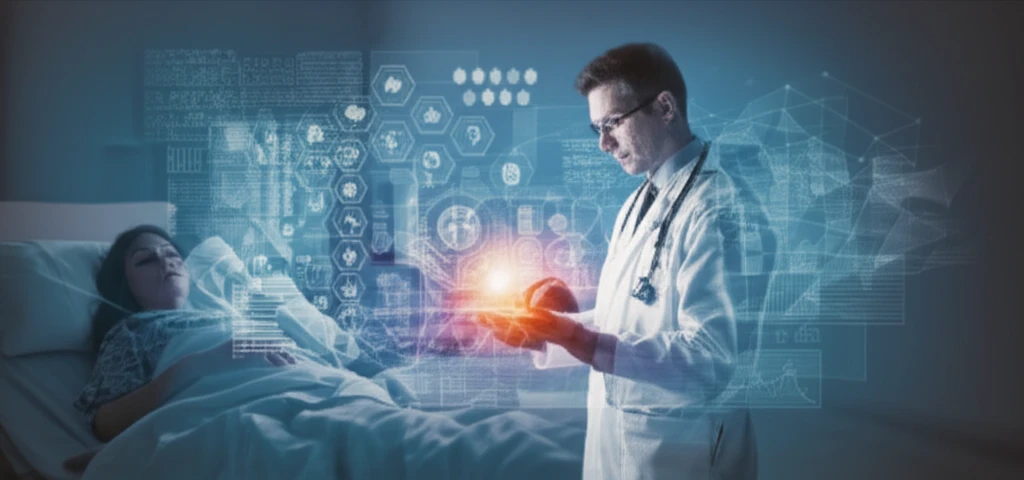
Doctor using tablet at patient's bedside

Unlock Seamless Healthcare: Mobile KIS Systems Transforming Patient Care

"Discover how mobile KIS systems are revolutionizing healthcare, improving efficiency, and enhancing patient experiences by providing secure, on-the-go access to critical information."


The healthcare industry has long recognized the need for efficient access to patient information at the point of care. Wireless access to Krankenhausinformationssysteme (KIS), or Hospital Information Systems, at the patient's bedside has been available for some time. Now, several manufacturers are taking it a step further by offering software solutions that allow access to the KIS through commonly used smartphones and tablets. These systems can be utilized anywhere within a clinic, providing unprecedented flexibility and convenience.

Mobile devices have become indispensable in our daily lives. It's not just younger people who are glued to their smartphones; adults also use them multiple times a day. According to an online study conducted by ARD and ZDF in 2014, smartphones and tablets are now more prevalent than traditional mobile phones. Smartphones account for 98% of mobile phone sales, according to the IT association Bitkom. Currently, 63% of the population over the age of 14 uses a smartphone or tablet, compared to just 41% in 2013. Given these trends, it's not surprising that clinical staff are eager to fully embrace the benefits of modern communication, which has long been standard practice in industry and commerce.

Despite these advancements, the healthcare sector lags slightly behind in adopting these technologies. While devices like mobile carts and laptops are increasingly common, doctors and nurses often still need to access a desktop PC to retrieve patient data, document cases, or issue treatment instructions. Recognizing this gap, several manufacturers now offer software solutions that allow access to the KIS via mobile devices, providing access to all treatment and examination data available within a hospital.

Mobile KIS: Transforming Healthcare with On-the-Go Access

Doctor using tablet at patient's bedside

Mobile KIS solutions come in the form of applications (APPs) that can be installed on standard smartphones and tablets. These apps then enable mobile access to the KIS via WLAN, which is widely available in many clinics. To protect the sensitive KIS data, the WLAN is encrypted. Additionally, users of the APPs must authenticate their devices within the KIS. These devices act as simple input and output mediums, while the data itself remains securely stored in the internal data center. All devices are centrally managed, allowing access rights to be revoked at any time or the APP to be remotely deleted from individual devices.

One notable APP, “Imed One Mobile,” was developed by the team formerly associated with the Finnish IT company Tieto, in collaboration with the Bottrop Hospital since 2005. This APP was further refined by Telekom Healthcare specifically for their in-house KIS system. “Imed One Mobile” is now used in around 40 clinics worldwide, enabling doctors and nurses to enter vital signs, appointments, and orders directly into the KIS via an iPad mini at the patient's bedside. Clinical data such as X-ray images and lab results can also be accessed on-site. Users can even utilize additional functions like the built-in camera to photograph wounds, track their progress, and store them in the digital file. Jan Ehlting, the creator of Imed One Mobile and head of mobile health solutions at Telekom Healthcare, explains, “The advantage is that, unlike digital cameras, these images are directly linked to the patient file: you take the picture, and the software immediately links it to the document. At the same time, it records which patient the picture belongs to and when the recording was made.”

The benefits of this Mobile KIS includes:
  • Enhanced Data Access: Provides mobile access to patient data, lab results, and medical images.
  • Streamlined Workflows: Facilitates efficient documentation and order placement at the point of care.
  • Improved Communication: Enables real-time communication and information sharing among healthcare teams.
  • Greater Flexibility: Allows clinicians to access KIS from anywhere within the clinic or even remotely via secure VPN tunnels.
Agfa Healthcare has developed a similar APP that allows mobile access to their KIS system, “Orbis.” In contrast to the Telekom solution, the “Orbis ME” APP is platform-independent, meaning it can be used not only with Apple devices but also with all other mobile devices. Oliver Nauroth, Business Manager for Clinical Workplace Systems at Agfa Healthcare, notes, “Given the increasing demand for Windows tablets and the fact that such interfaces fit better into the clinical IT structure, and Apple is still foreign to many in the hospital, this is a major advantage.” The APP also runs on Android operating systems and provides complete read access to administrative patient information: lab values, coded diagnoses, procedures, interventions, operations, medications, images – i.e., the complete contents of the patient history. Doctors can also place individual orders to service departments such as the lab or radiology. “In addition, we offer a complete medication workstation on the mobile devices, including information coming from a drug safety system,” says Nauroth.

Embracing Mobile KIS: A Step Towards Enhanced Patient-Centered Care

Mobile KIS offers numerous advantages, giving doctors and nurses instant, always-available access to the latest patient data, enabling them to manage cases more efficiently. By reducing time spent on administrative tasks and improving communication, healthcare providers can dedicate more time to direct patient care, ultimately enhancing the overall patient experience.

About this Article -

This article was crafted using a human-AI hybrid and collaborative approach. AI assisted our team with initial drafting, research insights, identifying key questions, and image generation. Our human editors guided topic selection, defined the angle, structured the content, ensured factual accuracy and relevance, refined the tone, and conducted thorough editing to deliver helpful, high-quality information.See our About page for more information.

Everything You Need To Know

1

What is a Mobile KIS system?

Mobile KIS solutions, or Krankenhausinformationssysteme, are software applications designed to be used on smartphones and tablets. They provide secure access to a hospital's existing KIS, allowing clinicians to view and manage patient data from anywhere within a clinic's WLAN network. This includes access to treatment information, examination results, and other critical data.

2

Why are Mobile KIS systems important?

The significance of Mobile KIS lies in its ability to enhance efficiency and improve patient care. By enabling instant access to patient data, doctors and nurses can make more informed decisions, streamline workflows, and reduce time spent on administrative tasks. This leads to improved communication among healthcare teams and allows clinicians to dedicate more time to direct patient care.

3

How are Mobile KIS systems secured?

Mobile KIS systems are protected through several security measures. Data transmission occurs over encrypted WLAN networks, ensuring that patient information remains secure. Additionally, users must authenticate their devices within the KIS. The data itself is stored securely in a central data center. Device management allows access rights to be revoked or APPs to be remotely deleted, enhancing data security and privacy.

4

What are the implications of implementing a Mobile KIS system?

The implications of using Mobile KIS are far-reaching. It leads to enhanced data access, streamlined workflows, improved communication, and greater flexibility for clinicians. By providing real-time access to patient data and facilitating efficient documentation and order placement, Mobile KIS supports a patient-centered approach. This ultimately results in a better patient experience.

5

Which companies offer Mobile KIS solutions and what do they provide?

Several manufacturers, such as Telekom Healthcare and Agfa Healthcare, offer Mobile KIS solutions. Telekom Healthcare's “Imed One Mobile” allows doctors and nurses to enter vital signs, appointments, and orders directly into the KIS via an iPad mini, and access clinical data. Agfa Healthcare's "Orbis ME" APP provides platform-independent mobile access to their KIS system, offering complete read access to administrative patient information, lab values, and coded diagnoses.

Newsletter Subscribe

Subscribe to get the latest articles and insights directly in your inbox.