
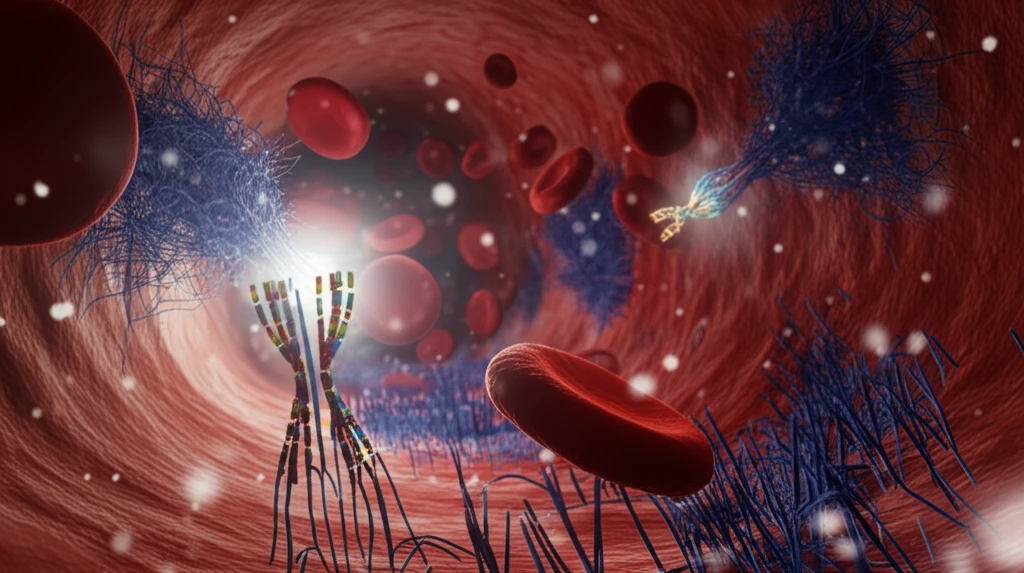
Unlock Malaria Treatment: Nanoemulsions and Oligonucleotides - A Promising Duo

"Discover how validated spectrophotometric methods are revolutionizing antimalarial drug delivery using nanoemulsions and oligonucleotides for targeted treatment."
Malaria remains a devastating global health issue, affecting hundreds of millions annually. The rise of drug-resistant parasites has intensified the challenge, demanding innovative therapeutic strategies.
Oligonucleotides, single-stranded nucleic acids, have emerged as a promising approach, capable of interfering with protein synthesis and inhibiting parasite growth. However, their effectiveness is limited by poor cell penetration and vulnerability to nuclease degradation.
To overcome these obstacles, researchers are exploring the use of positively-charged colloidal carriers, specifically oil-in-water (o/w) nanoemulsions, to deliver oligonucleotides. These nanoemulsions spontaneously interact with nucleic acids, forming protective polyionic complexes that enhance cell uptake and prevent degradation.
The Growing Malaria Burden
Malaria remains a critical global health issue, with an ongoing escalation in cases that is a leading source of increased mortality rates worldwide. The Plasmodium parasite-based disease, spread by infected mosquitoes, continues to threaten populations in malaria-endemic regions. Antimalarial drug resistance is a major challenge to progress, with WHO maintaining a global database on antimalarial drug efficacy and resistance initiated in 2000 to centralize data and track therapeutic efficacy studies. The discovery of novel molecules with unique mechanisms of action has become an urgent priority to combat growing drug resistance.
Drug Delivery Challenges and Nanocarrier Solutions
Current antimalarial therapies face significant limitations, including poor drug solubility, low bioavailability, and off-target toxicity. Innovation in drug delivery has become urgent, with researchers developing innovative systems capable of improving the pharmacokinetics of existing drugs. Nano- and microemulsion-based delivery systems represent a promising approach for enhancing the solubility of antimalarial drugs, leading to overall improvements in bioavailability and therapeutic efficacy. These lipid-based pharmaceutical systems have a high potential to increase drug permeation and overcome the limitations of conventional formulations.
From Early Experiments to Modern Therapeutics
The history of nanoemulsions traces back to the early twentieth century, when researchers first began experimenting with colloidal systems, initially focusing on macroemulsions and microemulsions. Strikingly, research activity and publications on nanoemulsions have rapidly overtaken those related to miniemulsions and microemulsions, reflecting growing scientific interest. Oligonucleotides, comprising single or double strands of RNA or DNA, emerged as a significant class of therapeutics, with the first scientists experimenting with short strands of synthetic DNA in the late 1970s and early 1980s. Between 1998 and 2023, nineteen oligonucleotides received FDA approval, demonstrating the maturation of this technology from early laboratory work to validated clinical applications.
How Spectrophotometry Validates Oligonucleotide Delivery via Nanoemulsions
A key challenge is accurately measuring how well oligonucleotides associate with these nanoemulsions. Due to the tiny size of the oil droplets, traditional methods are difficult to apply. Most approaches rely on indirect measurements, calculating the difference between the initial drug amount and the free drug found after separating the water phase using ultrafiltration.
- Specificity: Confirmed by comparing the absorption spectra of oligonucleotide solutions with solutions containing glycerol, ensuring no interference.
- Linearity: Demonstrated over a concentration range of 0.4 to 1.0 nmol/mL, with a high correlation coefficient (r > 0.998).
- Precision: High repeatability (intra-day) and intermediate precision (inter-day), with relative standard deviation values below 2.6%.
- Accuracy: Recoveries ranged from 98.8 to 103.6%, indicating excellent agreement between added and measured amounts.
Cutting-Edge Antimalarial Strategies
Recent research is exploring nanotechnological approaches to enhance the antimalarial activity of natural molecules, including nanoencapsulation of quinine, artemisinin, and newly identified agents such as piperine and quercetin. Nanoemulsions loaded with artemisinin have demonstrated improved antimalarial parasite efficacy in vitro, as evaluated through flow cytometry comparisons with original artemisinin solutions. The current landscape of small-molecule antimalarial therapies includes multiple methods for drug discovery, with modern advances in parasite biology and genomic techniques providing a wide range of novel targets for new therapy development.
The Persistent Challenge of Drug Resistance
Antimalarial treatments currently in clinical use face significant limitations due to parasite drug resistance, representing a major obstacle to malaria control. The problem extends beyond resistance alone, as existing drugs also suffer from pharmacokinetic shortcomings that reduce their effectiveness. Various approaches to antimalarial drug discovery are being pursued, yet resistance continues to undermine treatment outcomes. A comprehensive review of both rarely and extensively used methods reveals that no single strategy has fully overcome the resistance challenge, underscoring the need for innovative delivery approaches like nanoemulsions.
Microemulsions vs. Nanoemulsions in Drug Delivery
Both microemulsions and nanoemulsions are lipid-based pharmaceutical systems that can increase drug permeation through biological barriers. These isotropic dispersions of oil and water phases share fundamental characteristics as delivery platforms, yet they differ in droplet size, stability, and preparation methods. Nanoemulsions offer distinct advantages for antimalarial drug delivery, including enhanced solubility and bioavailability compared to conventional formulations. The choice between these systems depends on the specific drug properties and therapeutic goals, with nanoemulsions increasingly favored for their superior stability and loading capacity.
The Future of Malaria Treatment
This validated spectrophotometric method provides a reliable tool for estimating oligonucleotide association with nanoemulsions, crucial for optimizing antimalarial drug delivery systems. The method is linear, specific, precise, and accurate, paving the way for developing more effective treatments against drug-resistant malaria. Ongoing research focuses on refining intravenous nanoemulsions for antimalarial oligonucleotide delivery, promising a new era in malaria therapeutics.
Validated Methods for Oligonucleotide Delivery
A validated spectrophotometric method has been developed to estimate the adsorption of antimalarial oligonucleotides to cationic nanoemulsions, demonstrating high linearity and precision in measurements. The method shows a recovery rate of over ninety-two percent for oligonucleotides through thirty kilodalton membranes, confirming the reliability of the analytical approach. The extent of oligonucleotide association with nanoemulsions varies significantly with composition, ranging from forty-two to ninety-eight percent depending on the formulation parameters. These results indicate that both phosphodiester and phosphorothioate oligonucleotides can be effectively loaded into cationic nanoemulsion carriers for antimalarial applications.
Natural Products and Novel Targets
Natural products continue to provide an important source of compounds for antimalarial drug discovery, valued for their structural diversity, range of biological activities, and historical clinical successes, most notably quinine and artemisinin. Antimalarial drug development can follow several approaches ranging from modifications of existing agents to the design of novel agents that act against new targets. The availability of genomic techniques provides a wide range of novel targets in the development of new therapy, expanding the possibilities beyond traditional drug scaffolds. This convergence of natural product chemistry and modern genomics offers promising pathways for future antimalarial drug candidates.
Nanotechnology as a Transformative Tool
Malaria remains a major global health challenge exacerbated by parasite resistance, poor drug solubility, and off-target toxicity. Nanotechnology applications in antimalarial drug delivery offer transformative potential to address these interconnected challenges simultaneously. By engineering drug carriers at the nanoscale, researchers can improve bioavailability, reduce toxicity, and overcome resistance mechanisms that limit conventional therapies. The integration of nanotechnology with antimalarial drug development represents a systems-level approach to tackling one of humanity's most persistent infectious diseases.
Real-World Implications
The development of nanoemulsion-based oligonucleotide delivery systems for malaria treatment holds significant promise for patients in endemic regions who face limited treatment options due to drug resistance. While still in early research stages, this innovative approach could translate into more effective therapies that reduce mortality and improve outcomes for the millions affected by malaria annually. The practical implementation of such technologies will depend on continued research validation, manufacturing scalability, and equitable access to ensure the benefits reach the communities most burdened by the disease.