
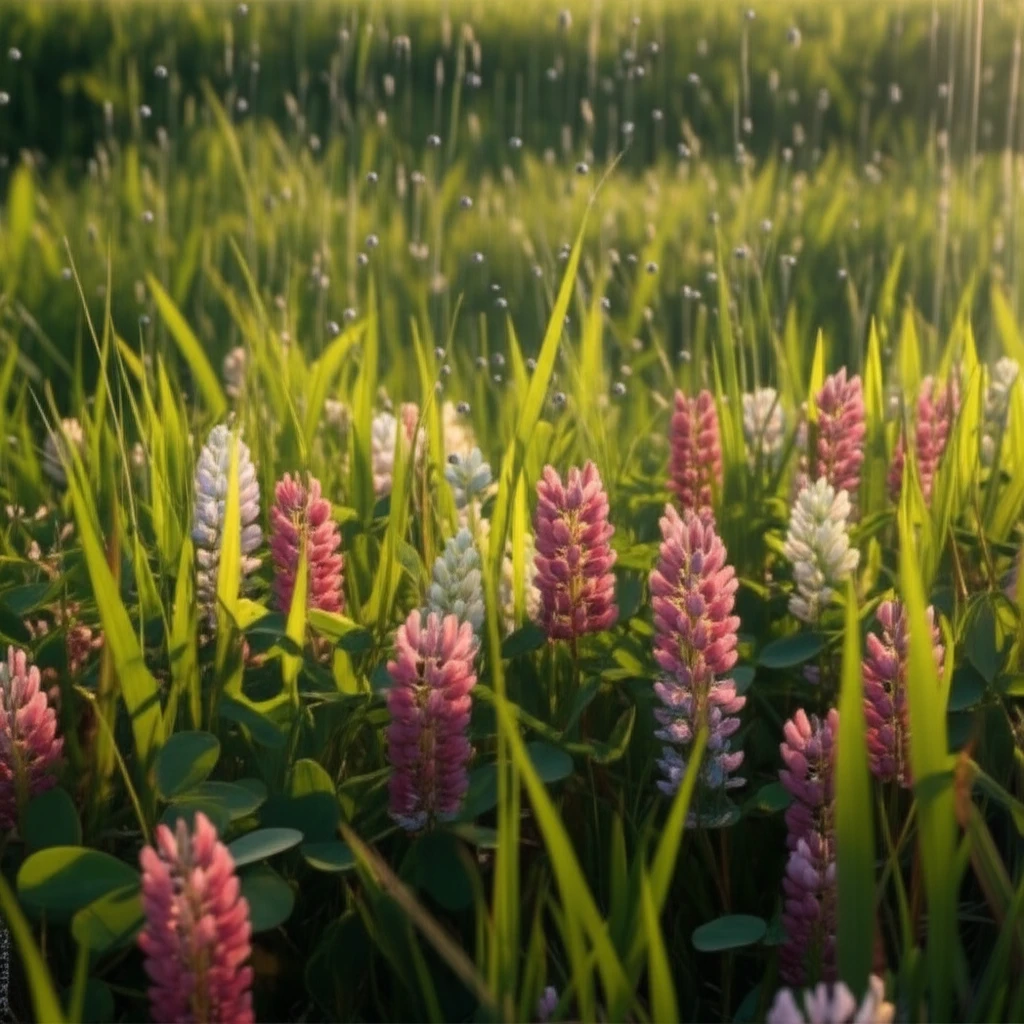
Lush meadow with balanced grasses and legumes, nourished by fertilizer.

Unlock Lush Meadows: How Fertilization Impacts Grass and Legume Balance

"Discover the secrets to optimizing vegetation cover in temporary meadows through strategic fertilization and species selection."


Achieving a balanced and thriving meadow ecosystem requires careful consideration of fertilization techniques and the selection of appropriate plant species. Perennial legumes and grasses respond differently to nutrient applications, making a tailored approach essential for maximizing growth and biodiversity.

Nitrogen fertilizers, when applied to a phosphorus and potassium-rich base, can create synergistic interactions that promote robust plant development. Phosphorus supports legume growth, while nitrogen fuels grasses, leading to a mutually beneficial relationship where legumes naturally provide nitrogen to the soil, reducing the need for excessive fertilization.

Changes in temporary meadows are inevitable due to environmental factors, agricultural practices, and the competitive nature of different species. Understanding these dynamics is crucial for maintaining a healthy and productive vegetation cover. Research conducted at the Agricultural Research – Development Station Secuieni in 2013-2014 investigated the effects of fertilization on various perennial grass and legume mixtures, providing valuable insights into optimizing meadow management.

The Sweet Spot: Balancing Grasses and Legumes Through Fertilization

Lush meadow with balanced grasses and legumes, nourished by fertilizer.

The study examined five different mixtures of perennial grasses and legumes, assessing how nitrogen fertilizers influenced vegetation structure on a phosphorus-enriched foundation. The results indicated a clear trend: as the growing season progressed from the first to the third cut, the proportion of grasses decreased while the proportion of legumes increased.

Increasing the dose of nitrogen fertilizer amplified the competitiveness of grasses, often at the expense of legumes and other plant species. This highlights the delicate balance required to maintain a diverse and resilient meadow ecosystem. Careful management of nitrogen inputs can promote the desired composition of grasses and legumes, optimizing the meadow for specific agricultural or environmental goals.

  • Species Selection Matters: The specific types of grasses and legumes in the mixture significantly influenced the outcome. Different species exhibit varying levels of competitiveness and responsiveness to fertilization.
  • Timing is Key: The timing of nitrogen application also played a crucial role. Applying nitrogen at different stages of growth can favor either grasses or legumes, depending on their respective nutrient requirements.
  • Environmental Conditions: Climatic factors such as temperature and rainfall interacted with fertilization to affect vegetation dynamics. Understanding these interactions is essential for adapting management practices to local conditions.
For example, in mixtures with 20% grasses and 80% legumes (specifically, 20% Dactylis glomerata + 80% Medicago sativa), the floristic composition in 2014 was heavily influenced by the balance between these species. Similarly, mixtures with 65% grasses and 35% legumes (30% Bromus inermis + 35% Dactylis glomerata + 35% Onobrychis viciifolia) showed that the proportion of grasses ranged from 26% to 75%, depending on the nitrogen fertilization level.

Sustainable Meadows: Practical Takeaways

The research underscores the importance of a balanced approach to fertilization in temporary meadows. While nitrogen is essential for grass growth, excessive application can suppress legume development and reduce overall biodiversity. Understanding the specific needs of different grass and legume species is crucial for optimizing vegetation cover.

Farmers and land managers can use these findings to tailor their fertilization strategies to achieve specific goals, whether it's maximizing forage production, enhancing soil health, or promoting a diverse and resilient meadow ecosystem. Regular monitoring of vegetation composition is essential for adapting management practices to changing environmental conditions.

By carefully considering the interactions between fertilization, species selection, and environmental factors, it’s possible to create and maintain thriving meadows that support sustainable agriculture and contribute to a healthy environment. The insights gained from this study can inform best practices for meadow management in the Center of Moldova conditions and beyond.

About this Article -

This article was crafted using a human-AI hybrid and collaborative approach. AI assisted our team with initial drafting, research insights, identifying key questions, and image generation. Our human editors guided topic selection, defined the angle, structured the content, ensured factual accuracy and relevance, refined the tone, and conducted thorough editing to deliver helpful, high-quality information.See our About page for more information.

This article is based on research published under:

DOI-LINK: 10.15835/buasvmcn-agr:11445, Alternate LINK

Title: The Influence Of Fertilization And Perennial Grasses And Legumes Mixture On The Structure Of Vegetation Cover In Temporary Meadows, Under The Center Of Moldova Conditions

Subject: General Medicine

Journal: Bulletin of University of Agricultural Sciences and Veterinary Medicine Cluj-Napoca. Agriculture

Publisher: University of Agricultural Sciences and Veterinary Medicine Cluj-Napoca

Authors: Margareta Naie, Vasile Vintu, Elena Trotus, Simona Florina Pochiscanu

Published: 2015-11-27

Everything You Need To Know

1

What is the role of fertilization in meadow management?

Fertilization in temporary meadows involves applying nutrients like nitrogen, phosphorus, and potassium to the soil to enhance plant growth. The article emphasizes that nitrogen fertilizers boost grass development. The research indicates that when nitrogen fertilizers are used in conjunction with phosphorus and potassium, they can lead to synergistic interactions, which means the plants benefit from the presence of both nutrients. The goal is to optimize vegetation cover and promote a balanced ecosystem of grasses and legumes. Excess application of nitrogen can suppress legume development, affecting the biodiversity.

2

Why is it important to balance grasses and legumes in meadows?

The balance between grasses and legumes is crucial because they have different responses to fertilization. Nitrogen fertilization primarily benefits grasses, while phosphorus supports legume growth. When the application of nitrogen is high, grasses can outcompete legumes, reducing the meadow's diversity. Managing the amount of nitrogen applied can help maintain the desired composition of grasses and legumes, which is important for both agricultural productivity and environmental sustainability.

3

How does species selection affect meadow vegetation?

The specific types of grasses and legumes in a mixture significantly impact the outcome. The article points out that different species show varied levels of competitiveness and responsiveness to fertilization. For instance, mixtures of 20% Dactylis glomerata and 80% Medicago sativa saw changes in their composition. Similarly, mixtures including Bromus inermis, Dactylis glomerata, and Onobrychis viciifolia showed varying grass proportions based on nitrogen levels. Therefore, selecting the right combination of species is vital for optimizing meadow management and achieving desired vegetation structure.

4

How does the timing of nitrogen application impact grass and legume balance?

The timing of nitrogen application affects the balance between grasses and legumes. Applying nitrogen at different growth stages can favor grasses or legumes. The article mentions how, as the growing season progresses from the first to the third cut, the proportion of grasses generally decreases. This highlights that the timing of fertilization can be used to manage the competition and proportion of grasses and legumes, depending on the needs of the plants.

5

Why are environmental conditions important when considering fertilization?

Environmental conditions, such as temperature and rainfall, interact with fertilization to affect vegetation dynamics in meadows. Understanding these interactions is essential for adapting management practices to local conditions. For example, the Agricultural Research – Development Station Secuieni study from 2013-2014 showed how these factors influence the effectiveness of fertilization strategies, highlighting the need for a tailored approach that considers the specific environment to achieve a thriving meadow ecosystem.

Newsletter Subscribe

Subscribe to get the latest articles and insights directly in your inbox.