
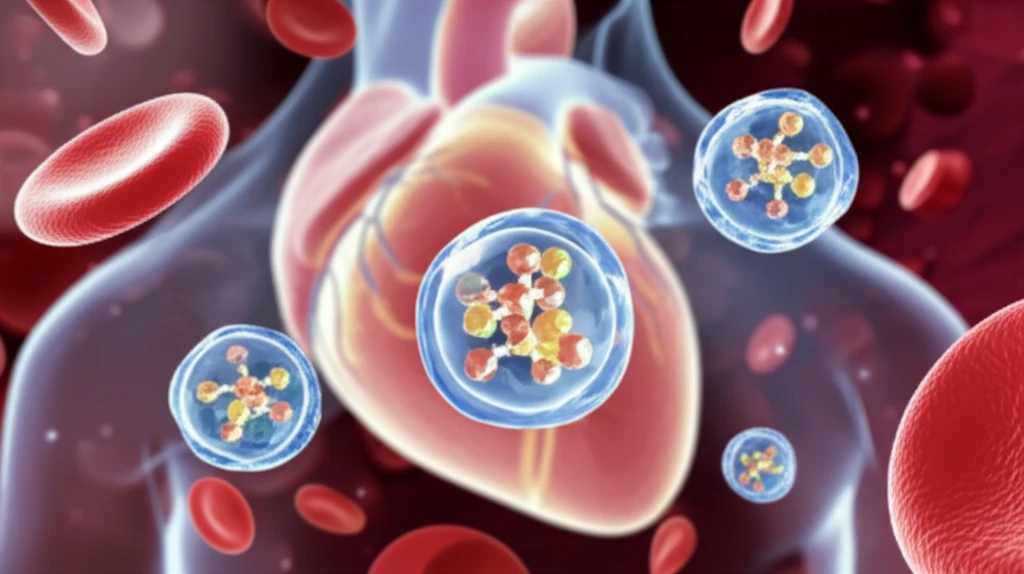
Unlock Cilnidipine's Potential: Nano-Tech for Better Blood Pressure Control

"Can Solid Lipid Nanoparticles (SLNs) Improve Cilnidipine's Effectiveness?"
High blood pressure, or hypertension, is a widespread health concern, demanding effective and innovative treatment strategies. Cilnidipine, a calcium channel blocker, has shown promise in managing cardiovascular diseases. However, its limited solubility hinders its full potential.
This research explores a groundbreaking approach: using Solid Lipid Nanoparticles (SLNs) to enhance cilnidipine's delivery and effectiveness. SLNs are minute particles made from solid lipids, offering a way to transport drugs directly to the body's cells.
By encapsulating cilnidipine within SLNs, the aim is to improve its absorption, bioavailability, and overall therapeutic impact. This article delves into the development, formulation, and characterization of these cilnidipine-loaded SLNs, highlighting their potential to revolutionize hypertension management.
Cilnidipine-Loaded SLNs: A Deep Dive
The study focuses on creating SLNs containing cilnidipine using a method called hot homogenization followed by ultrasonication. This process involves melting lipids (fats) and then using high-frequency sound waves to create extremely small particles. Different types of lipids, such as stearic acid (SA), glyceryl monostearate (GMS), and palmitic acid (PA), were tested to see which one worked best for encapsulating and delivering cilnidipine.
- Entrapment Efficiency (EE): How much of the drug was successfully captured within the SLNs.
- Particle Size: Measuring the size of the nanoparticles, as smaller particles can be absorbed more easily by the body.
- Zeta Potential: Assessing the stability of the nanoparticles – a higher zeta potential (negative or positive) indicates greater stability.
- Drug Release: Monitoring how the drug is released from the SLNs over time.
- Spectroscopic Analysis: Compatibility studies to check there is no interaction between drugs and excipients.
- Microscopy: Scanning electron microscopy was done to study the shape and structure of the nanoparticles.
The Future of Hypertension Treatment: SLNs and Beyond
This study demonstrates the potential of SLNs to improve the effectiveness of cilnidipine, offering a new avenue for managing hypertension. By improving drug delivery, SLNs could lead to better patient outcomes and a higher quality of life.
Further research is needed to explore the long-term effects of cilnidipine-loaded SLNs and to optimize their formulation for clinical use. However, this study provides a strong foundation for future innovations in hypertension treatment.
The successful development of SLNs for cilnidipine delivery highlights the transformative power of nanotechnology in medicine, paving the way for more targeted and effective therapies for a wide range of diseases.