
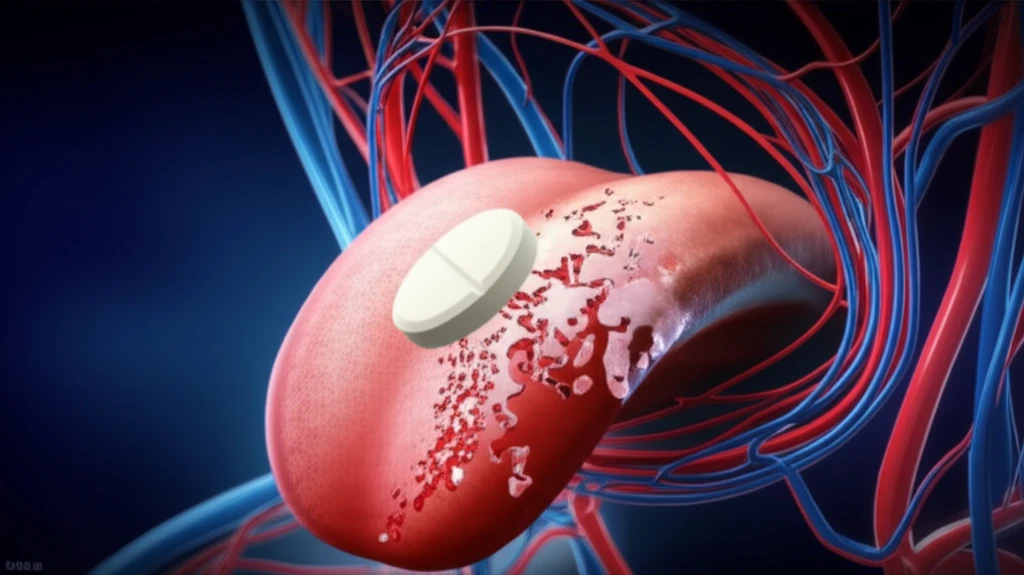
Melt Away High Blood Pressure? Fast-Dissolving Tablets Offer New Hope

"Revolutionary research explores how fast-dissolving tablets with doxazosin mesylate can lead to quicker relief and better results for hypertension patients."
For many facing high blood pressure, getting medication to work quickly can be crucial. Traditional tablets sometimes take too long to dissolve and absorb, delaying relief. This is especially challenging for those with difficulties swallowing pills or needing rapid blood pressure control.
Now, imagine a tablet that melts in your mouth, delivering medication faster than ever before. Researchers have been exploring fast-dissolving tablets (FDTs) as a solution, focusing on how to make them dissolve rapidly and improve drug absorption. One promising area involves using a drug called doxazosin mesylate to manage hypertension.
This article dives into the innovative research behind fast-dissolving doxazosin mesylate tablets, explaining how they're formulated, what makes them work faster, and what this could mean for the future of hypertension treatment. It will cover the methods used to create these tablets, the science behind their rapid action, and the potential benefits for patients.
Why Fast-Dissolving Tablets Matter
The CDC’s National Center for Health Statistics provides topic-specific hypertension statistics through its FastStats application. Oral drug delivery research has increasingly focused on dosage forms that address the difficulties some patients experience with traditional tablets. Fast Dissolving Tablets (FDTs) are designed to rapidly disintegrate or dissolve in saliva, offering a potentially more accessible way to take medication. A review of antihypertensive FDTs also examines their possible effect on adherence to prescribed treatment regimens.
From Conventional Tablets to Rapid Melts
One reported formulation of doxazosin mesylate FDTs used direct compression with a drug-polyethylene glycol 8000 solid dispersion in a 1:3 ratio. The formulation tested crospovidone, croscarmellose sodium, their mixture, and a coprocessed combination at concentrations of 2% and 5%. Other research developed a bilayer fast-disintegrating and sustained-release mucoadhesive captopril tablet to address limitations of conventional formulations in hypertension management and hypertensive crises. FDT reviews emphasize their usefulness for pediatric, geriatric, and dysphagic patients, while formulations containing losartan potassium or nifedipine are designed to dissolve or disintegrate in saliva without water.
Two Parallel Histories
The history of hypertension treatment has been documented through accounts including Dr. Moser’s personal history and a more detailed timeline created by Theodore Kotchen. The Frontiers review notes that relatively few attempts have comprehensively detailed this treatment history. In parallel, fast-dissolving tablets became a widely accepted dosage form, particularly for pediatric patients and older adults with conditions such as Parkinson’s disease or hand tremors. This development responded to the difficulty some patients have with conventional solid dosage forms such as capsules and tablets.
Unlocking Faster Relief: The Science of Fast-Dissolving Tablets
The key to fast-dissolving tablets lies in their ability to disintegrate quickly in the mouth without needing water. This rapid breakdown allows the medication to be absorbed faster, potentially leading to quicker therapeutic effects. In the case of doxazosin mesylate, which is used to treat hypertension, faster absorption could mean more rapid blood pressure control.
- Solid Dispersion: Doxazosin mesylate was combined with polyethylene glycol (PEG) 8000 to increase its solubility.
- Superdisintegrants: Crospovidone and croscarmellose sodium were used individually, in a mixture, and as a co-processed mixture to enhance disintegration.
- Direct Compression: This method simplifies manufacturing and helps maintain the integrity of the drug.
Engineering Better Disintegration
Recent formulation studies have examined novel superdisintegrants and optimization methods for fast-dissolving tablets. One study used a 2^3 factorial design to optimize starch glycolate in glipizide fast-dissolving tablets and analyzed glipizide mixtures with infrared spectroscopy using a Perkin Elmer Spectrum RXI instrument. Another evaluated starch glutamate through measurements including solubility, pH, viscosity, swelling index, moisture absorption, particle size, density, compressibility index, and angle of repose. Research on starch xanthate likewise assessed tablet hardness with a Monsanto hardness tester, while reviews distinguish true fast-dissolving tablets that dissolve within seconds from fast-disintegrating tablets that may take up to a minute to disintegrate.
Telmisartan and Natural Excipients
A 2026 review focuses on fast-dissolving tablets of telmisartan made with natural excipients. Its stated themes include natural superdisintegrants, dissolution enhancement, and oral drug delivery systems. The review places this work in the context of hypertension as a prevalent non-communicable disease. It also identifies heart failure, stroke, and kidney disorders as risks associated with hypertension.
- Disintegration Time: How quickly the tablet breaks apart.
- Drug Release: How much of the drug is released over time.
- Hardness and Friability: The tablet's strength and resistance to crumbling.
A Promising Step Forward
The study's results are encouraging, showing that fast-dissolving doxazosin mesylate tablets can be successfully formulated using direct compression and specific superdisintegrants. The formulation containing a co-processed mixture of crospovidone and croscarmellose sodium (5%) exhibited the fastest disintegration time and the highest drug release.
A Growing Delivery Platform
A market outlook from Verified Market Reports projects sustained expansion of the fast-dissolving tablets market from 2026 through 2033. It attributes the projected trajectory to demographic shifts, technological advancements, and changing regulatory landscapes. A separate projection estimates growth from USD 5.8 billion in 2024 to USD 10.12 billion by 2033, with a 7.2% CAGR. Another market report highlights rapid absorption through the oral mucosa or gastrointestinal tract as potentially useful in acute settings such as emergency treatments.
Convenience Without Water
Fast-dissolving drug delivery systems and rapid melts are described as a developing area of oral drug delivery. A 2025 review presents them as convenient, patient-friendly options for pediatric, geriatric, and dysphagic patients. These systems quickly dissolve in the mouth and do not require water. The same review examines their formulation aspects and broader development scope.
Designing for Urgent Care
Research has explored personalized 3D-printed fast-dissolving tablets for hypertension-related applications, using fused deposition modelling, hot melt extrusion, pharmacokinetics, and surface metrology. Another study concerns trandolapril fast-dissolving tablets for patients experiencing a sudden increase in blood pressure. Its abstract states that rapid onset of action may benefit acute treatment, while noting that trandolapril is insoluble in water and may therefore dissolve slowly. Together, these studies focus on adapting dosage forms to urgent situations and individual patient needs.
While these findings are a positive step, further research is needed to confirm the effectiveness and safety of these tablets in clinical trials. Factors such as taste-masking and long-term stability also need to be considered.
If proven successful, fast-dissolving doxazosin mesylate tablets could offer a valuable new option for managing hypertension, particularly for patients who need rapid relief or have difficulty swallowing traditional pills. This innovation highlights the potential of advanced drug delivery systems to improve patient outcomes and quality of life.