
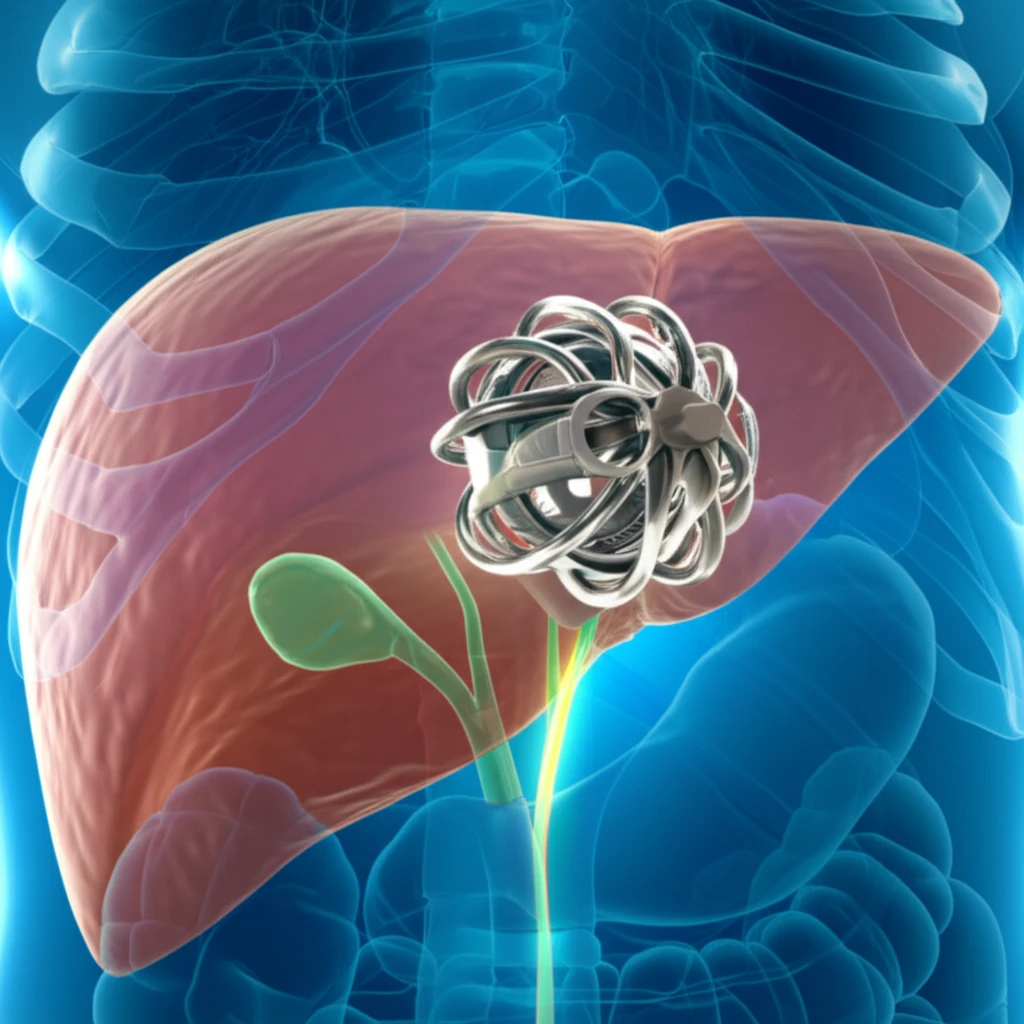
Digital illustration of an AVP in a liver, highlighting medical innovation.

Unexpected Liver Trouble: How a Small Procedure Saved a Life and What You Need to Know

"Unraveling the Mysteries of Chest Tube Complications and the Innovative Solutions Saving Lives"


Imagine a scenario where a routine medical procedure takes an unexpected turn, leading to a complex and life-threatening situation. This is precisely what happened to a 70-year-old man who, during a standard medical intervention, faced an unforeseen complication that put his life at risk. This article delves into this compelling medical case, highlighting the innovative use of a specific medical device to solve a problem.

This case study not only underscores the importance of medical innovation but also sheds light on the critical role of interventional radiology in modern healthcare. The use of advanced techniques and tools, as seen in this situation, demonstrates the ongoing evolution of medical practices aimed at improving patient outcomes. It also offers a glimpse into the challenges medical professionals face and the solutions they devise to overcome them.

By examining this case, we aim to inform and educate readers about the realities of medical interventions, the potential complications, and the cutting-edge solutions that are rapidly changing the landscape of healthcare. It is a story of resilience, innovation, and the unwavering commitment of medical professionals to save lives.

Unforeseen Complications: The Journey of a Chest Tube and Its Impact

Digital illustration of an AVP in a liver, highlighting medical innovation.

The story begins with a man experiencing respiratory distress, which led to the insertion of a chest tube—a common procedure to remove fluid from the lungs. However, what followed was far from routine. The chest tube, instead of draining fluid as intended, inadvertently made its way into the liver, causing significant internal bleeding. This complication set off a cascade of events, requiring immediate medical intervention to stabilize the patient.

The medical team quickly realized the severity of the situation. The chest tube had penetrated the liver, a sensitive organ, leading to substantial blood loss. This unexpected turn of events necessitated rapid action to prevent further complications. The medical team's swift response and the innovative solutions they employed were crucial in saving the patient's life.

  • Initial Insertion: A chest tube was inserted to address the patient's respiratory issues.
  • Unexpected Path: The tube deviated from its intended path, entering the liver.
  • Hemorrhage: This led to significant internal bleeding.
  • Emergency Response: Immediate medical intervention was required.
  • Innovative Solution: An Amplatzer Vascular Plug (AVP) was used to stop the bleeding.
The primary method to tackle this problem was through a procedure known as embolization. This procedure involves blocking the aberrant blood vessels. In this case, the Amplatzer Vascular Plug (AVP) was chosen to embolize the chest tube's path in the liver. This plug, a small device, was skillfully placed to stop the bleeding and prevent further damage.

The Road Ahead: Recovery and the Future of Medical Innovation

The story serves as a powerful reminder of the constant evolution of medical science and the hope it offers. Through innovation and rapid response, the patient could recover and continue treatment for lung cancer. This success story underscores the potential of innovative medical devices and techniques to address complex challenges and improve patient outcomes. It is a testament to the collaborative efforts of medical professionals and the relentless pursuit of better healthcare solutions.

About this Article -

This article was crafted using a human-AI hybrid and collaborative approach. AI assisted our team with initial drafting, research insights, identifying key questions, and image generation. Our human editors guided topic selection, defined the angle, structured the content, ensured factual accuracy and relevance, refined the tone, and conducted thorough editing to deliver helpful, high-quality information.See our About page for more information.

Everything You Need To Know

1

What is the purpose of inserting a chest tube, and what unexpected complication occurred in the described case?

A chest tube is typically inserted to remove fluid or air from the lungs, addressing respiratory distress. In the described case, instead of draining fluid as intended, the chest tube deviated from its intended path and inadvertently entered the liver. This caused significant internal bleeding, which became a life-threatening complication.

2

How did medical professionals address the complication caused by the chest tube's unintended path into the liver?

To address the complication, medical professionals employed a procedure called embolization. Specifically, they used an Amplatzer Vascular Plug (AVP) to block the aberrant path created by the chest tube within the liver. The AVP was skillfully placed to stop the bleeding and prevent further damage, stabilizing the patient's condition.

3

What is an Amplatzer Vascular Plug (AVP), and why was it chosen to resolve the liver complication?

An Amplatzer Vascular Plug (AVP) is a small medical device designed to block blood vessels or abnormal pathways within the body. In the case of the liver complication, the AVP was chosen because it could effectively embolize the path created by the misplaced chest tube. By blocking this path, the AVP stopped the internal bleeding and prevented further damage to the liver, offering a minimally invasive solution to a complex problem. The selection demonstrates the utility of interventional radiology in managing such complications.

4

In addition to the specific devices used, what broader significance does this medical case hold for the advancement of healthcare?

Beyond the specific use of the Amplatzer Vascular Plug (AVP) and embolization, the case underscores the critical role of medical innovation and interventional radiology in modern healthcare. It highlights the importance of advanced techniques and tools in addressing unexpected complications during medical interventions. Furthermore, it showcases the collaborative efforts of medical professionals and the continuous evolution of medical practices aimed at improving patient outcomes. The success story emphasizes the potential of innovative medical devices and techniques to tackle complex challenges, offering hope for better healthcare solutions in the future.

5

What implications does this case have for patients undergoing similar procedures, and what should patients know about potential risks and innovative solutions?

This case illustrates that while medical procedures are generally safe, unexpected complications can arise. Patients should be aware of the potential risks associated with any intervention, even routine ones like chest tube insertion. The case highlights the importance of a rapid and innovative medical response when complications occur. It also underscores the value of interventional radiology and devices like the Amplatzer Vascular Plug (AVP) in resolving complex problems. Patients can take comfort in knowing that medical science is continually advancing, offering new solutions to improve outcomes and save lives, even in unforeseen circumstances. However, open communication with healthcare providers about potential risks and available treatments is crucial for informed decision-making.

Newsletter Subscribe

Subscribe to get the latest articles and insights directly in your inbox.