
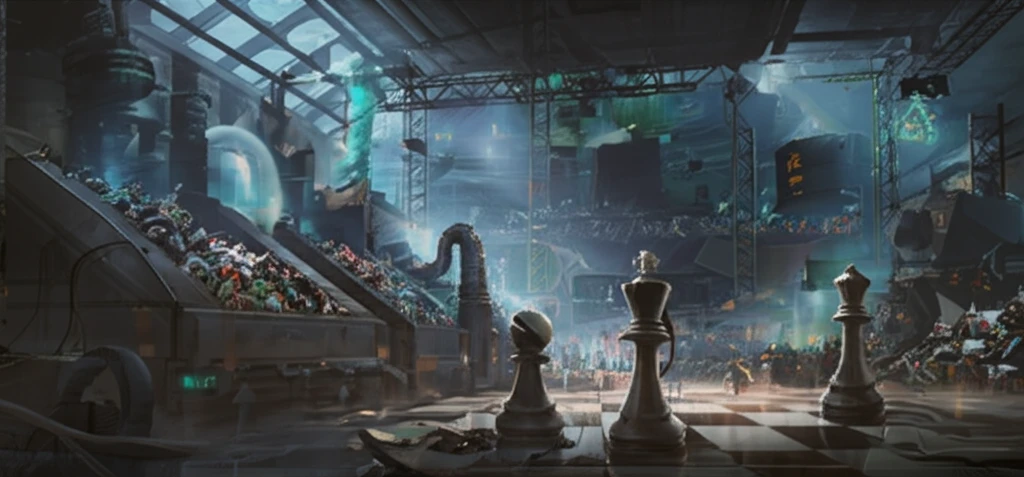
Turning Trash into Treasure: How Game Theory Can Revolutionize E-Waste Recycling

"Unlocking Economic and Environmental Benefits in Brazil's E-Waste Management"
In today's world, economic and environmental crises often stem from similar roots: market failures and the mismanagement of our precious natural resources. In Brazil, the establishment of the National Policy of Solid Waste (PNRS) has paved the way for innovative reverse logistics practices, especially in the realm of electrical and electronic equipment. But how can we truly optimize this system to benefit both the environment and the economy?
This article explores how Game Theory, a powerful tool for strategic decision-making, can be applied to the negotiation process between electronic manufacturers and cooperatives of collectors/recyclers dealing with waste electrical and electronic equipment (WEEE). By using a quantitative approach, we'll uncover the potential economic gains and the possibility of eliminating market failures.
Join us as we delve into the world of e-waste management in Brazil and discover how innovative economic strategies can lead to a more sustainable and prosperous future. Whether you're an environmental advocate, a business leader, or simply curious about the intersection of economics and sustainability, this article will provide valuable insights into a pressing global issue.
The Scale of the E-Waste Crisis
Electronic waste is one of the fastest-growing waste streams globally, with the EPA estimating it accounts for 20 to 50 million metric tons of worldwide waste each year. In Australia alone, e-waste volumes are projected to rise nearly 30 percent by 2030, reaching approximately 657,000 tonnes. Meanwhile, Agbogbloshie in Ghana demonstrates that e-waste sites are not simply dumps but complex ecosystems of recycling and maker activity. Despite growing awareness, recycling rates for electronics remain critically low across most regions.
Current Recycling Standards and Their Shortcomings
E-waste recycling relies on established certifications such as R2 (Responsible Recycling) from Sustainable Electronics Recycling International and WEEELABEX, the first e-waste standard in Europe. These frameworks ensure that recyclers handle materials professionally and in environmentally sound ways. However, planned obsolescence in technology design greatly aggravates recycling efforts, as devices are increasingly difficult to disassemble and recover materials from. Without dedicated investment, recycling infrastructure remains insufficient, and when landfilling remains cheap, recycling struggles to be economically viable.
A Long History of E-Waste Challenges
The e-waste problem has deep roots, with recycling infrastructure consistently lagging behind the pace of technological consumption. Research published in Science Advances found that only 20 percent of plastic waste is recycled globally, highlighting a longstanding gap in materials recovery. Municipal programs like e-waste drop-off centers in places such as Boroondara, Australia, represent incremental steps toward addressing the issue, yet the fundamental challenge of recovering valuable materials from complex electronics persists. The gap between waste generation and recycling capacity has been a defining feature of the e-waste landscape for decades.
The Power of Game Theory in E-Waste Management
Game Theory provides a framework for understanding strategic interactions, where the outcome for each participant depends on the actions of all. When applied to e-waste management, it helps align the interests of different stakeholders, such as manufacturers and recyclers, who may have conflicting objectives. By modeling their interactions as a 'game,' we can identify solutions that maximize benefits for all parties involved.
- Efficiency: Gives efficiency to the management of WEEE in Brazil.
- Goal Achievement: Reaching recycling goals without government intervention.
- Nash Bargaining Model: More efficient than Pareto Balance for WEEE management.
- Policy: Model depends on changes in Brazilian politics of solid waste.
Emerging Research on Recycling Behavior
Recent academic work is investigating the behavioral drivers behind e-waste recycling, with studies examining how recycling habits integrate into theories of planned behavior. Researchers are exploring determinants of household willingness to engage in e-waste recycling, seeking to understand what motivates or inhibits participation. These studies emphasize that recycling methods must be evaluated for environmental efficiency alongside behavioral factors. The field is increasingly drawing on interdisciplinary approaches to connect scientific recycling methods with human decision-making patterns.
The Recycling Paradox: High Value, Low Recovery
Despite the enormous value of critical materials in electronics, e-waste recycling remains stubbornly low worldwide. Even the extraction of precious metals has proved difficult for companies to capitalize on at scale. A significant structural failure persists: most recycled output from U.S. e-waste recyclers still ends up in China for downstream processing, undermining domestic circular economy goals. The remaining mass of e-waste, mainly plastics laced with metals, chemicals, and flame retardants, poses additional processing challenges that current infrastructure cannot efficiently handle.
Decision-Making Methods for Waste Recycling
Researchers are developing multicriteria decision-making frameworks to evaluate and compare waste recycling approaches. The THOR2 Method represents an evolution of the original THOR method, designed to analyze possible rank changes between approaches and support decision-making in the evolutionary process of waste recycling. Studies applying these methods in Brazil demonstrate how different criteria weightings can shift which recycling strategies appear most favorable. Such comparative tools are essential for policymakers seeking to optimize limited recycling resources across competing priorities.
The Future of E-Waste Management in Brazil
The application of Game Theory to e-waste management in Brazil offers a promising path toward a more sustainable and economically viable system. By aligning the interests of manufacturers and recyclers, we can unlock the potential of reverse logistics and create a circular economy for electronic devices. As Brazil continues to develop its environmental policies, embracing innovative economic tools like Game Theory will be essential for achieving its sustainability goals and transforming waste into a valuable resource.
Obsolescence and the Growing E-Waste Mountain
Built-in obsolescence is creating a massive e-waste challenge, with only about half of all e-waste recycled globally in 2022 and just 35 percent of valuable materials recovered. Experts warn that e-waste recyclers and communities living near dumpsites face serious health risks including cancer, stroke, and eye problems, with those within 500 meters of sites described as living on borrowed time. Transparency in recycling processes, including barcoding and tracking devices through facilities, is highlighted as key to building trust in responsible recycling systems. The gap between the scale of the problem and the adequacy of current responses remains stark.
Market Growth and Technological Promise
The electronic waste recycling market shows strong growth potential, with Spain's e-waste recycling market projected to expand from approximately 732 million USD in 2025 to 2.4 billion USD by 2035, a compound annual growth rate of 12.6 percent. The broader waste recovery and recycling market is driven by increasing demand for sustainable practices, technological advancements, and stricter regulations on waste disposal. These market signals suggest that economic incentives are beginning to align with environmental goals, though significant infrastructure gaps remain. The packaging waste recycling sector is also expected to witness significant growth as sustainability focus intensifies.
E-Waste in the Age of AI and Global Systems
The environmental impact of artificial intelligence is emerging as a new frontier in e-waste concerns, with generative AI creating additional electronic waste challenges on top of existing streams. E-waste recycling remains stubbornly low globally, with even precious metal extraction proving difficult to commercialize at scale. Extended Producer Responsibility and financing approaches are being discussed as potential systemic solutions, though implementing these frameworks across different regulatory environments remains complicated. The intersection of AI-driven device proliferation and existing e-waste management failures compounds the challenge significantly.
From Soil Contamination to Grassroots Innovation
A 2024 study of illegal dump sites across five Midwestern U.S. states found elevated levels of lead and cadmium in soil, with contamination spreading to nearby farmlands and affecting crop yields. In Argentina, engineers like Juan Carrique are pioneering roboticlaje, or robotic recycling, teaching children in schools how to repurpose e-waste into temperature sensors and motor controls. Over 190 countries have adopted non-binding recommendations on ethical AI use, including environmental considerations, signaling growing global awareness. Meanwhile, e-waste continues to grow faster than recycling capacity can keep up, underscoring the urgency of both systemic and community-level interventions.