
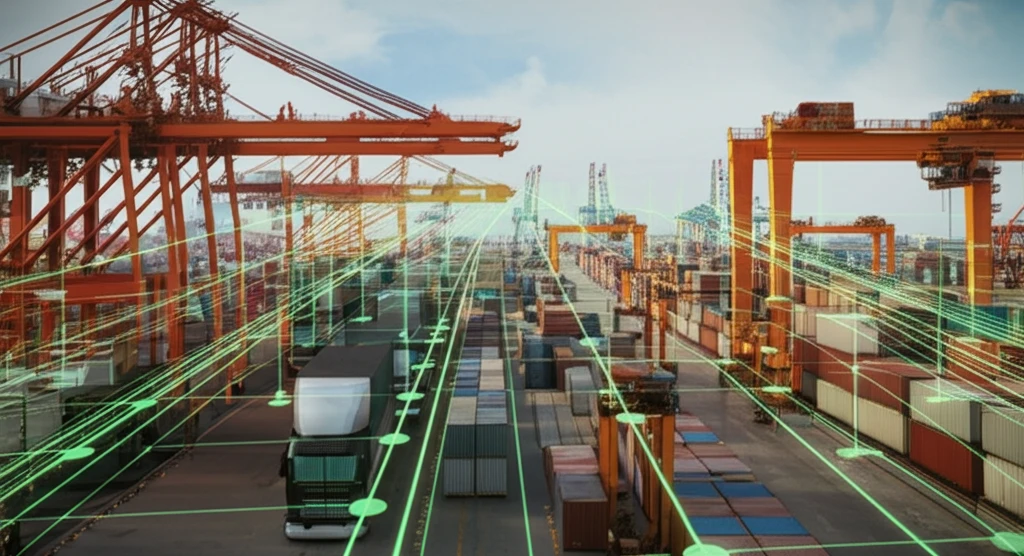
Truck Routing Revolution: Cutting Costs and Cleaning the Air

"Discover how multi-objective optimization is transforming inter-terminal transportation, making ports greener and more efficient."
Imagine a world where bustling ports aren't synonymous with pollution and congestion. The reality is, the exponential growth of global trade has put immense pressure on urban port areas, leading to severe traffic bottlenecks and harmful environmental impacts. But what if we could harness the power of data and smart technology to revolutionize how trucks navigate these complex environments?
Innovative strategies are emerging to tackle these challenges head-on. Ports worldwide are embracing development plans focused on minimizing their environmental footprint, particularly in urbanized zones. The key lies in finding solutions that not only address ecological concerns but also enhance economic performance. This means embracing practices, processes, and methods that simultaneously support green initiatives and sustainable growth.
This article explores the groundbreaking concept of multi-objective inter-terminal truck routing, a sophisticated approach that specifically considers truck emissions alongside traditional factors like cost and efficiency. We'll delve into cutting-edge algorithms, cloud-based decision support systems, and real-time data integration that are paving the way for a cleaner, more efficient future for port logistics.
Why Truck Routing Matters for Cost and Air Quality
Truck routing decisions carry outsized weight in both the cost and environmental performance of freight distribution, though the scale of that impact is context-specific and hard to generalize. In containerized shipping especially, growth in trade has been associated with urban traffic congestion and pollution pressure as trucks move containers between terminals, ports, and their hinterlands. Published figures on emissions savings, fuel reduction, or congestion relief vary widely across studies because they depend on terminal layout, fleet composition, and operating constraints, so precise global statistics cannot be stated with confidence. What is broadly accepted is that routing choices influence fuel consumed per mile, dwell time at facilities, and the air-quality burden on communities surrounding ports and freight hubs.
Routing as the Core Optimization Lever
Vehicle routing and planning is widely regarded as the best approach for optimizing transportation, since transportation decisions directly shape overall logistics and supply-chain costs. In the port context, container truck routing optimization and reservation have been identified as key factors in container terminal optimization, with earlier work using simulation to study both problems. Because efficiency and pollution targets are often in tension, researchers have framed the problem as multi-objective—explicitly accounting for truck emissions rather than treating cost as the sole criterion, often via methods such as multi-objective archived simulated annealing. Inter-terminal truck routing plays an essential role in coordinating container flows, and suboptimal routing is seen as materially affecting port productivity and efficiency. The accepted approaches are therefore powerful but must continuously balance competing objectives and the complexity of real terminal operations.
From Single-Depot Fleets to Emissions-Aware Planning
Vehicle routing research has evolved over decades from foundational work centered on single-depot truck fleets toward far richer models that incorporate time windows, capacity limits, and environmental objectives. Early milestones established the core problem of sequencing stops to minimize distance or cost, and that foundation still underpins nearly all modern routing systems. Later directions added emissions as an explicit objective and, more recently, dynamic, real-time, and learning-based decision-making. This is necessarily a thematic overview: specific dates, credited originators, and priority claims vary across the literature, so it should be read as a general trajectory rather than a precise chronology.
What is Multi-Objective Inter-Terminal Truck Routing?
Inter-terminal transportation (ITT) refers to the movement of containers and cargo between different areas within a seaport. As port activity increases, so does the need to optimize ITT, not just from an economic perspective, but an environmental one, too. It’s about finding the sweet spot where efficiency meets ecological responsibility. Business analytics can play a critical role, shaping organizational practices and processes to improve both economic and environmental performance.
- Economic Sustainability: Improving efficiency, productivity, security, and safety within ports.
- Environmental Sustainability: Reducing noise, emissions, and the overall environmental impact on surrounding neighborhoods.
- Multi-Objective Optimization: Balancing economic and environmental objectives to find innovative, viable solutions.
New Frontiers: Collaboration, Multi-Level Modeling, and Arrival Scheduling
Recent research is expanding truck routing well beyond conventional fleets and static plans. One emerging strand examines truck–drone collaborative routing, in which trucks serve as mobile depots with high payload capacity and long-range endurance while drones contribute speed, flexibility, and independence from road conditions. For container terminals specifically, recent work has split the problem into levels, including a single-truck routing model that minimizes total cost. A complementary line of research targets the scheduling of truck arrivals, since optimizing queues outside terminal gates can head off congestion while reducing logistical and environmental impacts on the port and its surroundings. Together, these studies point toward the integration of routing, arrival scheduling, and mixed-vehicle collaboration as the current research frontier.
Why Congestion and Cost Pressures Persist
Despite steady advances in routing optimization, real-world failures remain common and increasingly structural. Port congestion, for example, has reappeared across major trade lanes, and observers argue it can no longer be treated as a temporary disruption because many of the underlying causes remain unresolved. Long truck queues at ports impose hardships on drivers, disrupt surrounding traffic, raise environmental concerns, and can degrade a port's brand. Rising fuel costs continue to threaten logistics profitability, and industry guidance positions routing optimization only as one part of the mitigation toolkit rather than a cure-all. Planning gaps and shifting operating conditions mean that software solutions are powerful enablers but not automatic fixes, since poorly routed or badly planned operations can undercut their intended benefits.
Static vs. Dynamic, Cost-Only vs. Multi-Objective
When routing approaches are compared, they differ chiefly in whether they treat the problem as static or dynamic, single- or multi-objective, and isolated from or integrated with scheduling and reservation decisions at terminals. Cost-based approaches remain the baseline, but emissions-aware and collaborative models add criteria that can shift preferred routes even when the nominal cost change is small. In practice, the most suitable approach depends on fleet composition, terminal geography, and how a firm weighs environmental targets against financial ones. Because direct, apples-to-apples comparisons from published field trials are limited, any claim that a single method is superior should be read cautiously.
The Road Ahead: Sustainable Ports for a Greener Future
The multi-objective optimization in the context of port-related ITT considers aspects and restrictions of port-related ITT operations. Collaboration of trucking companies with small subcontractors is a common business model in many ports. A 'ready-to-use' cloud-based decision support system can simplify the generation of solutions for decision-makers aiming to find a good compromise between different objectives.
Experts See High Impact, Maturing Methods
Expert commentary on the sector emphasizes that logistics decisions ripple across ports, maritime shipping, trucking, rail, and broader supply-chain trends, making routing a strategic rather than purely operational concern. Within the port domain specifically, researchers observe that optimal truck routing in interterminal transport significantly affects port productivity and efficiency. The academic literature is candid about limits: the study of deep reinforcement learning applied to truck routing optimization is still limited, even as it draws growing attention as a promising technique. The resulting synthesis is that routing optimization is widely accepted as high-impact, but the underlying methods are still maturing, with theory in several areas running ahead of validated field deployments.
Toward Adaptive, Emissions-Aware Routing
Looking ahead, routing systems are likely to become more adaptive and emissions-aware, blending real-time operational data with longer-horizon planning. Deep reinforcement learning and truck–drone collaboration are widely discussed candidates, though both remain early-stage and evidence from operational deployments is limited. Climate-related disruptions, fuel price volatility, and tightening environmental regulation will probably push firms toward routing models that weigh resilience and emissions alongside pure cost. Given how quickly the logistics landscape is changing, specific timelines and adoption forecasts remain inherently uncertain.
Interconnected Networks Amplify Local Bottlenecks
Port disturbances tend to hit harder than ordinary supply-chain disruptions because they affect numerous companies that depend on seamless first-mile logistics transactions. Logistics networks are highly interconnected: a bottleneck in truck capacity or a shift in port fees can cascade into delayed shipments, increased costs, and strained distribution channels. Climate events now extend vessel transit times and disrupt synchronized logistics—for example, a multi-day crane shutdown or berth closure from storm surge forces reworking of container rotations, inland trucking schedules, and warehouse receipts. Despite the recognized importance of ports in integrated logistics, research on the success factors of port logistics integration remains scattered. The challenges ultimately play out at the level of systemic, cross-modal coordination rather than truck routes in isolation.
Real Fleets, Real Clients, Real Workloads
A real-world FMCG case study—a firm with nine agents across two operating regions serving 5,483 clients in Colombo and Gampaha—shows how routing problems emerge directly from business scale and geography, and how researchers modeled its outbound logistics to find better use of its distribution resources. Similarly, a logistics provider's routing case study describes analyzing current utilization of routed trucks and orders to rearrange distribution, allocate multi-stop truckload shipments more efficiently, and establish a benchmark for optimal distribution. These cases ground the field in measurable, practical gains rather than purely theoretical results. They also connect directly to the human side of operations, shaping driver workloads, on-time service for clients, and the daily feasibility of running a fleet.