
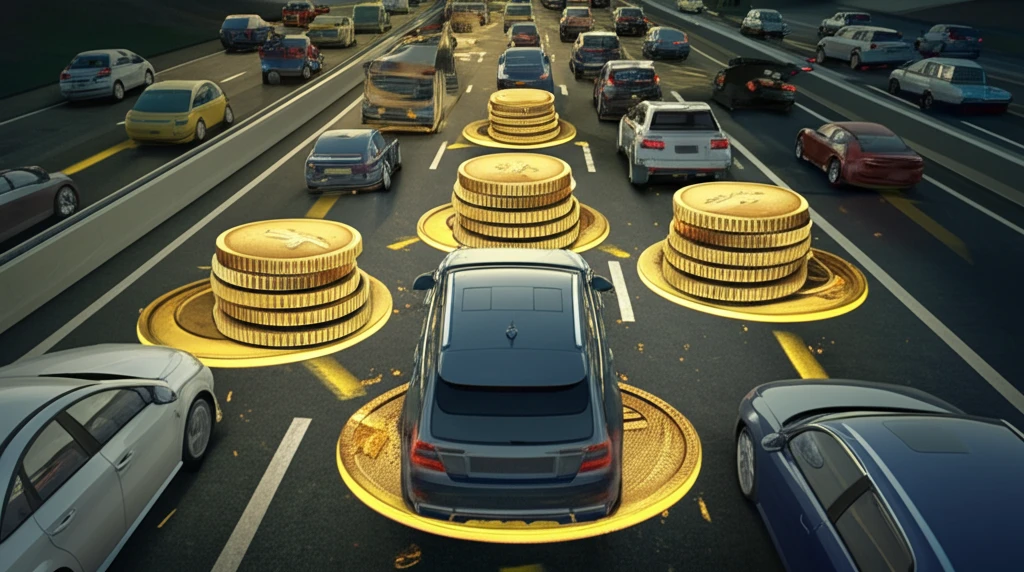
Optimized road traffic through smart congestion pricing.

Traffic Congestion Got You Down? How Smart Pricing Can Ease Your Commute (and Your Wallet!)

"Explore how innovative congestion pricing strategies can make your daily drive faster, fairer, and maybe even a little cheaper."


We’ve all been there: stuck in bumper-to-bumper traffic, watching the minutes tick by as we inch closer to our destination. Traffic congestion isn’t just a nuisance; it's a major drain on our time, our wallets, and our environment. Cities across the globe are grappling with this problem, and many are turning to a strategy called congestion pricing.

Congestion pricing, at its core, is a system that charges drivers a fee for using roads during peak hours. The goal? To encourage some drivers to travel at off-peak times, use public transportation, or carpool, ultimately reducing the number of vehicles clogging up the roads. While the concept sounds simple, the implementation can be complex, raising questions about fairness, equity, and effectiveness.

But what if congestion pricing could be more than just a way to reduce traffic? What if it could also address socioeconomic disparities, ensuring that low-income travelers aren’t disproportionately burdened by tolls? Recent research is exploring innovative pricing schemes that aim to do just that, by incorporating equity objectives alongside the traditional goal of minimizing travel time. Let’s dive into how these strategies work and what they could mean for the future of our commutes.

What is Congestion Pricing and Why Should You Care?

Optimized road traffic through smart congestion pricing.

Congestion pricing is a strategy that aims to reduce traffic by charging drivers a fee to use certain roads or areas during peak hours. The idea is simple: by making it more expensive to drive during the busiest times, some drivers will choose to travel at different times, use alternative routes, or opt for public transportation. This, in turn, reduces congestion for everyone else.

Think of it like surge pricing for ride-sharing services, but applied to entire road networks. When demand is high, prices go up, incentivizing some users to find alternatives. The revenue generated from these tolls can then be reinvested in transportation infrastructure, public transit, or other initiatives that benefit the community.

  • Reduced Traffic: Fewer cars on the road mean faster commutes and less time wasted in traffic.
  • Improved Air Quality: Less congestion translates to reduced emissions and cleaner air.
  • Funding for Transportation: Toll revenue can be used to improve roads, public transit, and other transportation options.
  • Fairer System: Some congestion pricing models aim to address socioeconomic disparities, ensuring that low-income travelers aren’t unfairly burdened.
However, congestion pricing also faces criticism. Some argue that it disproportionately impacts low-income drivers who may not have alternative transportation options. Others worry about the potential for increased traffic on untolled roads as drivers seek to avoid fees. That’s why it’s essential to design congestion pricing schemes carefully, taking into account equity and potential unintended consequences.

The Road Ahead: Is Congestion Pricing Right for Your City?

Congestion pricing is not a one-size-fits-all solution. It requires careful planning, public engagement, and a commitment to equity. However, with thoughtful design and implementation, it has the potential to transform our commutes, improve our air quality, and create a more sustainable transportation system for all. Whether congestion pricing becomes a widespread reality remains to be seen, but one thing is clear: we need innovative solutions to tackle the growing problem of traffic congestion, and smart pricing strategies are certainly worth exploring.

About this Article -

This article was crafted using a human-AI hybrid and collaborative approach. AI assisted our team with initial drafting, research insights, identifying key questions, and image generation. Our human editors guided topic selection, defined the angle, structured the content, ensured factual accuracy and relevance, refined the tone, and conducted thorough editing to deliver helpful, high-quality information.See our About page for more information.

This article is based on research published under:

DOI-LINK: https://doi.org/10.48550/arXiv.2401.16844,

Title: Congestion Pricing For Efficiency And Equity: Theory And Applications To The San Francisco Bay Area

Subject: cs.gt cs.cy cs.ma cs.sy econ.em eess.sy

Authors: Chinmay Maheshwari, Kshitij Kulkarni, Druv Pai, Jiarui Yang, Manxi Wu, Shankar Sastry

Published: 30-01-2024

Everything You Need To Know

1

What exactly is Congestion Pricing, and how does it aim to solve traffic problems?

Congestion pricing is a strategy designed to reduce traffic congestion by charging drivers a fee for using roads during peak hours. The primary goal is to encourage some drivers to alter their travel behavior. This could involve traveling during off-peak times, using public transportation, carpooling, or choosing alternative routes. By reducing the number of vehicles on the road, congestion pricing aims to decrease traffic, leading to faster commutes, reduced emissions, and improved overall efficiency of the transportation system.

2

What are the main benefits of implementing Congestion Pricing?

Implementing Congestion Pricing offers several key advantages. Firstly, it leads to Reduced Traffic, meaning faster commutes and less time wasted in traffic. Secondly, the strategy contributes to Improved Air Quality due to reduced emissions from fewer vehicles. Thirdly, revenue from Congestion Pricing can be used for Funding for Transportation, allowing for the enhancement of roads, public transit, and other crucial transportation options. Lastly, some models aim for a Fairer System by addressing socioeconomic disparities to prevent low-income travelers from being unfairly burdened by tolls.

3

How does Congestion Pricing compare to other strategies like surge pricing used by ride-sharing services?

Congestion Pricing functions similarly to surge pricing used by ride-sharing services but on a larger scale, applied to entire road networks. Both strategies use the principle of adjusting prices based on demand to influence user behavior. In ride-sharing, surge pricing increases fares during periods of high demand to encourage more drivers to work. Congestion Pricing increases tolls during peak hours to encourage drivers to find alternative times or modes of transportation. The main difference is the scope: Congestion Pricing affects all drivers on specific roads or areas, while surge pricing impacts users of a specific ride-sharing service.

4

What are the potential drawbacks or criticisms associated with Congestion Pricing?

While Congestion Pricing offers several benefits, it also faces criticism. One major concern is that it might disproportionately impact low-income drivers who may not have access to alternative transportation options. This could lead to increased financial burdens for those who rely on their cars for essential travel. Another concern is the potential for increased traffic on untolled roads as drivers try to avoid the fees. This can create congestion in other areas. It's essential to design Congestion Pricing schemes carefully, considering equity and potential unintended consequences to mitigate these issues.

5

What does the future hold for Congestion Pricing, and what factors are crucial for its successful implementation?

The future of Congestion Pricing is promising, but its widespread adoption depends on careful planning, public engagement, and a commitment to equity. For successful implementation, cities must consider how to mitigate the negative impacts on low-income drivers, such as through discounts, exemptions, or investments in public transportation. It's essential to address public concerns and ensure that the revenue generated is reinvested in transportation infrastructure or other initiatives that benefit the community. With thoughtful design and execution, Congestion Pricing has the potential to transform commutes, improve air quality, and create a more sustainable transportation system for all.

Newsletter Subscribe

Subscribe to get the latest articles and insights directly in your inbox.