
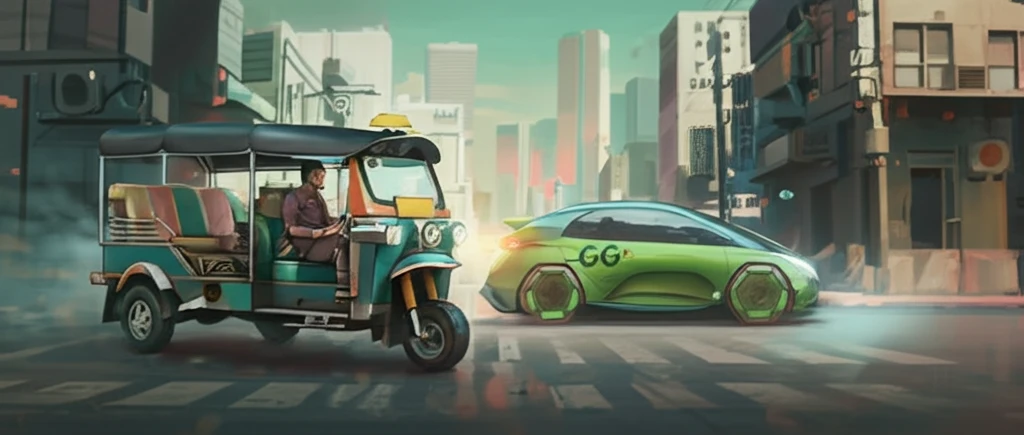
Bangkok's Tuk-Tuk Dilemma: Can Green Technology Overcome Poverty and Corruption?

"Exploring the barriers to eco-friendly transport adoption in Thailand's capital and what it means for a sustainable future."
Across the globe, cities face increasing pressure to adopt green technologies and practices to combat pollution. In Bangkok, Thailand, this push raises complex questions, especially when it comes to the city's iconic Tuk-Tuks. These three-wheeled vehicles, while beloved by tourists and locals alike, contribute significantly to air pollution. Efforts to transition Tuk-Tuks to cleaner alternatives like CNG (Compressed Natural Gas) have met with resistance, highlighting a tangled web of economic, social, and technical challenges.
A recent study delved into the factors influencing Tuk-Tuk drivers' adoption of green technology in Bangkok. The research combined qualitative exploration to identify key issues, followed by quantitative analysis to confirm their significance. By interviewing 176 drivers and analyzing the data, the study revealed that socio-economic factors, often exacerbated by green technology-related hurdles, play a major role in their reluctance to embrace change.
This article unpacks the findings of this research, exploring the specific challenges faced by Tuk-Tuk drivers in Bangkok. It examines how poverty, debt, lack of education, and systemic corruption intersect with issues like the high cost of green technology, insufficient infrastructure, and lack of technical expertise. Understanding these barriers is crucial for developing effective strategies to promote sustainable transportation and improve air quality in Bangkok and other developing cities.
The Scale of Bangkok's Tuk-Tuk Emissions Challenge
Bangkok's tuk-tuk fleet remains a significant contributor to urban air pollution and greenhouse gas emissions in the Thai capital. While exact current figures vary across reports, these three-wheeled vehicles are widely recognized as disproportionate polluters relative to their passenger capacity. The intersection of tourism-driven demand, poverty among drivers, and entrenched corruption creates a uniquely difficult policy environment. Any meaningful transition to green technology must grapple with all three factors simultaneously.
Auto Rickshaws: A Global Template with Limited Solutions
Auto rickshaws, the broader category to which tuk-tuks belong, are a ubiquitous mode of motorized transport across South and Southeast Asia. Standard approaches to modernizing these fleets have included conversion to compressed natural gas (CNG) and, more recently, electrification pilots. However, adoption has been uneven, with infrastructure gaps, upfront costs, and driver resistance posing persistent barriers. As documented on Wikipedia, the global auto rickshaw ecosystem spans diverse regulatory and economic contexts, making one-size-fits-all solutions impractical.
Early Electrification Efforts and Policy Shifts
Thailand's government has intermittently pursued policies to phase out two-stroke and older diesel-powered tuk-tuks, with various incentive programs introduced over the past two decades. Pilot electrification projects have been trialed in Bangkok's tourist districts, though scaling these efforts has proven difficult. The historical pattern suggests that policy announcements often outpace implementation, a recurring frustration for both environmental advocates and drivers themselves. Without sustained political will and enforcement, past milestones have had limited lasting impact.
Why Bangkok's Tuk-Tuk Drivers Are Hesitant to Go Green: Untangling the Barriers
The study identified a cluster of interconnected issues preventing Tuk-Tuk drivers from adopting green technology. These can be broadly categorized as:
- Limited Access to Capital: Many drivers lack the credit or savings to afford new CNG Tuk-Tuks or to convert their existing vehicles.
- Daily Survival: For many, their daily earnings are just enough to cover basic needs, leaving little room for long-term investments in green technology.
- Indebtedness: Some drivers are already burdened with debt, making it difficult to take on more financial obligations.
Emerging Green Technologies and Their Viability
Recent research has explored lithium-ion and solid-state battery technologies as potential power sources for tuk-tuk electrification, with varying cost and durability profiles. Solar-assist charging and battery-swap models have also been proposed as ways to address range limitations in tropical urban environments. However, peer-reviewed evaluations of these technologies in the specific context of Bangkok's climate and infrastructure remain limited. Most findings are extrapolated from broader Southeast Asian or global studies rather than Bangkok-specific data.
Why Previous Green Tuk-Tuk Initiatives Stalled
Several past attempts to introduce electric or low-emission tuk-tuks in Bangkok have failed to gain lasting traction, often due to high upfront vehicle costs that drivers living in poverty cannot absorb. Corruption in vehicle inspection and licensing processes has also undermined enforcement of emission standards. Critics argue that top-down mandates without corresponding financial support mechanisms are doomed to repeat past failures. The tension between environmental goals and the economic survival of drivers remains unresolved.
Bangkok vs. Other Asian Cities
Comparisons with cities like New Delhi, which mandated CNG conversion for auto rickshaws, and Shenzhen, which electrified its entire bus fleet, offer instructive but imperfect parallels for Bangkok. Bangkok's unique tourism economy, political dynamics, and corruption landscape make direct policy transfers challenging. While some neighboring cities have achieved notable emissions reductions, the tuk-tuk sector's informal and fragmented nature complicates replication. No single city's experience provides a comprehensive blueprint for Bangkok's specific dilemma.
Towards a Greener Future: Overcoming the Obstacles
Transitioning Bangkok's Tuk-Tuks to green technology requires a multi-faceted approach that addresses the socio-economic realities of the drivers, tackles corruption, and improves the accessibility and affordability of green alternatives. This includes providing financial assistance, streamlining bureaucratic processes, investing in CNG infrastructure, and promoting technical training. By working collaboratively, policymakers, businesses, and community stakeholders can pave the way for a cleaner, more sustainable transportation future for Bangkok, ensuring that the benefits of green technology reach all segments of society.
Weaving Poverty, Corruption, and Technology Together
Experts broadly agree that green technology alone cannot solve Bangkok's tuk-tuk problem without addressing the underlying poverty and corruption that sustain dirty fleets. Effective solutions likely require a combination of subsidized vehicle transitions, retraining programs, and genuine anti-corruption enforcement. The political economy of the tuk-tuk sector means that technology adoption is as much a governance challenge as an engineering one. Synthesis across environmental, economic, and political perspectives is essential for any viable pathway forward.
What Comes Next for Bangkok's Tuk-Tuk Fleet
Looking ahead, battery cost reductions and improving charging infrastructure in Bangkok could shift the economic calculus for drivers and fleet operators. International climate finance mechanisms and Thai government subsidy programs may also play a role in accelerating adoption. However, the timeline for meaningful fleet turnover remains uncertain, and interim measures to reduce emissions from existing vehicles may be necessary. The coming years will likely determine whether Bangkok's tuk-tuk sector transitions or stagnates.
Systemic Barriers Beyond Technology
Bangkok's tuk-tuk dilemma reflects broader systemic challenges facing developing-world cities attempting green transitions under conditions of poverty and weak governance. Corruption distorts policy implementation, from vehicle inspection to subsidy distribution, while poverty constrains the options available to individual drivers. International development frameworks often underestimate these governance barriers when promoting technology transfer. Addressing the tuk-tuk problem ultimately requires confronting entrenched power structures and economic inequalities.
Drivers, Passengers, and Communities
Behind the policy debates are tens of thousands of tuk-tuk drivers whose livelihoods depend on affordable, reliable vehicles. Passengers—predominantly tourists—demand convenience and safety, while Bangkok residents bear the health costs of air pollution. Community-level impacts, including noise pollution and traffic congestion, further complicate the picture. Any transition strategy that ignores these human realities risks both failure and social harm.