
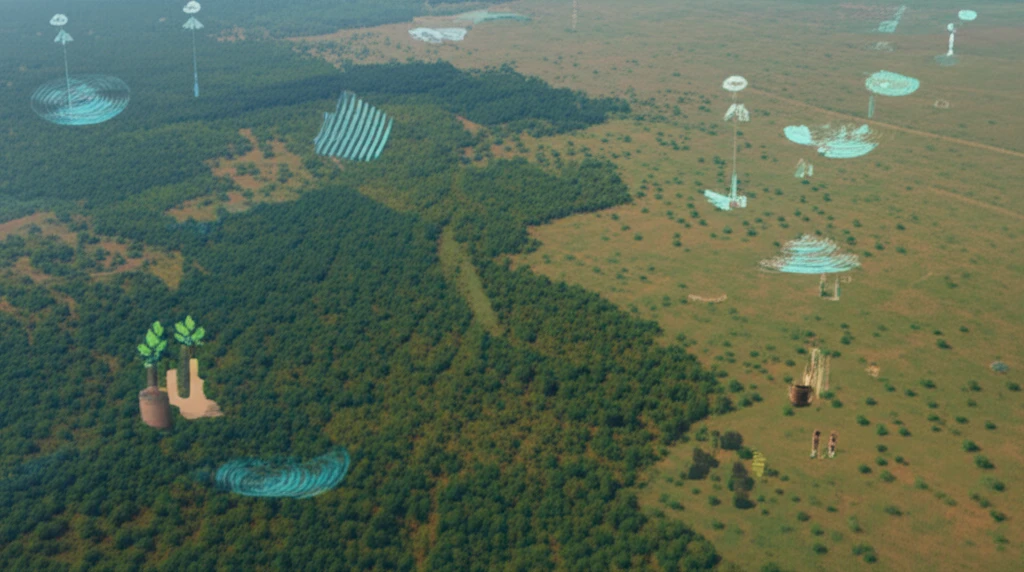
Fragmented forest landscape in Togo, overlaid with satellite imagery, symbolizing deforestation and conservation efforts.

Togo's Relic Forests: Can They Survive?

"A new study reveals the shrinking state of Togo's dry dense forests, offering vital clues for saving these ecological treasures."


In Togo, West Africa, dry dense forests, once a significant part of the landscape, are now critically endangered. Human activities have led to their fragmentation, leaving only small, isolated patches, particularly within protected areas. These relic forests are crucial for biodiversity and ecological balance, making their conservation a top priority.

Recognizing the urgent need for effective conservation, a recent study focused on the spatial dynamics and structural parameters of these forests within the Abdoulaye Wildlife Reserve (RFA). By analyzing changes in vegetation cover over time and assessing the current state of the forest fragments, researchers aimed to provide reliable scientific data to guide future management and conservation efforts.

This research offers a glimmer of hope for the development of sustainable strategies to safeguard Togo's dry dense forests. The findings highlight the dramatic changes in forest cover and provide essential insights into the forests' structure, paving the way for informed decisions about protected area management.

Tracking Forest Loss: What the Data Reveals

Fragmented forest landscape in Togo, overlaid with satellite imagery, symbolizing deforestation and conservation efforts.

The study used a diachronic analysis of LANDSAT satellite images from 1972, 1991, and 2000 to assess changes in the RFA's vegetation cover. This method allowed researchers to track deforestation rates and understand how land use patterns have evolved over time. The results paint a concerning picture: a significant decrease in forest area over the nearly three-decade period.

The analysis revealed an alarming annual regression rate of 3% across the entire reserve. This means that each year, a portion of the forest is lost, primarily due to human activities and, potentially, climatic changes. This deforestation not only reduces the total forest cover but also fragments the remaining habitat, impacting the species that depend on it.

Here’s a breakdown of the key changes observed:
  • Decreasing Forest Cover: The area covered by dense dry forests and gallery forests declined significantly.
  • Increase in Savanna: There was a notable increase in savanna shrubland, indicating forest degradation and a shift towards more open landscapes.
  • Agricultural Expansion: Areas used for cultivation and fallow land increased, reflecting the growing pressure from agriculture on the reserve's resources.
These changes underscore the need for immediate and targeted conservation actions to reverse the trend of forest loss and protect the remaining fragments. Understanding the drivers of deforestation is crucial for developing effective strategies that address both environmental and socio-economic factors.

Turning the Tide: A Path Forward for Togo's Forests

The study emphasizes that the old methods of managing protected areas, which relied heavily on government control and repression, have not been effective. The involvement of local communities is essential for the long-term success of any conservation initiative. This means finding ways to balance conservation goals with the needs and livelihoods of the people who live near the reserve. By working together, it is possible to protect these precious forests for future generations.

About this Article -

This article was crafted using a human-AI hybrid and collaborative approach. AI assisted our team with initial drafting, research insights, identifying key questions, and image generation. Our human editors guided topic selection, defined the angle, structured the content, ensured factual accuracy and relevance, refined the tone, and conducted thorough editing to deliver helpful, high-quality information.See our About page for more information.

This article is based on research published under:

DOI-LINK: 10.4314/ijbcs.v4i1.54242, Alternate LINK

Title: Etude De La Dynamique Spatiale Et Structure Des Forêts Denses Sèches Reliques Du Togo: Implications Pour Une Gestion Durable Des Aires Protégées

Subject: General Medicine

Journal: International Journal of Biological and Chemical Sciences

Publisher: African Journals Online (AJOL)

Authors: K Adjonou, O Djiwa, Y Kombate, Ad Kokutse, K Kokou

Published: 2010-05-06

Everything You Need To Know

1

What are the dry dense forests in Togo, and why are they important?

The dry dense forests in Togo are critically endangered. Once a significant part of the landscape, these forests have been fragmented due to human activities. The remaining fragments are crucial for biodiversity and ecological balance, making their conservation a top priority. Their importance lies in their role as habitats for various species and their contribution to the overall ecological health of the region.

2

What is the Abdoulaye Wildlife Reserve (RFA), and what role does it play in this context?

The Abdoulaye Wildlife Reserve (RFA) is a specific protected area in Togo where researchers focused on the spatial dynamics and structural parameters of the dry dense forests. Studying the RFA allows scientists to gather reliable data on forest changes and inform management strategies. This research provides essential insights into the forests' structure, aiding in making informed decisions about protected area management.

3

How was forest loss tracked in the study?

The diachronic analysis of LANDSAT satellite images from 1972, 1991, and 2000 was used to assess changes in vegetation cover within the Abdoulaye Wildlife Reserve. This method tracked deforestation rates and how land use patterns evolved. The study revealed a significant decrease in forest area, helping to understand the scale and pace of forest loss. This analysis offers crucial data to guide future conservation and management efforts in Togo's dry dense forests.

4

What rate of forest loss was observed in Togo?

The study found an alarming annual regression rate of 3% across the Abdoulaye Wildlife Reserve. This indicates a significant loss of forest cover each year due to human activities and potential climatic changes. This deforestation reduces the total forest cover, fragments the remaining habitat, and impacts the species that depend on it. The observed changes, including decreasing forest cover and an increase in savanna and agricultural land, underscore the urgency for immediate conservation action.

5

What approach is needed to protect Togo's forests?

The study suggests that relying solely on government control and repression is not an effective approach for managing protected areas. The involvement of local communities is essential for successful conservation. The most effective conservation will find ways to balance conservation goals with the needs and livelihoods of the people near the Abdoulaye Wildlife Reserve. This collaborative approach is key to protecting Togo's dry dense forests for the future.

Newsletter Subscribe

Subscribe to get the latest articles and insights directly in your inbox.