
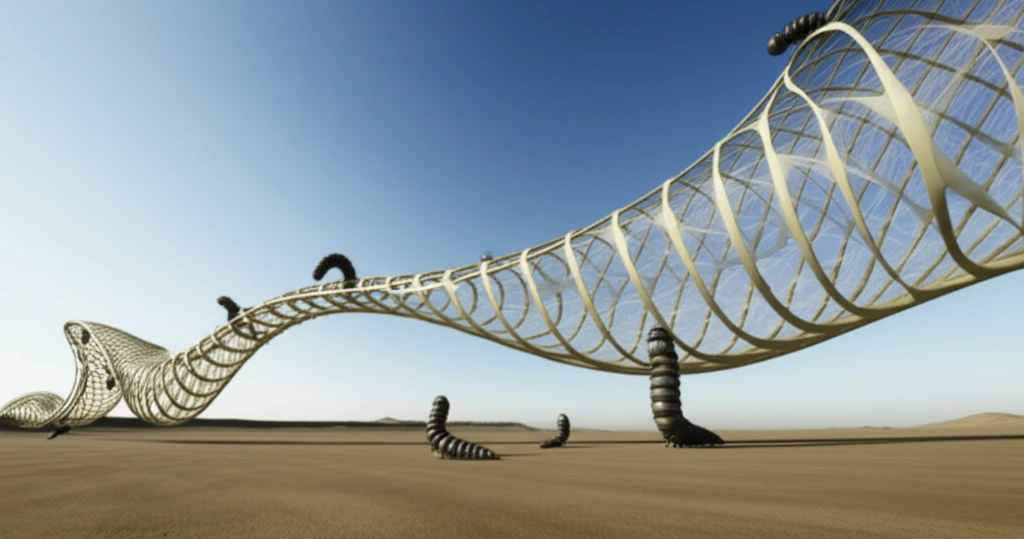
Fiberbots constructing a futuristic bridge.

Tiny Titans: How Worm-Like Robots Could Revolutionize Construction

"Inspired by silkworms, swarms of miniature robots are building the future, one cocoon-like tube at a time."


Construction is an industry ripe for innovation. Traditional methods are often labor-intensive, costly, and environmentally unfriendly. But what if we could reimagine construction using cutting-edge technology inspired by nature itself?

Enter the Fiberbots, a swarm of silkworm-inspired robots developed by Neri Oxman and her team at the Massachusetts Institute of Technology (MIT). These aren't your typical heavy-duty construction machines; instead, they are small, agile robots that work together to create complex structures.

Inspired by the way silkworms weave cocoons, each Fiberbot is a 30-centimeter-tall cylinder with a thin, specialized arm. These arms wind fiberglass thread around their bodies, creating tube-like structures segment by segment. After creating an 8-centimeter-long segment, the Fiberbot crawls forward to build the next section.

Fiberbots: A Collaborative Construction Team

Fiberbots constructing a futuristic bridge.

What sets the Fiberbots apart is their ability to work as a team. The MIT team created 22 Fiberbots, preprogramming each with specific details about the length and curvature required for the final structure. An algorithm was also installed to prevent collisions as the bots worked.

Over 12 hours, the Fiberbot swarm constructed curved tubes ranging from 2.5 to 4.1 meters in height. Remarkably, the bots managed to complete the task without any collisions, showcasing the effectiveness of their collaborative programming.

Here's a breakdown of what makes Fiberbots special:
  • Inspired by Nature: Mimicking the silkworm's cocoon-building process.
  • Collaborative Swarm: Robots work together, coordinated by algorithms.
  • Lightweight Materials: Using fiberglass, known for its strength and light weight.
  • Collision Avoidance: Programmed to prevent accidents and ensure smooth operation.
  • Versatile Structures: Capable of building curved tubes and complex shapes.
Fiberglass offers a unique combination of strength and lightweight properties. It has been used in various applications, from golf clubs and pipes to even spacecraft parts. Compared to some metals, fiberglass can bear more weight and withstand extreme conditions. However, its bulky form has traditionally made it difficult to transport.

The Future of Construction with Robot Swarms

Neri Oxman envisions Fiberbots working in remote or extraterrestrial environments, places where traditional construction methods are impractical or impossible. Imagine building habitats on Mars or creating infrastructure in disaster zones using these autonomous robot swarms. Fiberbots represent a significant step toward a future where construction is more efficient, sustainable, and accessible.

About this Article -

This article was crafted using a human-AI hybrid and collaborative approach. AI assisted our team with initial drafting, research insights, identifying key questions, and image generation. Our human editors guided topic selection, defined the angle, structured the content, ensured factual accuracy and relevance, refined the tone, and conducted thorough editing to deliver helpful, high-quality information.See our About page for more information.

Everything You Need To Know

1

What are Fiberbots?

Fiberbots are small, silkworm-inspired robots developed by Neri Oxman and her team at MIT. They are designed to work collaboratively to construct structures by winding fiberglass thread around themselves, creating tube-like segments. This method mimics how silkworms build cocoons.

2

Why is it important that Fiberbots can work together?

The collaborative aspect of Fiberbots is important because it allows for the construction of complex structures that would be difficult or impossible for a single robot to build. The swarm is preprogrammed with specific details and an algorithm to prevent collisions, ensuring efficient and coordinated construction.

3

Why do the Fiberbots use fiberglass?

Fiberglass is used by the Fiberbots because it is a lightweight yet strong material. This combination allows the robots to build sturdy structures while remaining agile and efficient. Fiberglass's ability to withstand extreme conditions makes it suitable for diverse applications.

4

What is the main advantage of using Fiberbots for construction?

The primary advantage of using Fiberbots is the potential to revolutionize construction by making it more efficient, sustainable, and accessible. They can be deployed in remote or extraterrestrial environments where traditional construction methods are impractical. Furthermore, their collaborative nature and use of lightweight materials reduce labor and transportation costs.

5

How do the Fiberbots avoid bumping into each other while they are working?

The Fiberbots can avoid collisions because they are preprogrammed with an algorithm that manages their movements and prevents them from interfering with each other. This collaborative programming ensures that the swarm can work together efficiently and safely, even in complex environments. This is crucial for maintaining the integrity of the construction process and preventing damage to the robots themselves.

Newsletter Subscribe

Subscribe to get the latest articles and insights directly in your inbox.