
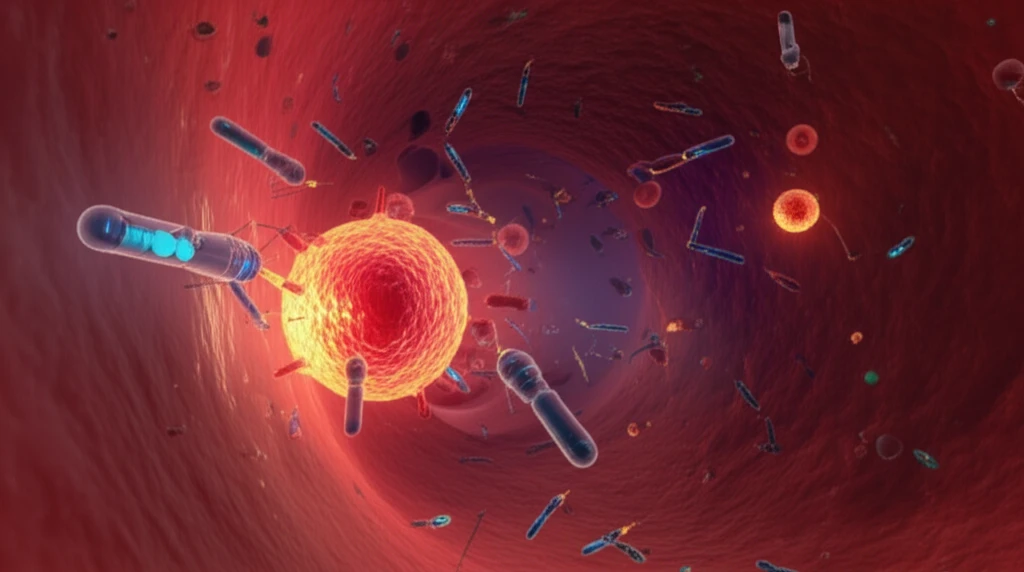
Microscopic robots navigate a bloodstream, delivering targeted medication.

Tiny Tech, Big Impact: How Light-Driven Nanomotors Could Revolutionize Medicine and Environmental Cleanup

"Scientists are developing light-powered nanomotors, microscopic machines that promise targeted drug delivery and efficient pollution removal. Are we on the verge of a technological revolution at the smallest scale?"


Imagine a fleet of microscopic robots navigating your bloodstream, delivering medication directly to cancerous cells, or swarms of tiny machines cleaning up oil spills at the molecular level. This isn't science fiction; it's the rapidly evolving field of light-driven micro and nanomotors. These minuscule machines, often smaller than a human cell, are powered by light and are showing incredible promise across a range of applications.

Nanomotors aren't new. The idea was introduced in the 1950s, but it's only recently that advances in materials science and nanotechnology have made their widespread development feasible. Researchers are experimenting with different designs, materials, and light sources to optimize these tiny machines for specific tasks.

This article will explore the exciting world of light-driven nanomotors, breaking down the science in an accessible way. We'll examine their potential applications, discuss the challenges that researchers face, and consider the ethical implications of deploying such advanced technology.

What Exactly ARE Light-Driven Nanomotors and HOW do They Work?

Microscopic robots navigate a bloodstream, delivering targeted medication.

Light-driven nanomotors are essentially tiny engines that convert light energy into mechanical motion. They are designed to perform specific tasks at the micro and nanoscale, from drug delivery to environmental remediation. Unlike traditional motors that rely on electricity or fuel, these motors are powered by light, making them potentially cleaner and more sustainable.

The key to a nanomotor's function lies in its materials. Many designs incorporate light-sensitive materials that undergo a physical or chemical change when exposed to light. That change triggers movement. Here are a few common actuation mechanisms:

  • Photothermal Propulsion: Some materials heat up when exposed to light, creating a temperature gradient in the surrounding fluid. This gradient propels the motor forward.
  • Bubble Propulsion: Light can trigger chemical reactions that produce gas bubbles, which then generate thrust.
  • Self-Electrophoresis: Light can create an electrical field on the surface of the motor, causing it to move through a solution.
  • Osmotic Propulsion: Light induces a concentration gradient, leading to fluid flow and movement.
The type of light used (UV, visible, or near-infrared) and the structure of the motor (microsphere, nanorod, etc.) also play crucial roles in determining its speed, direction, and force. Researchers carefully select these factors to tailor the motor's performance to its intended application.

The Future is Tiny: Navigating the Ethical Considerations of Nanotechnology

Light-driven nanomotors hold immense promise, but like any powerful technology, they also raise ethical concerns. What happens if nanomotors are used for malicious purposes? Who regulates their development and deployment? These are questions that society must address as nanotechnology continues to advance. Despite these challenges, the potential benefits of light-driven nanomotors are too significant to ignore. As research progresses and regulations are put into place, we can anticipate a future where these minuscule machines play a major role in improving health, protecting the environment, and transforming our world.

About this Article -

This article was crafted using a human-AI hybrid and collaborative approach. AI assisted our team with initial drafting, research insights, identifying key questions, and image generation. Our human editors guided topic selection, defined the angle, structured the content, ensured factual accuracy and relevance, refined the tone, and conducted thorough editing to deliver helpful, high-quality information.See our About page for more information.

Everything You Need To Know

1

What are light-driven nanomotors?

Light-driven nanomotors are miniature engines that convert light energy into mechanical motion, enabling them to perform tasks at the micro and nanoscale. Unlike traditional motors that use electricity or fuel, they're powered by light, potentially making them cleaner and more sustainable. This is important because it opens possibilities for applications where traditional power sources are impractical or undesirable, such as within the human body or in delicate ecosystems.

2

How do light-driven nanomotors actually work?

The function of light-driven nanomotors depends on materials that react to light. When exposed to light, these materials undergo physical or chemical changes that trigger movement. Specific actuation mechanisms include: photothermal propulsion, bubble propulsion, self-electrophoresis and osmotic propulsion. The choice of light type (UV, visible, or near-infrared) and motor structure (microsphere, nanorod, etc.) are crucial for controlling performance. Without light-sensitive materials and these actuation mechanisms, nanomotors wouldn't be able to convert light into the mechanical motion needed for their applications.

3

What are the different methods used to propel these nanomotors?

There are several different ways that light-driven nanomotors move. Photothermal propulsion uses light to heat materials and create a temperature gradient in fluid. Bubble propulsion uses light to trigger chemical reactions that produce gas bubbles for thrust. Self-electrophoresis uses light to create an electrical field on the motor's surface, causing movement. Osmotic propulsion uses light to induce a concentration gradient, leading to fluid flow and movement. These various methods highlight the versatility of light-driven nanomotors, allowing them to be adapted for different environments and tasks. Other methods such as using magnetic fields are also possible.

4

What are the potential applications of light-driven nanomotors?

Light-driven nanomotors hold great promise for medicine, particularly in targeted drug delivery, where they could transport medication directly to cancer cells. In environmental cleanup, they could remove pollutants at a molecular level, like cleaning up oil spills. The significance of these applications lies in their potential to increase the effectiveness of treatments while minimizing side effects, and to address environmental challenges more efficiently. They could also be used in manufacturing in ways that are not yet imagined.

5

What are some of the ethical considerations surrounding the use of light-driven nanomotors?

Like any advanced technology, light-driven nanomotors raise ethical concerns, such as the potential for malicious use and the need for regulation. These concerns are important because nanotechnology impacts society. Addressing these issues is essential to ensure the responsible development and deployment of nanomotors, maximizing their benefits while minimizing potential harm. Aspects like safety, privacy, and environmental impact need to be carefully considered.

Newsletter Subscribe

Subscribe to get the latest articles and insights directly in your inbox.