
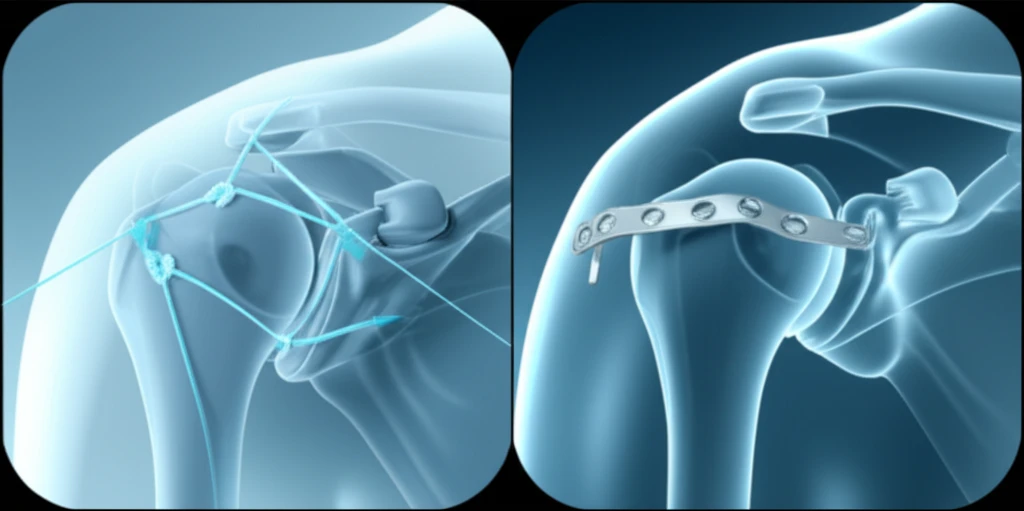
Tightrope vs. Hook Plate: Which is Best for AC Joint Dislocations?

"A comparison of arthroscopic tightrope fixation and hook plate fixation for acute AC joint dislocations: weighing the benefits and risks."
Acromioclavicular joint (ACJ) separations, commonly known as shoulder separations, are frequent injuries, particularly among athletes and active individuals. These injuries occur when the ligaments connecting the collarbone (clavicle) to the shoulder blade (scapula) are damaged, leading to pain, instability, and limited range of motion. The severity of ACJ separations varies, with high-grade separations (types III-VI) representing complete dislocations that often require surgical intervention.
When surgery is needed, two modern techniques have become popular: hook plate fixation and coracoclavicular (CC) ligament fixation using a suspensory loop device, often referred to by the brand name Tightrope. Both methods aim to restore stability to the AC joint, but they differ significantly in their approach and potential outcomes. Hook plate fixation involves using a metal plate with a hook that anchors under the acromion (part of the scapula), while Tightrope fixation utilizes strong sutures to secure the clavicle to the coracoid process (another part of the scapula).
Given the ongoing debate about which technique yields the best results, a study was conducted to compare the short-term outcomes of arthroscopic Tightrope fixation with those of hook plate fixation in patients with acute unstable ACJ dislocations. This article will delve into the findings of this research, providing insights into the benefits and drawbacks of each surgical approach to help patients and healthcare professionals make informed decisions.
Why AC Injuries Matter
Acromioclavicular joint dislocations are common shoulder injuries that can affect pain, stability, and upper-extremity function. Their impact varies with injury severity, activity demands, and the individual’s recovery goals. Because treatment outcomes are not uniform, evaluation should be individualized.
Treatment Depends on Severity
Management commonly ranges from nonoperative care for less severe injuries to surgical stabilization or reconstruction for selected high-grade injuries. Conservative care may avoid surgical complications, while surgery can be considered when instability or functional demands justify it. The absence of a universally accepted approach means clinicians must weigh injury characteristics, expected function, and patient preferences.
An Evolving Treatment Debate
Understanding of AC joint dislocations has developed around the anatomy of the AC and coracoclavicular ligaments, injury severity, and the distinction between shoulder separation and glenohumeral dislocation. Treatment concepts have continued to evolve as clinicians compare nonoperative care with different reconstructive techniques. The field remains shaped by ongoing debate over which approach best restores durable function.
Tightrope Fixation vs. Hook Plate Fixation: Understanding the Surgical Techniques
Arthroscopic Tightrope fixation is a minimally invasive procedure that involves creating small incisions around the shoulder joint. The surgeon then uses an arthroscope, a small camera, to visualize the joint and guide the placement of strong sutures between the clavicle and the coracoid process. These sutures act like a tightrope, pulling the clavicle back into its correct position and stabilizing the AC joint. This technique aims to restore the natural alignment of the joint while minimizing damage to surrounding tissues.
- Arthroscopic Tightrope Fixation:
- Minimally invasive with smaller incisions.
- Uses strong sutures to stabilize the joint.
- Aims to restore natural joint alignment.
- Less damage to surrounding tissues.
- Hook Plate Fixation:
- Involves a larger incision.
- Uses a metal plate with a hook for rigid fixation.
- Provides strong stabilization of the AC joint.
- More soft tissue damage compared to Tightrope fixation.
What Recent Reviews Show
A 2026 comprehensive review reports that AC joint dislocations account for about 9% of shoulder injuries and are commonly seen in athletes participating in direct-contact sports such as field hockey, rugby, and soccer. The review emphasizes the AC joint’s important role in normal upper-extremity motion and the complexity that makes these injuries challenging. A 2025 multicenter expert study also identifies continuing lack of consensus on imaging protocols, surgical techniques, and rehabilitation timelines. These findings suggest that current research is focused not only on fixation methods but also on standardizing diagnosis and recovery.
Why Treatment Can Fail
AC joint separation involves disruption of the AC and/or coracoclavicular ligaments, and the injury mechanism can include a direct blow to the shoulder or a fall onto an outstretched hand or elbow. Most ACJ injuries can be managed nonoperatively with good functional outcomes, according to the cited Springer chapter, but some injury grades may benefit from operative treatment. A separate retrospective-study summary notes that surgery has been proposed for Rockwood type III or higher injuries, while conservative treatment has regained favor because it may involve fewer complications with seemingly similar functional outcomes. These differing perspectives help explain why fixation is not automatically the best answer for every patient.
Separation Is Not Dislocation
A shoulder separation is an injury centered on the acromioclavicular joint, whereas a shoulder dislocation generally refers to instability of the glenohumeral joint. The cited clinical sources describe separation as stretching or tearing of ligaments connecting the clavicle to the acromion, often after a direct fall onto the shoulder. Because the two conditions can share symptoms while affecting different structures, distinguishing them is important for diagnosis and treatment planning. The terms should therefore not be used interchangeably.
Which Method is Right for You?
Ultimately, the choice between arthroscopic Tightrope fixation and hook plate fixation for acute ACJ dislocations depends on individual patient factors and surgeon preference. While the study suggests that Tightrope fixation may offer superior short-term outcomes, both techniques can be effective in restoring stability to the AC joint and improving shoulder function. Consulting with an experienced orthopedic surgeon is crucial to determine the most appropriate treatment plan based on the specific characteristics of your injury and your overall health status. Further research, including larger randomized controlled trials, is needed to provide more definitive evidence on the long-term outcomes of these two surgical approaches.
No Universal Surgical Winner
A 2025 expert-opinion review states that more than 150 treatments for ACJ dislocations have been described, yet definitive evidence favoring one technique over another is lacking. The review specifically considers whether hook plate fixation has a role in treating acute high-grade injuries. Another contemporary review emphasizes that decisions should account for the mechanism, clinical presentation, imaging, and available surgical techniques. Taken together, the evidence supports selecting treatment according to injury pattern and patient needs rather than assuming one operation is best for everyone.
Toward More Consistent Care
Recent work describes a wide range of surgical reconstruction options for AC joint injuries, but consensus remains limited because current approaches have high and variable failure rates. A 2025 epidemiologic study is examining incidence, demographic variation, and injury mechanisms for AC joint separations in the United States from 2004 to 2023. These directions could help future research connect surgical choices with patient characteristics and injury patterns. Better comparative evidence may ultimately clarify when specific techniques are most appropriate.
Variation in Clinical Practice
AC joint dislocation care is affected by variation in diagnostic practices, surgical preferences, rehabilitation planning, and access to specialist expertise. Differences in injury severity and patient goals can make direct comparisons between treatments difficult. A broader challenge is developing consistent guidance without ignoring the individual features that influence recovery.
Function and Individual Recovery
Treatment can range from conservative shoulder immobilization for low-grade AC joint separations to surgical reconstruction for high-grade injuries. This range means that recovery planning must reflect both the structural injury and the person’s functional needs. A separate case report describes simultaneous glenohumeral and type III AC joint dislocations, illustrating that more than one shoulder structure may require assessment after trauma. For patients, the practical goal is not simply radiographic alignment but restoration of useful, comfortable shoulder function.