
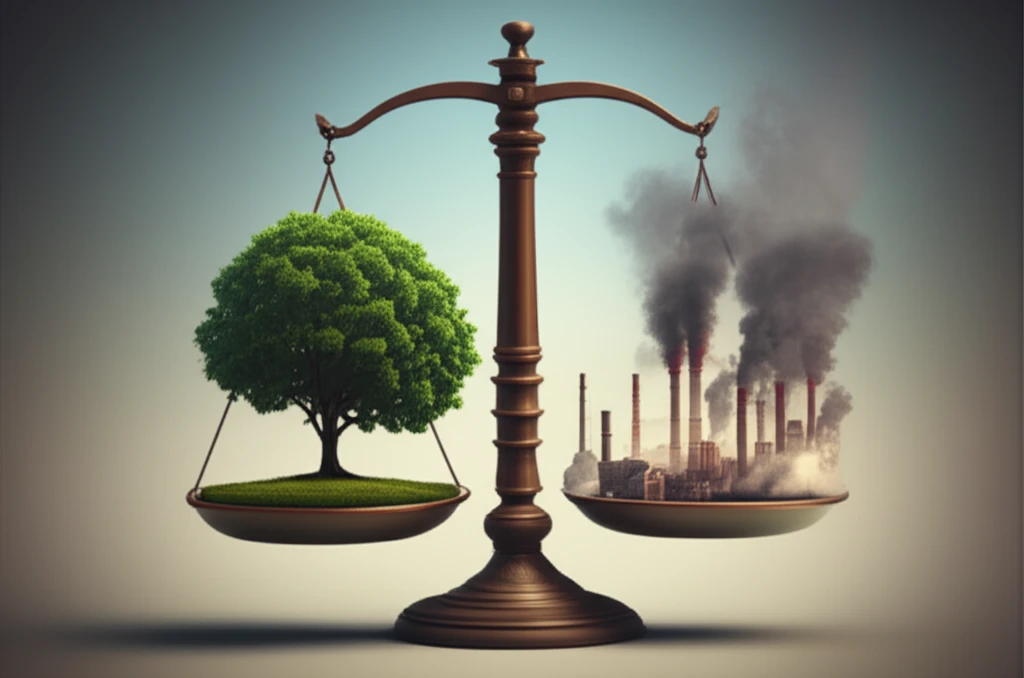
The Tricky Balance: How Environmental Regulations Impact Economic Growth

"Navigating the Non-Linear Effects for a Sustainable Future"
In our ever-evolving world, the intertwining of environmental governance and sustainable development has taken center stage on the global stage. As human activities expand and the global climate undergoes profound shifts, the critical need to address environmental challenges has become increasingly apparent. For years, there has been an ongoing debate around whether environmental regulations serve as a constraint or an incentive for production development.
Existing studies have primarily focused on the 'compliance cost theory' and the 'innovation compensation theory (Porter hypothesis),' yet a definitive consensus has remained elusive. The compliance cost theory suggests that strict environmental regulations impose substantial costs on firms, thereby limiting investment in capital, labor, and other production factors. Conversely, the Porter hypothesis posits that appropriate environmental regulations can spur technological innovation, offsetting costs and enhancing competitiveness.
However, we often miss that environmental regulations improve labor productivity. Pollution and unhealthy environment reduces labor output; Therefore, this article analyzes the effects of environmental regulations on economic outcomes.
The Environmental-Growth Nexus
Environmental regulations represent one of the most debated policy areas in modern economics, with governments worldwide grappling to balance ecological protection against economic prosperity. The relationship between regulatory stringency and economic output remains complex and context-dependent, varying significantly across industries, regions, and time periods. While some view environmental rules as necessary safeguards for long-term sustainability, others perceive them as impediments to competitiveness and growth.
Measuring Regulatory Impact
Researchers typically employ econometric analyses, panel data studies, and comparative policy assessments to examine the economic effects of environmental regulations. Common methodological approaches include analyzing relationships between environmental policy stringency indices and macroeconomic indicators such as GDP growth, productivity, and employment levels. However, these methods face inherent limitations in isolating causal relationships, as numerous confounding factors simultaneously influence economic performance.
Evolving Policy Paradigms
The study of environmental regulation's economic impact has evolved considerably since the establishment of major environmental agencies and legislation in the 1970s. Early research often assumed a zero-sum relationship between environmental protection and economic growth, but subsequent decades of analysis have challenged this simplistic view. Foundational work has progressively revealed more nuanced interactions, including the potential for environmental constraints to stimulate innovation and efficiency improvements.
Decoding the Impact: How Environmental Regulations Affect Your Wallet
To truly grasp the complexities at play, it's crucial to understand the dual nature of environmental regulations. In essence, these regulations exert two primary effects: the 'environmental regulation cost effect' and the 'labor productivity compensation effect.'
- Increased Production Costs: Meeting eco-friendly standards requires investment in new technologies and processes.
- Reduced Profits: Compliance expenses can cut into a company's earnings.
- Investment Disruption: Funds allocated to compliance might otherwise be used for expansion or innovation.
Contemporary Findings on Regulation and Growth
Recent research indicates that environmental regulations can positively influence enterprise development and resilience when combined with strong environmental, social, and governance performance. Studies published in 2023 and 2024 demonstrate that the combined effect of environmental regulations and industrial structure advancement has a significantly positive impact on green economy growth, particularly in regions with higher resource endowments and economic development. Furthermore, research suggests that appropriate environmental regulation policies can promote the utilization of ecological capital, supporting high-quality economic development when implemented through innovation-driven strategies.
Challenging the Regulatory Burden Narrative
Emerging evidence challenges the long-standing misconception that environmental regulations necessarily impede economic growth. According to OECD analysis and case studies, modern, well-designed environmental policies can catalyze innovation and create competitive advantages rather than imposing纯粹 costs. Research also indicates that market-based incentive approaches have minimal negative impact on growth compared to older command-and-control regulatory methods, suggesting that regulatory design significantly influences economic outcomes.
Cross-Country and Sectoral Perspectives
Comparative research examining multiple countries reveals that the stringency of environmental regulations correlates with changes in economic insecurity and environmental exposure at both individual and country levels. Working papers from the U.S. EPA indicate that concerns about environmental regulation's economic impacts have persisted since the agency's inception, even as environmental quality improvements occurred simultaneously. Studies also highlight the complex trade-offs between economic growth and environmental sustainability as one of the most pressing global challenges in the context of climate change.
Striking the Balance: Policy Recommendations for a Sustainable Future
Navigating the intricate relationship between environmental regulations and economic outcomes requires a nuanced approach. Policymakers must consider the non-linear effects, tailoring regulations to specific contexts and stages of development. In regions with relatively lax environmental standards, a gradual increase in regulatory intensity can stimulate economic growth by enhancing labor productivity and promoting innovation. However, in areas with already stringent regulations, further tightening may stifle economic activity due to increased compliance costs.
Integrating Diverse Perspectives
The accumulated evidence suggests that the relationship between environmental regulations and economic growth is neither purely positive nor negative, but rather contingent on policy design, implementation quality, and regional context. Experts increasingly recognize that well-crafted environmental policies can align ecological and economic objectives, though achieving this balance requires careful consideration of sectoral impacts and distributional effects. The emerging consensus emphasizes the importance of evidence-based regulatory approaches that account for both short-term adjustment costs and long-term sustainability benefits.
Emerging Research Directions
Future research is likely to focus on developing more sophisticated frameworks for evaluating the dynamic interactions between environmental regulations and economic systems. Anticipated frontiers include better understanding of how technological innovation mediates regulatory impacts, assessing distributional consequences across different populations and regions, and evaluating policy effectiveness under accelerating climate change scenarios. Methodological advances in causal inference and systems modeling will likely enhance our ability to inform evidence-based environmental-economic policy decisions.
Balancing Competing Imperatives
Environmental regulations must address multiple economic sectors simultaneously, creating complex trade-offs between immediate economic costs and long-term sustainability benefits. Research examining both OECD and non-OECD countries suggests that well-designed environmental regulations can support both economic growth and competitiveness when properly implemented. However, striking the balance between environmental protection and economic growth remains crucial in the face of accelerating global environmental challenges that demand coordinated policy responses.
Beyond Abstract Economics
Ultimately, environmental regulations affect real people through their impacts on employment opportunities, consumer prices, public health outcomes, and quality of life in communities worldwide. The human dimension of environmental-economic policy extends beyond aggregate economic indicators to encompass distributional justice concerns and varying capacities of different populations to adapt to regulatory changes. Understanding these lived experiences remains essential for designing policies that are not only economically efficient but also socially equitable and politically sustainable.