
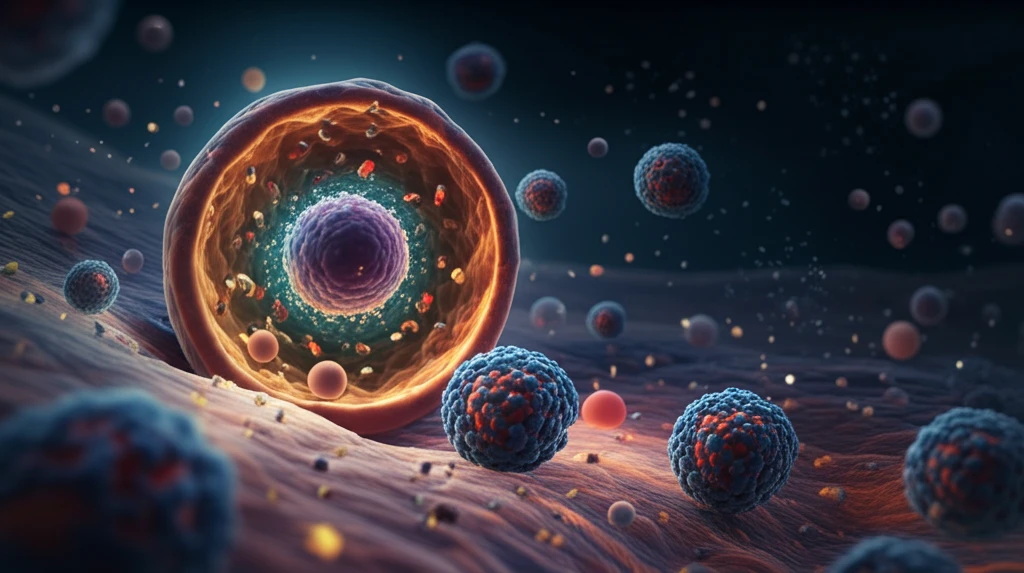
The Tiny Avengers: How Nanoparticles Are Revolutionizing Medicine from Within

"Unlocking the Secrets of Biodegradable Nanoparticles for Targeted Drug Delivery"
In the ever-evolving landscape of medical science, the development of smart drug delivery systems has captured the imagination of researchers worldwide. At the heart of this revolution lies biodegradable polymeric nanoparticles, microscopic vehicles capable of ferrying medications directly to diseased cells. This approach promises to minimize side effects and maximize therapeutic impact. Imagine tiny, biocompatible containers, loaded with life-saving drugs, navigating the intricate pathways within our bodies to precisely target tumors or repair damaged tissues.
Among the most promising materials for these nanoparticles is poly(L-lactic acid) (PLLA), a biodegradable polymer that has been extensively studied for its compatibility with biological systems. While the degradation of PLLA in various environments is well-documented, what happens when these nanoparticles enter individual cells remains a topic of intense scientific curiosity. How do they break down? What is the fate of the released drug? Answering these questions is crucial to unlocking the full potential of PLLA nanoparticles in medicine.
This article explores groundbreaking research into the intracellular degradation of PLLA nanoparticles, offering a glimpse into their fate within living cells. By tracking these particles and their components over time, scientists are gaining valuable insights that could pave the way for more effective and targeted therapies.
Nanoparticles as Emerging Drug Carriers
Biodegradable nanoparticles (NPs) are novel carriers for administering drug molecules, constructed as insoluble particles in suspension contained within a polymeric matrix. Poly(D,L-lactide-co-glycolide) (PLGA)-based nanoparticles have been extensively investigated for sustained and targeted delivery of agents including plasmid DNA, proteins, peptides, and low molecular weight compounds. Research is also underway to create biodegradable nanoparticles capable of simultaneously capturing images and administering medication to treat conditions such as peripheral arterial disease (PAD). Some formulations are engineered to include specific genetic material within the matrix, broadening their therapeutic scope.
Formulation Methods and Material Choices
Biodegradable nanoparticles are typically composed of natural or synthetic polymers and are designed to degrade in biological environments. A commonly employed fabrication technique is the double-step desolvation approach, as demonstrated in the formulation of acyclovir-loaded gelatin nanoparticles where multiple formulations are prepared and optimized. Biodegradable magnetic iron oxide nanoparticles (MNPs) have emerged as an easily synthesized, chemically stable, and magnetically controllable nanomaterial for versatile nanomedicine applications. The field is also moving toward green and sustainable synthesis of nanomaterials, representing a philosophical shift in how medicine approaches material design.
From PLGA Foundations to Immune Education
PLGA-based biodegradable nanoparticles have been extensively investigated over many years for sustained and targeted delivery of diverse therapeutic agents, forming a cornerstone of the field. Foundational laboratory protocols for preparing biodegradable nanoparticles and using them in transfection were established and formalized in reference works such as 'Gene Transfer: Delivery and Expression of DNA and RNA.' Research has demonstrated the possibility of targeting multiple genes, proteins, enzymes, or signaling molecules using biodegradable nanoparticles loaded with siRNA and drugs or combinations thereof. In a more recent milestone, Johns Hopkins Medicine scientists developed a simplified version of biodegradable nanoparticles that can 'educate' the immune system to find and destroy disease-causing cells throughout the body.
A Nanoparticle's Journey: Tracking PLLA Degradation Inside Cells
To observe the intracellular behavior of PLLA nanoparticles, scientists at the Max Planck Institute for Polymer Research designed a clever experiment. They created PLLA nanoparticles with an average diameter of approximately 120 nanometers and decorated them with magnetite nanocrystals. These nanocrystals acted as markers, allowing the researchers to track the nanoparticles' location and breakdown within mesenchymal stem cells (MSCs).
- Magnetite as a Marker: The magnetite nanocrystals served as a visual cue, revealing when the PLLA nanoparticles began to degrade and release their contents.
- Long-Term Monitoring: Observing the nanoparticles for two weeks allowed the researchers to capture both early and late stages of degradation.
- High-Resolution Insights: TEM provided ultrastructural details, revealing how the cells processed the nanoparticles.
Advances in Targeted and Sustained Delivery
PLGA-based biodegradable nanoparticles continue to be extensively investigated for sustained and targeted or localized delivery of plasmid DNA, proteins, peptides, and low molecular weight compounds. Recent work has focused on depot injectable biodegradable nanoparticles loaded with recombinant human bone morphogenetic protein-2 (BMP-2), with studies evaluating their preparation, characterization, and in vivo performance. Nanoparticle drug delivery systems are also being explored as a strategy for managing central nervous system infections, including HIV-associated neurocognitive disorder (HAND), where researchers have discussed the neurotoxicity profiles of various approved antiretroviral therapies delivered via these systems.
Clinical Failures and Size Constraints
Despite significant research efforts, more than 90% of drug candidates fail, with most failures occurring during clinical trials due to issues related to efficacy, safety, or poor pharmacokinetics. Biodegradable nanoparticles based on iron or silicon—trace elements naturally present in the human body—are under development partly because they present lower toxicity concerns compared to other materials. However, nanoparticle size remains a critical design parameter; research has identified a critical size limit of biodegradable nanoparticles that affects enhanced lymph node trafficking and vaccine delivery outcomes, suggesting that not all size ranges perform equally in vivo.
Material Performance and Toxicity Comparisons
Dextran-based biodegradable nanoparticles have been investigated as an alternative and convenient platform, though studies found that empty acetalated dextran (Ac-DEX) nanoparticles did not show improvement in neurite extension compared to a CSPG control group. When comparing in vivo toxicity in mice, researchers examined lung-delivered biodegradable nanoparticles and found that while biodegradable materials are generally considered safe for nanoparticle-based pulmonary drug delivery systems, their potential toxicity had been poorly explored prior to this work. These comparative studies underscore that safety profiles can vary significantly depending on both the base polymer used and the route of administration.
The Future of Nanomedicine: Targeted Therapies and Beyond
This research underscores the importance of TEM studies in understanding the intracellular fate of nanoparticles. By combining TEM with other techniques like flow cytometry and confocal laser scanning microscopy (CLSM), scientists can gain a comprehensive picture of how cells interact with these tiny vehicles. These insights are crucial for designing more effective and targeted drug delivery systems. As our understanding of nanoparticle behavior within cells deepens, we can anticipate a future where nanomedicine plays an increasingly vital role in treating diseases and improving human health.
Barriers and Promises of Nonviral Delivery
Expert commentary in the field highlights that biodegradable and biocompatible polymers have raised great interest in biomedical fields due to their potential as gene carriers. However, significant barriers to successful in vivo delivery of nucleic acids using nonviral vectors remain, as illustrated in reviews of biodegradable nanoparticle gene carriers. Despite these challenges, researchers have described biodegradable nanoparticles as excellent vehicles for site-directed in vivo delivery of drugs and vaccines, suggesting the fundamental approach holds promise even as specific delivery hurdles persist.
Self-Assembling Systems and Historical Trajectory
Emerging research describes biodegradable nanoparticles that assemble when they come in contact with water, creating new structures inside the body that become attracted to infected cells, with the aim of giving antibiotics a turbo-charged effect. The broader field traces its origins to the discovery of nanoparticles in the seventies, after which the development of biodegradable materials and nanoparticle surface functionalization enabled new treatment strategies. Opinion papers in the field now identify future challenges in the nanoparticle space, signaling that the technology, while mature in some respects, still has significant frontiers to explore.
Wider Impact on Disease Understanding and Treatment
Advances in nanoscale technologies are beginning to have broader impacts on the understanding, treatment, and prevention of disease, extending well beyond simple drug encapsulation. Biodegradable polymeric nanoparticle drug delivery systems encompass a range of base materials including PLGA, PLA, chitosan, gelatin, polycaprolactone, and poly-alkyl-cyanoacrylates, each with distinct properties that influence performance. The impact of nanoencapsulation of various disease-related drugs on these different biodegradable nanoparticle platforms remains an active area of investigation, as researchers work to match materials to specific therapeutic challenges.
Tracking Degradation and Fabrication in Practice
A new fluorescent-based tool has been developed to directly measure nanoparticle degradation in real time within biological environments, representing a significant methodological advance. The Children's Hospital of Philadelphia (CHOP) team has long investigated biodegradable nanoparticles for medical applications, contributing sustained expertise to the field. In practical fabrication, biodegradable nanoparticles typically fall in the 10–500 nm size range, and widely used fabrication methods include emulsification, solvent evaporation, coprecipitation, desolvation, coacervation, electrospray, and electrospinning.