
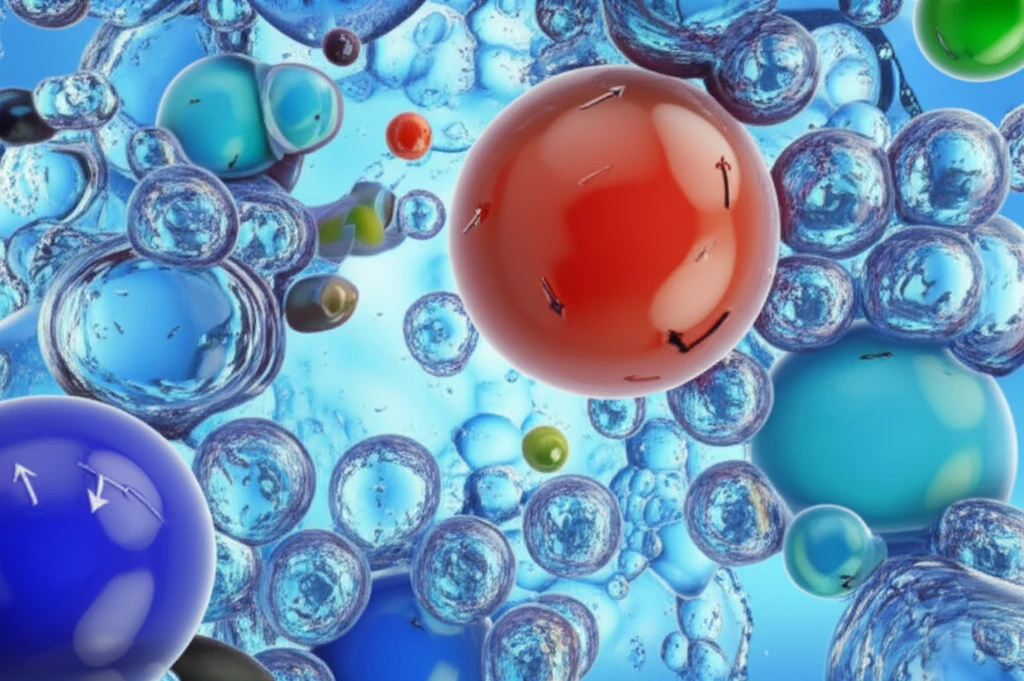
Surreal illustration of water molecules and ions in motion, depicting the slowdown effect.

The Secret Life of Water: How Ions Slow Down Molecular Movement

"Unraveling the mysteries of water dynamics in concentrated ionic solutions and its implications for energy and biology."


Water, seemingly simple, plays a crucial role in countless chemical and biological processes. From facilitating reactions to influencing protein structures, its dynamics are fundamental to life and technology. However, the behavior of water changes dramatically when it interacts with ions, especially in concentrated solutions.

One particularly puzzling phenomenon is that in high concentrations, all electrolytes—regardless of their individual properties—cause water molecules to rotate slower. This effect has significant implications for various applications, including aqueous rechargeable ion batteries, which are emerging as greener alternatives to traditional batteries.

Recent research has shed light on this mystery, challenging long-held assumptions about how ions interact with water. By combining theoretical simulations with advanced modeling, scientists are uncovering the molecular mechanisms behind this slowdown, revealing a story far more complex than previously imagined.

The Puzzle of Slowing Water: Beyond Simple Explanations

Surreal illustration of water molecules and ions in motion, depicting the slowdown effect.

For years, scientists believed that the retardation of water rotation in ionic solutions was due to changes in the hydrogen-bond switching behavior of water molecules directly adjacent to ions. The idea was that ions, depending on their 'structure-making' or 'structure-breaking' nature, would alter the way water molecules exchanged hydrogen bonds, leading to a general slowdown.

However, this explanation couldn't account for the fact that all electrolytes slow down water rotation at high concentrations, regardless of their individual effects on hydrogen bonding. It suggested that something else was at play, a more universal mechanism that transcended the specific properties of individual ions.

  • Traditional View: Slowdown caused by altered hydrogen-bond switching near ions.
  • The Anomaly: All electrolytes slow water rotation at high concentrations, regardless of their 'structure-making' or 'structure-breaking' nature.
  • New Research: Focuses on collective water dynamics and ion cluster formation.
New research reveals that the general deceleration is largely due to the coupling of the slow, collective component of water rotation with the motion of large hydrated ion clusters that ubiquitously exist in concentrated ionic solutions. Collective water rotation is then retarded due to its coupling with the slow dynamics of ion clusters.

A New Picture of Water and Ions: Implications and Future Directions

The finding that ion clusters play a significant role in slowing down water rotation offers a new perspective on the behavior of water in concentrated ionic solutions. It suggests that the collective dynamics of water, rather than just the local interactions between water and individual ions, are crucial in determining its properties.

This understanding has far-reaching implications. For example, it could help in the design of more efficient aqueous rechargeable ion batteries by optimizing the electrolyte composition to minimize the formation of large ion clusters and maximize water mobility. It could also provide insights into protein folding, enzyme catalysis, and other biological processes where water dynamics play a crucial role.

Further research is needed to fully unravel the complexities of water-ion interactions. By combining advanced simulation techniques with experimental studies, scientists can continue to refine our understanding of this fundamental phenomenon and unlock its potential for technological innovation.

About this Article -

This article was crafted using a human-AI hybrid and collaborative approach. AI assisted our team with initial drafting, research insights, identifying key questions, and image generation. Our human editors guided topic selection, defined the angle, structured the content, ensured factual accuracy and relevance, refined the tone, and conducted thorough editing to deliver helpful, high-quality information.See our About page for more information.

This article is based on research published under:

DOI-LINK: 10.1073/pnas.1707453114, Alternate LINK

Title: Molecular Mechanism Of Water Reorientational Slowing Down In Concentrated Ionic Solutions

Subject: Multidisciplinary

Journal: Proceedings of the National Academy of Sciences

Publisher: Proceedings of the National Academy of Sciences

Authors: Qiang Zhang, Tianmin Wu, Chen Chen, Shaul Mukamel, Wei Zhuang

Published: 2017-09-05

Everything You Need To Know

1

Why does water's molecular movement slow down in concentrated ionic solutions?

In concentrated ionic solutions, the rotation of water molecules slows down regardless of the specific electrolyte used. This universal slowdown occurs because the slow, collective component of water rotation is coupled with the motion of large hydrated ion clusters. These ion clusters exist in high concentrations and impede the collective water rotation, leading to the observed deceleration.

2

What was the traditional explanation for why water rotation slows down in ionic solutions, and what were its shortcomings?

Scientists previously believed that the slowdown of water rotation was due to the changes in hydrogen-bond switching behavior of water molecules directly adjacent to ions. The idea was that ions would alter the way water molecules exchanged hydrogen bonds. However, this explanation failed to explain why all electrolytes slow down water rotation at high concentrations, regardless of their structure-making or structure-breaking nature.

3

What are the implications of understanding the role of ion clusters in slowing down water rotation?

The discovery that ion clusters significantly contribute to slowing down water rotation implies that the collective dynamics of water are crucial in determining water properties in concentrated ionic solutions. Rather than just looking at local interactions between water and individual ions, it's essential to consider how water molecules move together and how these collective movements are affected by the presence and dynamics of ion clusters. This understanding changes how we view water behavior in systems like aqueous batteries and biological environments.

4

How does the behavior of water in concentrated ionic solutions affect the performance of aqueous rechargeable ion batteries?

Aqueous rechargeable ion batteries, which are seen as greener alternatives, are affected by the way ions influence water's molecular movements. The slowdown of water rotation in concentrated ionic solutions can impact the efficiency and performance of these batteries. By understanding the underlying mechanisms of how ions and ion clusters affect water dynamics, researchers can optimize battery design and improve their overall performance.

5

What are some potential areas for future research to further understand water dynamics in ionic solutions?

Future research should explore the precise dynamics of ion cluster formation and their interaction with the collective water network in different ionic solutions. Understanding how the size, charge, and concentration of ions influence cluster formation and dynamics will be crucial. Advanced simulation techniques and experimental methods can provide more detailed insights into these complex interactions, which can further refine our understanding of water behavior in various applications.

Newsletter Subscribe

Subscribe to get the latest articles and insights directly in your inbox.