
The Salty Solution: How Advanced Carbon Tech is Making Desalination Cheaper and More Efficient

"New research unveils a groundbreaking three-dimensional N-doped porous carbon material that promises to revolutionize capacitive deionization (CDI) and energy storage, paving the way for accessible clean water and sustainable energy solutions."
In an era defined by pressing environmental challenges, the quest for sustainable solutions has never been more critical. Two of the most significant hurdles we face are the increasing scarcity of clean water and the urgent need for efficient energy storage. Fortunately, groundbreaking research is emerging that offers promising pathways to address these challenges head-on.
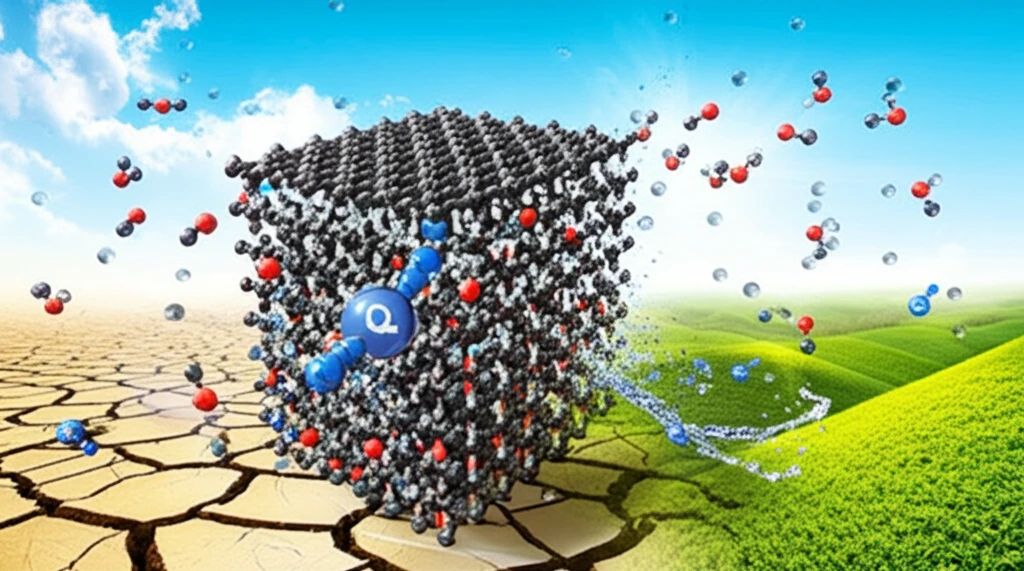
At the forefront of this innovation is the development of advanced carbon materials, particularly a novel substance known as three-dimensional N-doped porous carbon (3D-NPC). This material is proving to be a game-changer in capacitive deionization (CDI), a technique used for water desalination, and also holds immense potential for enhancing the performance of energy storage devices like zinc-air batteries.
This article explores the fascinating world of 3D-NPCs, delving into their unique properties, the science behind their effectiveness, and the far-reaching implications they hold for a more sustainable and resource-efficient future. Prepare to discover how cutting-edge carbon technology is poised to revolutionize water treatment and energy storage, bringing us closer to a world where clean water is accessible to all and renewable energy is readily available.
CDI's Promise and Performance Challenges
Capacitive deionization (CDI) has emerged as an energy-efficient and environmentally friendly technology for water desalination. Traditional CDI materials usually exhibit low salt adsorption capacities due to limitations in optimizing their specific surface area and chemical composition. Researchers have recently introduced the curvature parameter as a new variable for designing high-performance CDI electrodes. Membrane capacitive deionization (MCDI) improves charge efficiency and reduces co-ion reabsorption during regeneration, while enhancing CDI performance requires expanding the inner structure of porous activated carbon to facilitate charge storage and electrolyte penetration.
The Mechanics and Limits of Capacitive Deionization
Capacitive deionization works by pumping water into a cell containing two porous carbon electrodes with a potential difference applied, drawing ions from the water and storing them in the electrical double layers. However, CDI and membrane capacitive deionization face potential limits, particularly when considered for water electrolysis applications. Flow-electrode capacitive deionization (FCDI) is a promising approach to scale up the technology because it allows electrode regeneration outside the main cell, enabling removal of higher salt amounts from feed water using carbon slurries as flowable electrodes. Pore-scale modeling using methods like the Lattice Boltzmann approach helps researchers understand the capacitive charging and desalination processes within porous electrodes.
From Concept to Cycling: CDI's Evolution
Capacitive deionization is a technology to deionize water by applying an electrical potential difference over two electrodes, which are often made of porous carbon. The technology has received considerable attention as a promising water treatment and desalination approach, with multiple review articles documenting its history, mechanism, advantages, and challenges. CDI works by pumping water into a cell containing two carbon electrodes, and researchers have demonstrated that capacitive deionization cycling can decrease the relative amount of sodium ions in irrigation water, benefiting crop health and production. The technology has evolved from basic electrode configurations to increasingly sophisticated systems designed to improve salt removal efficiency.
The Rise of 3D-NPCs: A New Frontier in Material Science
Three-dimensional N-doped porous carbon (3D-NPC) is not just another carbon material; it's a meticulously engineered structure designed to maximize its performance in specific applications. The key to its effectiveness lies in its unique architecture and composition. The 'three-dimensional' aspect refers to its interconnected network of carbon, creating a highly porous structure. This porosity is crucial because it provides a large surface area, which is essential for both capacitive deionization and energy storage.
- High Surface Area: The porous structure provides an extensive surface area for ion adsorption.
- Enhanced Conductivity: Nitrogen doping boosts the material's ability to conduct electricity.
- Tunable Properties: The material's characteristics can be adjusted to optimize performance for specific applications.
- Sustainable Material: Derived from monosodium glutamate, a renewable resource, making it environmentally friendly.
Recent Advances in CDI Applications
Capacitive deionization has recently attracted researcher attention due to its simplicity, low price, and low energy consumption compared to traditional desalination methods. The main challenge of CDI is high energy consumption when treating high water concentrations, which limits its applicability for seawater desalination without pre-treatment or hybrid approaches. Recent reviews have critically examined CDI's progress in water treatment, focusing on representative research results and the technology's ability to meet technical requirements across various application fields. Flow-electrode capacitive deionization represents a significant area of recent research, offering new perspectives for scaling up the technology beyond laboratory demonstrations.
Challenges and Skepticism in CDI Development
Despite its promise, capacitive deionization faces significant challenges that have led some observers to question its commercial viability. The technology's service life and long-term durability remain concerns, with electrode degradation over repeated charge-discharge cycles potentially limiting practical deployment. However, proponents argue that CDI represents a subtle but powerful approach to water treatment, taking advantage of electrical power in a more efficient manner than conventional desalination technologies. The path from laboratory demonstrations to industrial-scale implementation continues to present engineering and economic hurdles that must be overcome.
CDI vs. Traditional Desalination Technologies
Capacitive deionization is considered an alternative desalination technology due to its easy operation, high energy efficiency, and environmentally friendly process, though it faces competition from established methods like reverse osmosis. Membrane capacitive deionization (MCDI) has been investigated as an alternative to standard CDI, with the potential to lower required voltage and improve electrode renewal capabilities. The energy consumption comparison between MCDI and reverse osmosis remains an active area of research, with each technology having distinct advantages depending on application requirements. CDI's competitiveness will ultimately depend on continued improvements in electrode materials and system design to match or exceed the performance of mature desalination technologies.
The Future is Clear: Sustainable Solutions for a Thirsty World
The development and application of 3D-NPCs in capacitive deionization and energy storage represent a significant step towards a more sustainable and resource-efficient future. As we continue to refine and scale up these technologies, we can envision a world where clean water is readily available to communities around the globe and renewable energy sources are harnessed more effectively. By embracing innovative materials and techniques, we can pave the way for a brighter, more sustainable tomorrow.
Modeling and Understanding CDI Performance
Researchers have developed analytical models for capacitive deionization that can predict salt concentration changes during the desalination process. These analytical models have been validated against comprehensive computational models, such as those using COMSOL software, showing good agreement in predicting system behavior. The ability to model CDI performance across different length scales provides valuable insights for optimizing electrode design and system operation. Such modeling approaches help bridge the gap between fundamental research and practical implementation by offering predictive tools for system designers.
The Path Forward for CDI Technology
Capacitive deionization, as an emerging desalination technology, has received considerable attention in recent years due to advances in porous carbon development, new cell designs, and unique operational modes that provide higher performance for capacitance-based salt removal. CDI is particularly promising for supplying water to populations because it operates at low potential along with low energy expenditure when desalinating low salinity feed water solutions around 5 mM NaCl. Progress in electrode materials, including biomass-derived carbons and novel nanostructures, continues to expand the technology's capabilities. The combination of these material advances with innovative system designs suggests CDI will play an increasingly important role in addressing global water scarcity challenges.
CDI in the Water-Energy-Resource Nexus
Capacitive deionization is a promising water purification technology that works by removing salt ions or charged species from aqueous solutions, with biomass-based carbon electrode materials offering sustainable alternatives to traditional electrode production. Flow electrode capacitive deionization systems have been designed to simultaneously obtain freshwater resources and metallic elements, adding an ion enrichment module to conventional systems to collect metal elements while seawater is dealinated. This dual-purpose approach addresses both water scarcity and resource recovery challenges, positioning CDI within the broader circular economy framework. The development of industrial prototype systems demonstrates progress toward practical implementation of these resource recovery capabilities.
Practical Considerations for CDI Deployment
Capacitive deionization is an emerging technology for energy-efficient removal of dissolved ions from aqueous solutions, with researchers now expanding its application to non-aqueous media like organic solutions. Temperature and desorption mode significantly impact CDI performance, with studies showing that water temperatures from 15°C to 45°C and different salt concentrations affect system efficiency. The choice between potential removal, short circuit, and polarity reversal desorption modes influences both energy consumption and salt removal rates. These practical operational parameters demonstrate that successful CDI implementation requires careful optimization based on specific water conditions and treatment goals.