
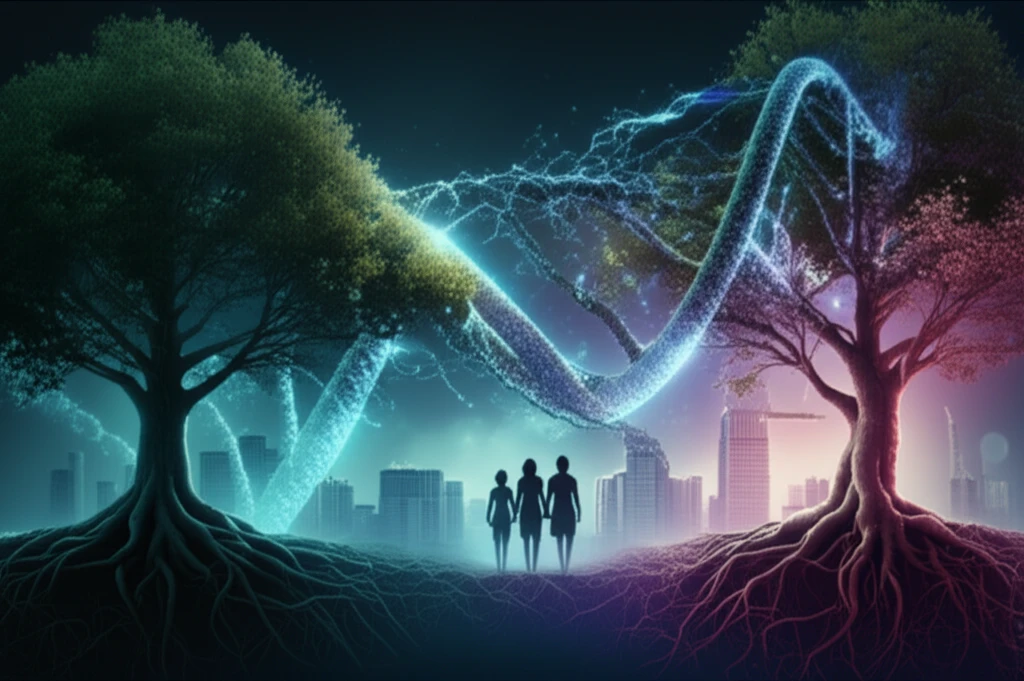
DNA strands intertwined with natural and urban elements, representing genetic and environmental influences on health.

The PARK2 Paradox: When Genetic Mutations Don't Tell the Whole Story

"Exploring the complexities of Parkinson's disease through a family's surprising genetic inheritance."


The intricate world of genetics often promises clear-cut explanations for inherited diseases. However, the reality is rarely so simple, especially when it comes to complex conditions like Parkinson's disease (PD). Recent research highlights the limitations of relying solely on genetic mutations to predict disease onset and severity, painting a more nuanced picture of how genes interact with individual factors.

Parkinson's disease, particularly its early-onset form (EOPD), has long been associated with mutations in the PARK2 gene. This gene encodes Parkin, a protein crucial for clearing damaged proteins from cells. Biallelic mutations—meaning both copies of the gene are affected—are typically considered a primary cause of EOPD. Yet, the story doesn't end there.

A fascinating case study from an Italian family, published in "Movement Disorders Clinical Practice", throws a curveball into our understanding of PARK2 mutations. The study reveals a 41-year-old man with EOPD who carries a single, heterozygous duplication of exons 2 and 3 in the PARK2 gene. Even more surprising, his 71-year-old aunt, who is homozygous for the same duplication (meaning she has four copies of these exons), is nearly asymptomatic. This discrepancy challenges the assumption that PARK2 mutations invariably lead to Parkinson's disease.

Decoding the Genetic Anomaly: What Does This Mean for Parkinson's?

DNA strands intertwined with natural and urban elements, representing genetic and environmental influences on health.

The proband's case presents a classic scenario of early-onset Parkinson's. Starting at age 36, he experienced slowness and rigidity in his left upper limb, which gradually progressed. A dopamine transporter (DAT) scan confirmed reduced dopaminergic activity in the brain, and he responded well to dopaminergic medications. Psychiatric assessments also revealed depression and mystic delusions, requiring treatment with atypical antipsychotics.

Genetic testing revealed the heterozygous duplication of exons 2 and 3 in the PARK2 gene. While single heterozygous mutations are sometimes seen in PD patients, they are often considered minor susceptibility factors. The puzzle deepened when segregation analysis showed that neither the patient's mother nor brother carried the same duplication. This suggested that the duplication occurred "in cis," meaning it was present on the same allele.

  • Exon Duplication: A duplication of exons 2 and 3 of the PARK2 gene.
  • Heterozygous vs. Homozygous: The proband had one copy of the duplication (heterozygous), while his aunt had two copies (homozygous).
  • Clinical Presentation: The proband exhibited early-onset Parkinson's, while his aunt was nearly asymptomatic.
  • Dopamine Transporter Scan: Both the proband and his aunt showed reduced dopaminergic uptake, but to differing degrees.
The truly remarkable part of the study emerges with the examination of the patient's paternal aunt. At 71 years old, she was found to be homozygous for the exon 2 and 3 duplication, possessing four copies of these exons. Despite this significant genetic alteration, she displayed only a postural-action tremor and right-hand dystonic posturing, which started in her 40s. Neurological examination and DAT scan data indicated only a mild decrease in dopamine uptake, contrasting sharply with her nephew's condition. This begs the question: How can someone with a double dose of the supposed disease-causing mutation remain largely unaffected?

The Future of Parkinson's Research: Beyond the Gene

This Italian family's case underscores the complex interplay between genes and individual resilience. It suggests that additional genetic, epigenetic, and environmental factors can significantly modulate the penetrance and expressivity of PARK2 mutations. Future research should focus on identifying these modifying factors to better understand the full spectrum of Parkinson's disease. By moving beyond a gene-centric view, we can hope to develop more personalized and effective treatments for this debilitating condition.

About this Article -

This article was crafted using a human-AI hybrid and collaborative approach. AI assisted our team with initial drafting, research insights, identifying key questions, and image generation. Our human editors guided topic selection, defined the angle, structured the content, ensured factual accuracy and relevance, refined the tone, and conducted thorough editing to deliver helpful, high-quality information.See our About page for more information.

Everything You Need To Know

1

What is the role of the PARK2 gene and its corresponding protein, Parkin, in the context of Parkinson's disease?

The PARK2 gene provides instructions for making the Parkin protein. Parkin's crucial function is to clear damaged proteins from cells. When the PARK2 gene mutates, the Parkin protein may not function correctly, leading to the accumulation of damaged proteins. This accumulation can damage the cells and is strongly associated with Early-Onset Parkinson's Disease (EOPD). Specifically, biallelic mutations in PARK2 (affecting both copies of the gene) are commonly linked to EOPD.

2

How did the study of the Italian family challenge the conventional understanding of PARK2 gene mutations and Parkinson's disease?

The study revealed a discrepancy between the genetic makeup and the disease manifestation. A 41-year-old man with EOPD had a heterozygous duplication of exons 2 and 3 in the PARK2 gene. His 71-year-old aunt, who was homozygous for the same duplication (four copies of the affected exons), was nearly asymptomatic. This unexpected finding challenges the assumption that PARK2 mutations always lead to Parkinson's and highlights the role of other factors influencing disease onset and severity.

3

What is the difference between heterozygous and homozygous mutations, and how did this distinction impact the study's findings?

In genetics, heterozygous means having two different versions of a gene (one normal and one mutated), while homozygous means having two identical copies of the same gene (both mutated). In the study, the proband (the man with EOPD) was heterozygous for the PARK2 duplication, meaning he had one copy of the duplication. His aunt was homozygous, having two copies of the duplication. Despite having twice the amount of the genetic alteration, the aunt showed minimal symptoms compared to her nephew. This difference underscores the complex relationship between genes and disease expression, demonstrating that the number of gene copies does not always correlate directly with the severity or presence of the disease.

4

Beyond the PARK2 gene, what other factors might influence the development and severity of Parkinson's disease?

The case study suggests that other genetic, epigenetic, and environmental factors significantly influence the expression of PARK2 mutations. Epigenetic factors involve changes in gene expression without altering the DNA sequence itself. The study implies that these modifying factors influence the disease's penetrance (the likelihood of the gene causing the disease) and expressivity (the degree of the disease). These factors explain why individuals with the same genetic mutations can experience different disease severities or not experience the disease at all.

5

What were the specific clinical presentations and diagnostic findings in the affected individuals?

The proband, a 41-year-old man, exhibited early-onset Parkinson's disease (EOPD) starting at age 36. His symptoms included slowness and rigidity in his left upper limb. A dopamine transporter (DAT) scan confirmed reduced dopaminergic activity in the brain. He also experienced depression and mystic delusions, which were treated with medication. In contrast, the 71-year-old aunt, who was homozygous for the same genetic duplication, displayed only a postural-action tremor and right-hand dystonic posturing, which began in her 40s. Her neurological examination and DAT scan data indicated a mild decrease in dopamine uptake, contrasting sharply with her nephew's more severe condition.

Newsletter Subscribe

Subscribe to get the latest articles and insights directly in your inbox.