
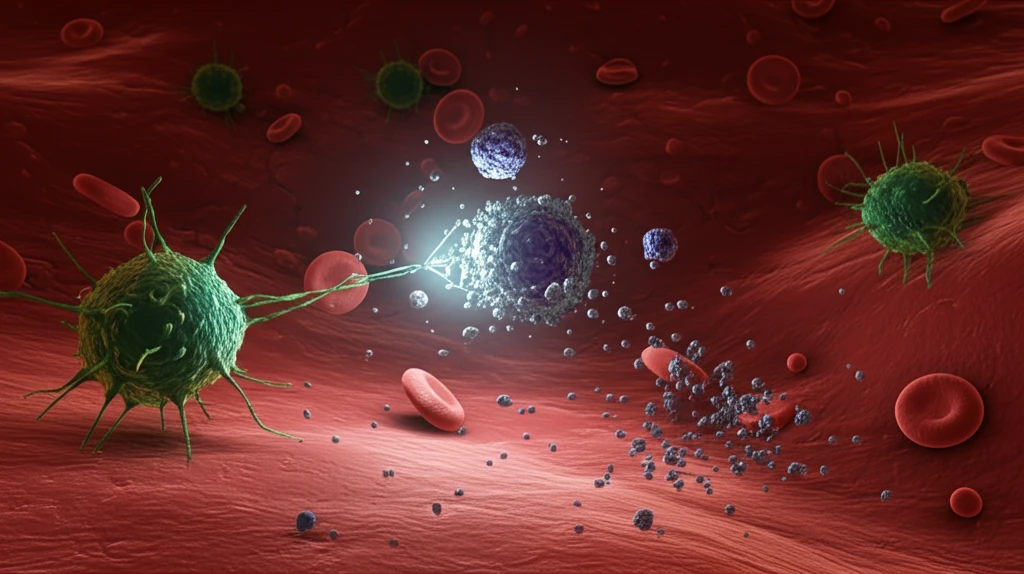
The Future of Autoimmune Treatment: How Killer Artificial Antigen Presenting Cells (KaAPC) Could Revolutionize Therapy

"Discover how KaAPC offers a precise, efficient way to deplete harmful T cells in autoimmune diseases, offering a potential alternative to broad immunosuppression."
Current treatments for autoimmune diseases often rely on broad immunosuppression, which, while managing symptoms, can lead to significant side effects such as increased susceptibility to infections and malignancies. This underscores the urgent need for more targeted therapies that can precisely address the root causes of these conditions without compromising the entire immune system.
In recent years, cell-based immunotherapy strategies have emerged as promising alternatives. These approaches often involve using antigen-presenting cells (APCs) to modulate the immune response. However, traditional methods can be technically challenging and may not always be effective due to their sensitivity to cytotoxic T cell responses.
Killer Artificial Antigen Presenting Cells (KaAPC) offer a novel solution by enabling the targeted depletion of pathologic T cells while preserving the broader immune system's functionality. This innovative approach holds considerable promise for treating autoimmune diseases and preventing allograft rejections by specifically regulating undesirable T cell responses. This article delves into the mechanics, benefits, and potential future applications of KaAPC technology.
The Burden of Autoimmune Disease
Approximately 5% of the Western population suffers from autoimmune diseases, placing substantial demand on long-term treatment strategies aimed at preventing organ damage and reducing disease-related mortality. Current therapies rely predominantly on global immunosuppression, which over extended periods carries significant adverse side effects and leaves patients vulnerable to infections and other complications. Killer Artificial Antigen Presenting Cells (KaAPC) represent an emerging approach designed to deplete specifically pathologic T cells while leaving the broader immune system intact and functional, offering a potentially transformative alternative to conventional immunosuppressive regimens.
Conventional Treatment Paradigms
The standard of care for most T cell-mediated autoimmune diseases has long centered on broad immunosuppressive agents, including corticosteroids, methotrexate, and biologics that dampen overall immune activity. While these therapies can manage symptoms and slow disease progression, they do not selectively target the rogue T cells driving pathology and therefore carry risks of infection, malignancy, and organ toxicity with prolonged use. More targeted cellular immunotherapies have been explored, but their clinical translation has been hampered by complexity, cost, and challenges in consistent manufacturing. These limitations have driven interest in non-cellular, synthetic alternatives capable of precise immune modulation.
From Cellular to Synthetic Immune Therapies
The concept of antigen-presenting cells as central orchestrators of immune responses dates back to the mid-20th century, with dendritic cells identified as the most potent initiators of T cell immunity. Early immunotherapy efforts sought to harness patient-derived dendritic cells ex vivo to prime or delete specific T cell populations, but scalability and consistency proved problematic. The development of artificial antigen-presenting cells (aAPCs) marked a significant milestone, demonstrating that key signals required for T cell activation could be delivered by engineered micro- or nanoparticles. Building on this foundation, researchers introduced the killer variant—KaAPCs—designed not merely to activate but to selectively eliminate autoreactive T cells through apoptosis-inducing molecules.
What are Killer Artificial Antigen Presenting Cells (KaAPC)?
Killer Artificial Antigen Presenting Cells (KaAPC) are synthetically engineered constructs designed to mimic the function of natural antigen-presenting cells, but with enhanced precision and control. Unlike traditional cell-based therapies, KaAPC are non-cellular, bead-based systems that can be easily manufactured and standardized. They consist of a HLA-A2-Ig dimer (signal 1) and an anti-Fas mAb (apoptosis-inducing signal) covalently immobilized onto a surface of a 4.5 µm paramagnetic latex bead.
- Precision Targeting: KaAPC selectively target and eliminate disease-causing T cells.
- Preservation of Immune Function: The broader immune system remains untouched, maintaining its ability to fight infections.
- Ease of Production: As a non-cellular system, KaAPC can be easily manufactured and standardized.
- Dual-Action Mechanism: KaAPC presents antigens to T cells while delivering an apoptosis signal.
Advances in aAPC Engineering
Recent reviews have highlighted the rapid evolution of artificial antigen-presenting cell design, with platforms now incorporating sophisticated combinations of co-stimulatory molecules, cytokines, and targeting ligands on micro- and nanoparticle scaffolds. Researchers continue to refine the immunological signals delivered by these devices, drawing directly from the natural interactions between dendritic cells and T lymphocytes to optimize activation, expansion, or deletion outcomes. Despite this progress, translating bench-top successes into clinically viable products remains a significant hurdle, requiring standardization, scalability, and rigorous safety evaluation across diverse autoimmune indications.
Challenges and Limitations of KaAPC Approaches
While bead-based KaAPCs have demonstrated successful in vitro elimination of targeted antigen-specific cytotoxic T cells, significant questions remain regarding their translational potential. A key criticism is that natural antigen-presenting cells offer a richness of signaling—through multiple ligands, cytokines, and cell-cell contact—that synthetic platforms struggle to replicate fully. High treatment costs and the complexity of manufacturing consistent, clinical-grade KaAPCs present practical barriers to widespread adoption. Additionally, concerns persist about potential off-target effects and the difficulty of validating antigen specificity in the heterogeneous immune landscapes characteristic of autoimmune patients.
aAPCs vs. Natural Dendritic Cells
Artificial antigen-presenting cells have emerged as a compelling alternative to dendritic cell-based therapies, primarily because they offer reproducibility and scalability that biological cells cannot easily match. Recent design reviews emphasize that key principles—such as presenting MHC-peptide complexes alongside co-stimulatory signals—have been directly inspired by the natural immunology of dendritic cell-T cell interactions. However, natural APCs provide a dynamic and context-dependent array of signals that remain difficult to fully capture in synthetic systems. The choice between aAPC platforms and cellular approaches therefore depends on the clinical context, with each offering distinct advantages in terms of precision, cost, and manufacturing feasibility.
The Future of KaAPC Therapy
KaAPC represent a significant advancement in the field of immunotherapy, offering a targeted and efficient way to modulate T cell responses in autoimmune diseases and other conditions. While the current research is primarily focused on in vitro applications, the potential for in vivo use is substantial. Future studies may explore the use of biocompatible or biodegradable matrices to enhance KaAPC's applicability in clinical settings. By continuing to refine and expand this technology, researchers hope to develop new and more effective treatments for a wide range of immune-related disorders.
Expert Perspectives on KaAPC Potential
The promise of KaAPC technology lies in its capacity to address a fundamental unmet need: the selective elimination of disease-driving T cells without the collateral immune suppression inherent in current therapies. Experts in the field generally acknowledge that while the mechanistic rationale is sound and early in vitro results are encouraging, the path to clinical utility demands rigorous validation in animal models and, ultimately, controlled human trials. The technology sits at an intriguing intersection of immunology, materials science, and bioengineering, requiring interdisciplinary collaboration to overcome remaining design and manufacturing challenges. As the field matures, a balanced perspective—one that recognizes both the revolutionary potential and the substantial hurdles ahead—will be essential.
The Road Ahead for KaAPC Therapy
Looking forward, KaAPC technology could fundamentally reshape the treatment landscape for T cell-mediated autoimmune diseases by offering an antigen-specific intervention that preserves general immune competence. The approach is envisioned as a potential alternative to cellular immunotherapy, eliminating the need for complex ex vivo cell manipulation while providing a consistent, off-the-shelf therapeutic modality. Key next steps include optimizing particle design for in vivo efficacy, establishing safety profiles in preclinical models, and defining clinical indications where the risk-benefit profile most strongly favors this approach. If these milestones are achieved, KaAPCs could transition from a promising laboratory concept to a practical clinical tool.
Systemic Barriers to Translation
Beyond the scientific and technical challenges, the broader adoption of KaAPC therapies faces significant systemic hurdles, including regulatory pathway clarity, reimbursement frameworks, and equitable access. Autoimmune diseases disproportionately affect populations with limited healthcare resources in many regions, raising questions about the affordability and scalability of advanced bioengineered treatments. Manufacturing consistency and quality control at scale will also need to meet the stringent standards required for biologic therapies. Addressing these systemic challenges will be as critical as refining the science itself in determining whether KaAPCs fulfill their promise in real-world clinical settings.
Implications for Patients and Clinicians
For the millions living with autoimmune diseases, KaAPC technology represents a hopeful shift away from lifelong immunosuppression toward a more targeted, disease-modifying approach. The ability to selectively deplete autoreactive T cells without compromising the broader immune system could dramatically improve quality of life by reducing infection risk and treatment-related side effects. Clinicians, in turn, would gain a new tool that moves beyond symptom management toward addressing the immunological root cause of disease. While widespread clinical availability remains on the horizon, the patient-centered rationale driving this research underscores its potential to deliver meaningful, real-world impact.