
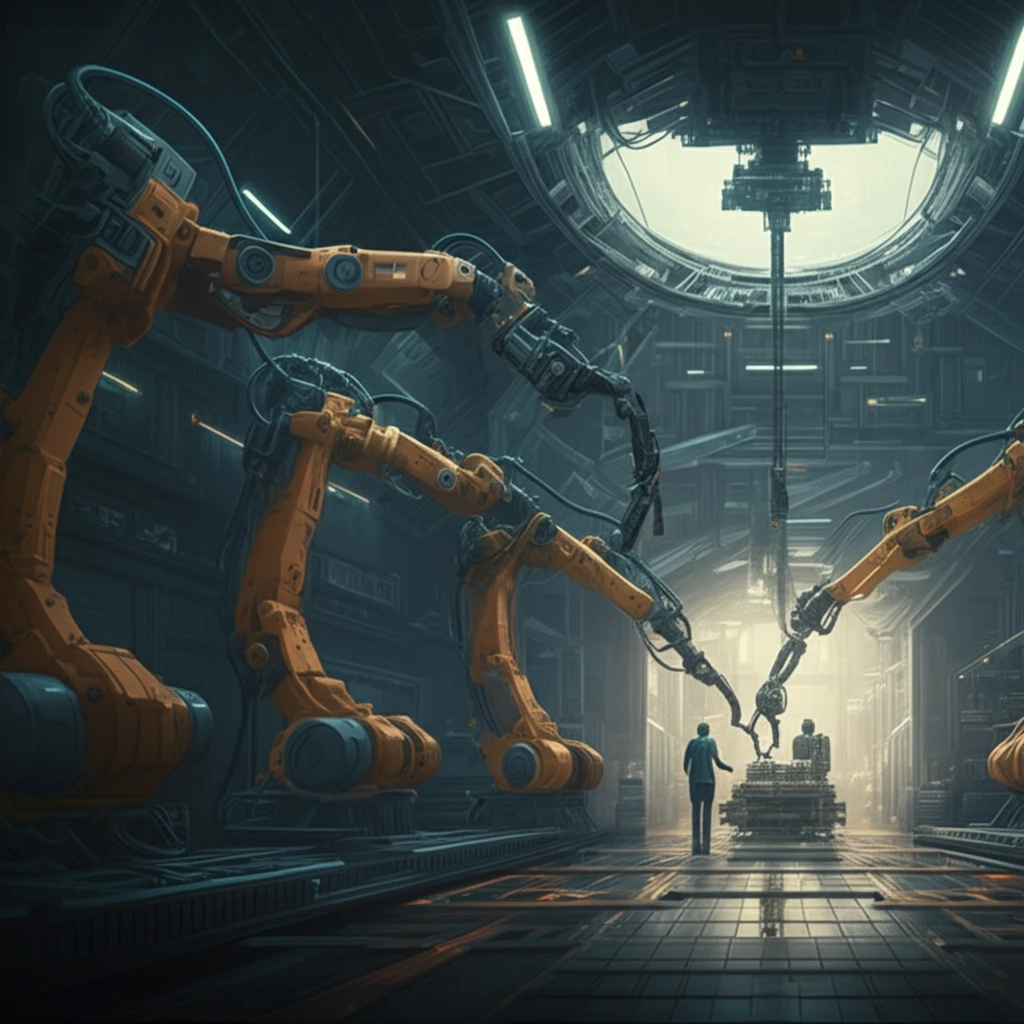
The Flow Shop Fix: How Optimizing Assembly Lines Can Save Your Business

"Tired of production bottlenecks? Discover how flow shop scheduling with assembly operations can revolutionize your efficiency and boost your bottom line with the latest trends."
In today's fast-paced business environment, efficiency is the name of the game. Every company, from small startups to large corporations, is constantly seeking ways to optimize their processes and gain a competitive edge. One area where significant improvements can often be made is in production, specifically in assembly line operations. The concept of flow shop scheduling with assembly operations has emerged as a powerful approach to tackling production bottlenecks and maximizing output.
Flow shop scheduling involves arranging production processes in a linear sequence, where each job follows the same path from start to finish. When assembly operations are integrated into this model, it creates a dynamic system where components are manufactured and then assembled into final products. This approach is particularly useful for businesses that deal with complex products requiring multiple stages of assembly.
The benefits of mastering flow shop scheduling with assembly operations are substantial. By implementing efficient scheduling strategies, companies can reduce production times, minimize work-in-progress inventory, and improve on-time delivery performance. This not only leads to increased customer satisfaction but also translates into significant cost savings and revenue growth. Ready to transform your production line? Let's dive into the world of flow shop scheduling and explore how it can revolutionize your business.
Current Statistics & Impact
Flow shop optimization has become increasingly relevant for manufacturers seeking to improve efficiency in their production processes. While adoption rates vary significantly by industry, many businesses report substantial potential for cost reduction and throughput improvement through systematic line balancing. The practical impact often depends on factors such as product variety, volume, and existing process infrastructure.
Standard Approach, Accepted Methods & Their Limitations
Google Flow and related platforms position themselves as AI creative studios designed for visual content creation, offering tools that span image generation, video production, and integrated strategic utilities. The systems are marketed toward creators working on films, music videos, and other art forms, with some providing unified suites that combine multiple media types under a single workflow. Mobile companions extend the creative pipeline beyond desktop environments, though the scope of capabilities varies across offerings. Together, these approaches constitute the current standard of AI-augmented visual production toolchains.
Historical Perspective, Milestones, Foundational Discoveries
Google Flow was introduced as an AI filmmaking tool designed specifically for creatives, leveraging Google's most capable generative models to produce consistent cinematic clips, scenes, and stories. The platform represents a foundational discovery in applying large-scale generative models to real-time video and narrative generation, marking a shift toward AI-assisted story development. By targeting filmmakers and artists rather than general users, it signals a specialization milestone in how major tech companies are positioning generative AI for professional content creation workflows.
Understanding Flow Shop Scheduling with Assembly Operations
At its core, flow shop scheduling is about creating a smooth and efficient workflow. Imagine a series of workstations arranged in a line, where each station performs a specific task on every product that passes through. This linear arrangement ensures that all jobs follow the same sequence of operations, making it easier to manage and optimize the production process.
- Fabrication Stage: This involves manufacturing the individual components needed for the final product. This stage may involve machining, molding, or other processes to create the necessary parts.
- Assembly Stage: This is where the components come together to form the final product. Assembly can range from simple tasks to complex procedures requiring specialized equipment and skilled labor.
- Hierarchical Assembly Structure: Many products have a hierarchical structure, meaning that sub-assemblies are created before being integrated into the final product. Managing this hierarchy is crucial for efficient scheduling.
Latest Research and Reviews
Emerging research into assembly line optimization continues to explore hybrid approaches that combine traditional operations research with modern data analytics. Early studies suggest that dynamic routing and real-time adjustment capabilities hold promise for reducing bottlenecks, though results often depend on specific production contexts. The field remains active, with many findings still preliminary or context-dependent.
Counter Arguments and Failures
Critiques of flow shop optimization typically focus on the significant modeling complexity and data requirements needed for effective implementation. Many proposed solutions struggle to scale across diverse product mixes or to accommodate rapid changes in demand patterns. Empirical results are mixed, with some implementations delivering expected gains while others fall short of projections, particularly in environments with high variability.
Comparative Analysis
Comparisons between different production optimization frameworks often highlight trade-offs between solution quality, computation time, and implementation effort. Mixed-integer programming approaches may yield stronger bounds for simpler line configurations, while heuristic methods tend to perform better in large, heterogeneous environments. No single methodology dominates across all scenarios, suggesting that context-specific selection remains a practical necessity.
Future Directions and Untapped Opportunities
While flow shop scheduling with assembly operations has been extensively studied, there are still many avenues for future research and innovation. Areas such as incorporating uncertain processing times, exploring different assembly structures, and addressing real-world constraints like limited resources and machine breakdowns offer exciting opportunities to further enhance the effectiveness of these scheduling strategies. By embracing these challenges, businesses can unlock even greater levels of efficiency and competitiveness.
Synthesis & Expert Commentary
Industry experts often emphasize that technological tools alone cannot resolve fundamental operational challenges without accompanying process discipline. The most successful implementations typically pair new systems with changes in workforce training, quality protocols, and performance measurement. Sustainability of improvements frequently depends as much on organizational adoption as on the underlying algorithms.
Future Outlook & Next Frontiers
Looking ahead, research agendas point toward greater integration of real-time sensing, adaptive scheduling, and multi-objective optimization in production planning. Several development paths involve bridging the gap between theoretical optimization models and the messy realities of shop floor dynamics. The convergence of these trends may yield more resilient frameworks for managing increasingly complex manufacturing networks.
Broader Context & Systemic Challenges
Systemic challenges in production optimization include balancing efficiency gains with workforce implications, addressing environmental constraints, and maintaining flexibility amid shifting market demands. Global supply chain disruptions have heightened awareness of vulnerability in tightly coupled line configurations. Decision-makers must often weigh short-term optimization against longer-term resilience considerations.
The Human Element & Real-World Impact
Real-world case studies suggest that the human factor remains central to the success or failure of optimization initiatives. Operators' tacit knowledge, resistance to change, and ability to adapt procedures on the fly often determine whether theoretical gains translate to practice. Investment in change management and continuous feedback loops is frequently cited as a decisive factor in sustaining improvements over time.