
Flow Shop Scheduling: A Modern Guide to Optimizing Assembly Lines

"Discover how flow shop scheduling with assembly operations can revolutionize production, reduce bottlenecks, and meet today's market demands."
In today's fast-paced manufacturing world, businesses are constantly seeking ways to improve efficiency and reduce costs. One area that offers significant potential for optimization is flow shop scheduling, particularly when combined with assembly operations. Flow shop scheduling involves sequencing jobs through a series of machines or workstations in a fixed order. When assembly operations are integrated, the complexity increases, but so does the opportunity for significant gains.
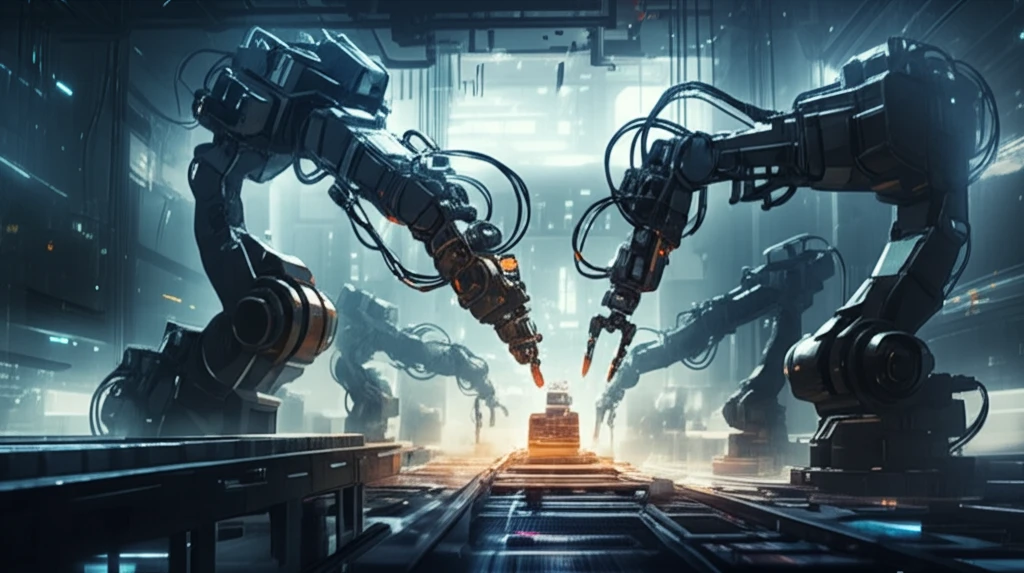
Think of a typical manufacturing plant where products move sequentially from one workstation to another, like cars on an assembly line. Each station performs a specific task, and the goal is to minimize the time it takes to complete the entire process. Assembly operations add another layer by combining different components at certain stages, requiring careful coordination to avoid bottlenecks and delays.
This guide explores flow shop scheduling problems with assembly operations, offering insights into the latest research and trends. We'll break down complex concepts into easy-to-understand terms, provide practical examples, and highlight the benefits of implementing these strategies. Whether you're a seasoned operations manager or new to the field, you'll find valuable information to optimize your assembly lines and gain a competitive edge.
AI-Powered Creative Tools Reshape Content Production
AI creative studios such as Google Flow and Flow Video AI are expanding access to visual content production for creators of all skill levels. Google Flow enables users to explore visual ideas and turn them into films, music videos, and conceptual art using advanced generative models. Flow Video AI offers an integrated suite combining video, image, audio, and strategic tools aimed at simplifying the creative process for professional output. These platforms represent a growing trend toward AI-driven tools that lower barriers to entry in content creation across industries.
Mobile-First Utility Apps and Their Scope
The My Flow mobile application demonstrates a common approach in consumer technology: consolidating multiple service management tasks into a single platform. The app allows users to pay bills, manage mobile plans, and top up accounts from one interface designed for everyday convenience. While such single-purpose utility apps address specific consumer needs, their scope is limited to personal account management rather than broader operational optimization. This highlights a general limitation of many mobile-first tools in addressing complex, multi-variable scheduling problems.
Early Foundations of Assembly Line Optimization
The conceptual roots of flow shop scheduling trace back to early 20th-century manufacturing principles, where assembly line optimization first became a formal area of study. Foundational work in operations research established mathematical frameworks for minimizing makespan and balancing workloads across sequential processing stages. These early milestones laid the groundwork for algorithmic approaches that continue to evolve in modern production environments. While comprehensive historical records of specific discoveries vary, the field has generally progressed through iterative refinement of heuristic and exact methods.
Understanding Flow Shop Scheduling with Assembly Operations
At its core, flow shop scheduling aims to determine the optimal sequence of jobs to minimize makespan, reduce idle time, and improve overall throughput. The basic assembly flow shop consists of two main stages: the fabrication or machining stage and the assembly stage. In the machining stage, individual components are produced, while in the assembly stage, these components are combined to create the final product.
- Fabrication Stage: This involves machining and producing individual parts or components. This stage might involve multiple machines working in parallel.
- Assembly Stage: Once the components are ready, they move to the assembly stage, where they are joined together. This stage can also involve multiple machines or workstations.
- Hierarchical Assembly: Many products have a hierarchical assembly structure, meaning that components are assembled into sub-assemblies, which are then assembled into the final product.
- Optimization Goal: The primary goal is to find the sequence of jobs that minimizes the total time to complete all products (makespan) while meeting other objectives like minimizing tardiness or reducing inventory costs.
Advances in Heuristic and Metaheuristic Methods
Contemporary research in flow shop scheduling increasingly focuses on metaheuristic approaches such as genetic algorithms, simulated annealing, and ant colony optimization to address complex production scenarios. Recent studies evaluate the effectiveness of hybrid methods that combine multiple algorithmic strategies to improve solution quality for large-scale problems. While no single approach has emerged as universally superior, hybrid metaheuristics generally show promise in balancing computational efficiency with solution optimality. Ongoing research continues to refine these methods for real-world applicability across diverse manufacturing contexts.
Challenges in Practical Implementation
Despite theoretical advances, practical implementation of optimal flow shop schedules often faces significant hurdles including machine breakdowns, variability in processing times, and unexpected demand fluctuations. Some researchers argue that overly complex optimization models may not translate effectively to dynamic shop floor conditions. Failures in implementation frequently stem from the gap between static model assumptions and the stochastic nature of real production environments. These challenges suggest that while algorithmic solutions are valuable, their practical utility depends heavily on adaptability and robustness to uncertainty.
Exact vs. Heuristic Approaches
Comparative studies of flow shop scheduling methods typically contrast exact algorithms, which guarantee optimal solutions but scale poorly, against heuristic and metaheuristic approaches that offer feasible solutions within reasonable time frames. For small problem instances, exact methods such as branch-and-bound can identify global optima, while larger instances generally require heuristic strategies. Metaheuristic approaches often outperform simple heuristics in solution quality but at the cost of increased computational complexity. The choice between methods typically depends on problem size, available computational resources, and the specific objectives of the scheduling problem.
The Future of Flow Shop Scheduling
Flow shop scheduling with assembly operations is a dynamic and evolving field, driven by the increasing demands of modern manufacturing. As businesses strive for greater efficiency, reduced costs, and faster turnaround times, the principles and techniques discussed here will become even more critical. By embracing these strategies and continuously seeking innovative solutions, you can position your operations for long-term success in a competitive global market.
Integrating Theory with Practice
Experts in operations research generally agree that effective flow shop scheduling requires balancing theoretical optimality with practical feasibility. Synthesis of current literature suggests that no single scheduling algorithm suits all production scenarios, and context-specific factors should guide method selection. Industry practitioners increasingly emphasize the importance of flexible scheduling frameworks that can adapt to changing production requirements. This pragmatic approach acknowledges that while mathematical models provide valuable guidance, successful implementation demands attention to real-world constraints and organizational factors.
Emerging Trends and Open Questions
Future research in flow shop scheduling is likely to explore integration with Industry 4.0 technologies including real-time data analytics and cyber-physical systems. Open questions remain regarding how scheduling algorithms can best incorporate machine learning for predictive maintenance and dynamic adjustment. The growing complexity of multi-objective optimization problems, balancing throughput, energy consumption, and environmental impact, presents additional frontiers for investigation. These emerging areas suggest that the field will continue evolving to address increasingly sophisticated production challenges.
Industry-Wide Implications
Flow shop scheduling operates within broader systemic challenges including supply chain volatility, workforce availability constraints, and sustainability requirements. The optimization of individual production stages must be considered within the context of end-to-end manufacturing systems and their interdependencies. Industry-wide adoption of advanced scheduling methods faces barriers including implementation costs, technical expertise requirements, and organizational resistance to change. These systemic factors suggest that progress in flow shop scheduling depends not only on algorithmic innovation but also on broader industry adaptation and infrastructure development.
Practical Consequences for Production Environments
Effective flow shop scheduling directly impacts production efficiency, resource utilization, and ultimately profitability in manufacturing operations. The human element remains critical as production managers must interpret algorithmic recommendations and adapt schedules to changing conditions on the shop floor. Real-world impact varies considerably depending on implementation quality, organizational readiness, and alignment between scheduling objectives and business goals. While advanced scheduling methods offer significant potential benefits, their translation into tangible improvements depends on careful integration with existing operational practices and workforce capabilities.