
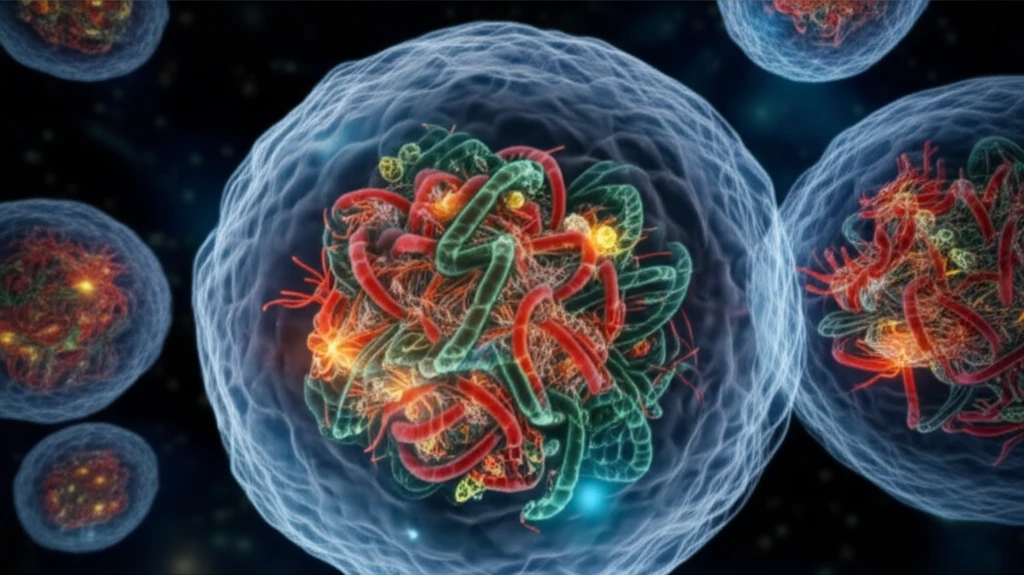
The 3D Cancer Nucleus: A New Dimension in Understanding and Treating Cancer

"Delving into the spatial organization of the cancer cell genome could revolutionize cancer diagnostics and treatment."
For over a century, scientists have been exploring the intricate world within the cell's nucleus, particularly how the organization of chromosomes changes in cancer. Groundbreaking early observations by Hansemann and Boveri laid the foundation for our current understanding of the cancer cell. Their work highlighted the abnormal structure and behavior of nuclei and chromosomes in cancerous cells, sparking decades of research into the underlying causes and potential therapeutic targets.
Today, modern molecular and imaging techniques are providing an unprecedented look at the spatial arrangement of the cancer cell's genome. This deeper understanding is revealing that the structural order of the nucleus isn't just a static feature—it's a dynamic element that can serve as a biomarker for cancer.
This article explores the exciting advancements in understanding the 3D organization of the cancer nucleus, from its historical roots to its potential applications in cancer diagnosis and personalized medicine. We'll delve into the key discoveries, technological breakthroughs, and future directions that promise to reshape our approach to cancer care.
Unlocking the Secrets of the 3D Genome: Key Discoveries and Technologies
Research into the spatial organization of the cancer nucleus has been accelerated by advancements in several key areas:
- Fluorescent in situ hybridization (FISH): This technique allows scientists to visualize the location of specific DNA sequences within the nucleus, providing insights into chromosome positioning and organization in 3D.
- Chromosome conformation capture technologies: Methods like Hi-C reveal how different regions of the genome interact with each other, mapping the complex network of contacts within the nucleus.
- Super-resolution microscopy: Breaking the diffraction limit of light, these advanced imaging techniques provide unprecedented detail of nuclear architecture, revealing the organization of DNA and other components at the nanoscale.
The Future of Cancer Care: Targeting the 3D Nucleus
The research paints a promising picture: By understanding the intricacies of the 3D cancer nucleus, we can develop new diagnostic tools, personalize treatment strategies, and potentially even target the nuclear architecture itself to disrupt cancer development.
While significant progress has been made, further research is crucial. Large-scale studies are needed to validate these findings and translate them into clinical applications. Multi-center collaborations and clinical trials will be essential to ensure that these innovative approaches benefit all cancer patients.
The journey into the 3D cancer nucleus is ongoing, but the potential rewards are immense. By continuing to explore this new dimension of cancer biology, we can unlock new possibilities for prevention, diagnosis, and treatment, bringing hope to millions affected by this disease.