
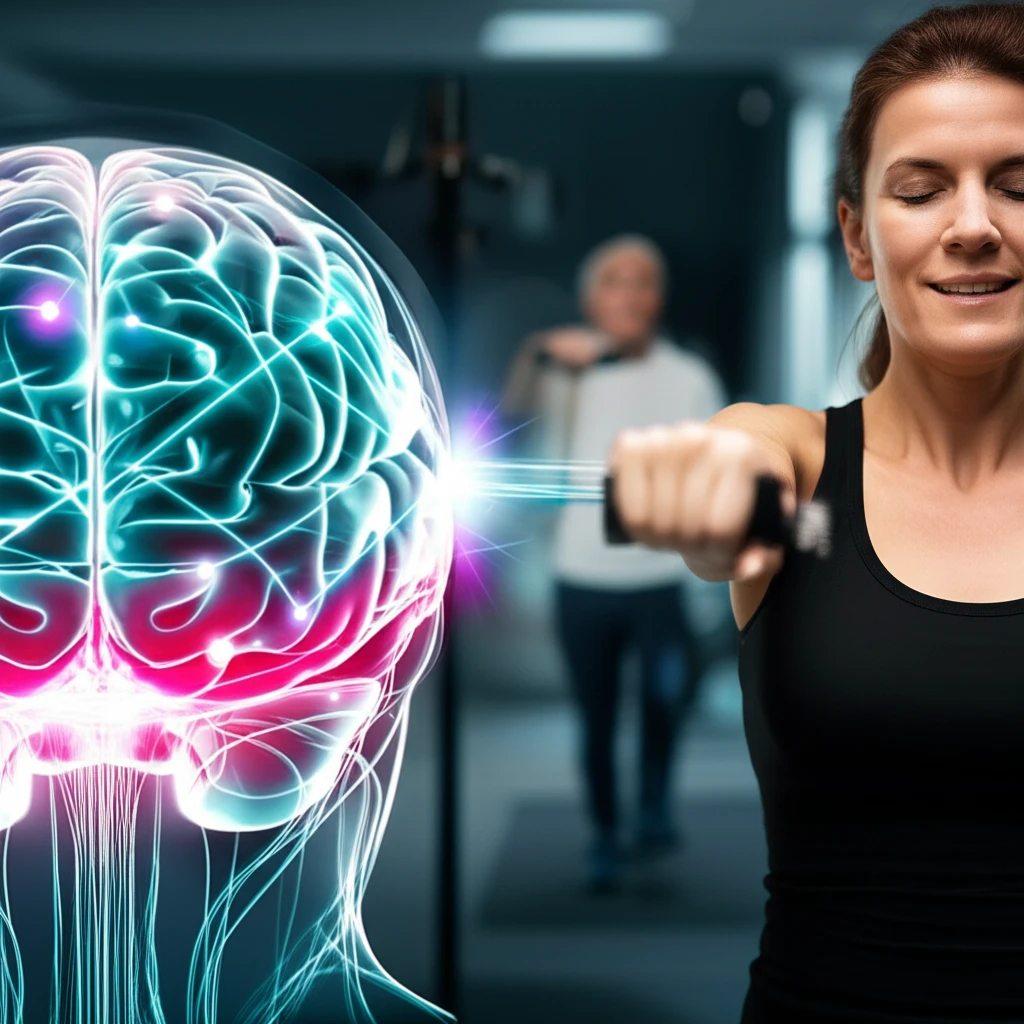
Illustration of brain pathways representing neuroplasticity, with a stroke survivor exercising, and innovative therapies integrated, symbolizing stroke recovery.

Stroke Recovery Breakthroughs: Can Exercise and Innovative Therapies Truly Restore Function?

"Exploring Cutting-Edge Approaches to Stroke Rehabilitation for Enhanced Recovery and Improved Quality of Life"


Stroke, a leading cause of disability worldwide, can dramatically alter lives, impacting motor skills, cognitive function, and overall well-being. For those affected, the journey to recovery is often long and challenging. However, recent advancements in rehabilitation offer new hope, with innovative therapies and exercise regimens showing promising results in restoring function and enhancing the quality of life for stroke survivors.

This article aims to explore these cutting-edge approaches, focusing on the impact of exercise combined with innovative therapies such as non-elastic taping, transcranial magnetic stimulation (TMS), and brain-computer interfaces. We'll delve into how these methods work, the science behind their effectiveness, and the real-world impact they're having on individuals' lives.

By examining the latest research and practical applications, we aim to provide a comprehensive overview of the most promising stroke rehabilitation strategies. Our goal is to offer insights that empower both patients and healthcare professionals with the knowledge to navigate the complexities of stroke recovery effectively and optimistically.

Unveiling the Power of Exercise and Innovative Therapies in Stroke Rehabilitation

Illustration of brain pathways representing neuroplasticity, with a stroke survivor exercising, and innovative therapies integrated, symbolizing stroke recovery.

At the heart of effective stroke rehabilitation lies a multi-faceted approach that combines traditional exercise with innovative therapies. Exercise, in various forms, plays a critical role in restoring motor function, improving balance, and enhancing overall physical fitness. Parallel to this, innovative therapies such as non-elastic taping, TMS, and brain-computer interfaces are emerging as powerful tools to augment the benefits of exercise.

One promising area of research involves the use of non-elastic taping combined with exercise. Studies have shown that this combination can significantly improve motor function in individuals with chronic stroke. Non-elastic taping, when applied correctly, can help to facilitate proper muscle activation, improve joint alignment, and enhance proprioception—the body's sense of position and movement. This, coupled with targeted exercises, can lead to improvements in gait performance, balance, and muscle strength.

  • Exercise for Motor Function: Focused exercises to regain control over affected limbs.
  • Balance Training: Exercises to improve stability and reduce the risk of falls.
  • Task-Specific Training: Exercises that mimic real-life activities to enhance functional skills.
Another groundbreaking therapy, TMS, uses magnetic pulses to stimulate specific areas of the brain, promoting neuroplasticity—the brain's ability to reorganize itself by forming new neural connections throughout life. This can be particularly effective in stroke rehabilitation, as it can help to reactivate dormant pathways and improve motor function. Additionally, brain-computer interfaces (BCIs) offer a novel approach, allowing individuals to control external devices with their thoughts. These technologies can facilitate rehabilitation by providing real-time feedback and promoting motor learning. By combining exercise with these advanced therapies, stroke survivors can achieve significant improvements in their physical capabilities and overall quality of life.

Looking Ahead: The Future of Stroke Recovery

The field of stroke rehabilitation is rapidly evolving, with new research and technologies constantly emerging. As we continue to refine our understanding of the brain's plasticity and develop more effective therapies, the outlook for stroke survivors is brighter than ever. By embracing these advancements, healthcare professionals and patients can work together to achieve remarkable improvements in function, independence, and overall quality of life. The combination of exercise, innovative therapies, and a patient-centered approach offers the best path toward a full and fulfilling recovery journey.

About this Article -

This article was crafted using a human-AI hybrid and collaborative approach. AI assisted our team with initial drafting, research insights, identifying key questions, and image generation. Our human editors guided topic selection, defined the angle, structured the content, ensured factual accuracy and relevance, refined the tone, and conducted thorough editing to deliver helpful, high-quality information.See our About page for more information.

This article is based on research published under:

DOI-LINK: 10.1016/j.rehab.2018.05.497, Alternate LINK

Title: The Effects Of Non-Elastic Taping Combined With Exercises Training On Motor Function In Cane-Assisted Individuals After Stroke

Subject: Rehabilitation

Journal: Annals of Physical and Rehabilitation Medicine

Publisher: Elsevier BV

Authors: C.Y. Lin, R.Y. Wang, C.S. Lee, Y.R. Yang

Published: 2018-07-01

Everything You Need To Know

1

What role does exercise play in stroke rehabilitation, and what types of exercises are most beneficial?

Exercise is a critical component of stroke rehabilitation, focusing on restoring motor function, improving balance, and enhancing overall physical fitness. Specific exercises include those focused on regaining control over affected limbs to improve motor skills. Balance training is incorporated to enhance stability and reduce the risk of falls. Furthermore, task-specific training, which mimics real-life activities, is essential for improving functional skills. These exercises should be tailored to the individual's needs and abilities for optimal recovery outcomes. Note that Cognitive rehabilitation, while not discussed here, is also an essential component of stroke rehabilitation.

2

How does non-elastic taping contribute to improved motor function during stroke rehabilitation, and what are its specific benefits?

Non-elastic taping enhances motor function by facilitating proper muscle activation, improving joint alignment, and enhancing proprioception, which is the body's sense of position and movement. When combined with targeted exercises, non-elastic taping can lead to significant improvements in gait performance, balance, and muscle strength. The tape provides support and stability, helping individuals regain control over their movements and improve their overall functional abilities. Constraint-induced movement therapy, not discussed here, is another rehabilitation technique that focuses on improving the use of an affected upper limb by restraining the unaffected limb.

3

What is Transcranial Magnetic Stimulation (TMS), and how does it aid in stroke recovery?

Transcranial Magnetic Stimulation (TMS) is a groundbreaking therapy that uses magnetic pulses to stimulate specific areas of the brain. In stroke rehabilitation, TMS promotes neuroplasticity, the brain's ability to reorganize itself by forming new neural connections. This stimulation can help reactivate dormant neural pathways, improving motor function and cognitive abilities affected by the stroke. TMS offers a non-invasive method to encourage the brain to rewire itself, enhancing recovery outcomes. Robotic-assisted therapy, not mentioned, is another advanced technique that can improve motor function.

4

How do brain-computer interfaces (BCIs) work in stroke rehabilitation, and what advantages do they offer for patients?

Brain-computer interfaces (BCIs) allow individuals to control external devices with their thoughts, offering a novel approach to stroke rehabilitation. These technologies provide real-time feedback and promote motor learning by translating brain signals into actions. BCIs can facilitate rehabilitation by helping patients regain control over movement and improve their physical capabilities. This technology enhances neuroplasticity and provides a direct link between the brain and external devices, fostering independence and improved quality of life. Virtual reality therapy, a related technology, can also provide immersive and engaging rehabilitation experiences.

5

What is the overall outlook for stroke survivors, considering the advancements in exercise and innovative therapies?

The outlook for stroke survivors is increasingly promising due to continuous advancements in rehabilitation techniques and a growing understanding of the brain's plasticity. The combination of exercise, innovative therapies like non-elastic taping, TMS, and brain-computer interfaces, and a patient-centered approach offers the best path toward a full and fulfilling recovery journey. As research continues and new technologies emerge, healthcare professionals and patients can work together to achieve remarkable improvements in function, independence, and overall quality of life. Future research directions may include personalized rehabilitation plans based on individual brain imaging and genetic profiles.

Newsletter Subscribe

Subscribe to get the latest articles and insights directly in your inbox.