
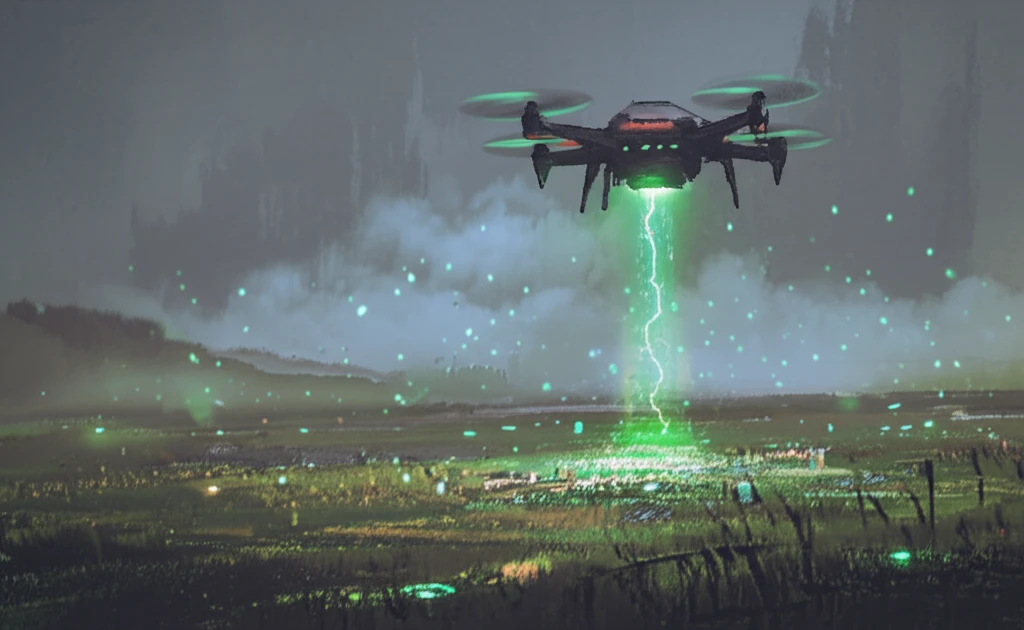
Soaring to New Heights: How Drones and Wireless Power Are Revolutionizing IoT Networks

"Unmanned aerial vehicles are changing the game for Internet of Things connectivity and energy, enhancing everything from smart cities to precision agriculture."
The Internet of Things (IoT) is rapidly transforming our world, connecting devices and systems in ways that promise unprecedented efficiency and convenience. From smart cities optimizing traffic flow to precision agriculture monitoring crop health, IoT's potential is vast. However, a significant challenge lies in powering the remote sensors that form the backbone of these networks. Traditional batteries are often impractical due to their limited lifespan and the high costs and logistical hurdles associated with replacing them, particularly in harsh or inaccessible environments.
Enter the unmanned aerial vehicle (UAV), or drone, equipped with wireless power capabilities. This innovative approach offers a dynamic solution to the energy problem, allowing for on-demand charging of sensors in the field. Instead of relying on fixed power sources or frequent battery replacements, drones can deliver energy wirelessly to IoT devices, extending their operational life and expanding the possibilities for remote monitoring and data collection. This technology also addresses the cost issues of deploying multiple Hybrid Access Points in locations where sensors are sparsely distributed.
Imagine a network of environmental sensors scattered across a vast agricultural landscape, each relaying critical data about soil conditions, temperature, and humidity. With wireless-powered drones, these sensors can operate continuously, providing farmers with real-time insights to optimize irrigation, reduce fertilizer use, and improve crop yields. This is just one example of how UAV-assisted IoT networks are poised to revolutionize various industries.
Drones Reshape Testing and Storytelling
Drone technology is transforming mobile network testing, offering mobile network operators (MNOs) a faster, cost-effective, and more accurate alternative for tasks such as base station inspections and network testing. Drones have also fundamentally changed how travel bloggers visually represent their adventures, overcoming the ground-level perspectives that once limited traditional photography. Together these uses show how UAVs are moving from novelty to essential infrastructure across industries.
Ground-Bound Limits of Legacy Methods
Traditional photography often limited creators to ground-level perspectives, which could obscure breathtaking vistas or the true scale of a scene, a constraint drones now bypass. In aviation, a UAV is an aircraft that operates without a human pilot onboard, controlled either autonomously by onboard computers, which makes inspection and testing possible in locations that are hard or hazardous to reach. Wireless power systems, by contrast, historically required a direct, wired connection between a power source and an electrical load, constraining where devices could be placed.
From Piloted Craft to Autonomous Platforms
The UAV is defined as an aircraft that operates without a human pilot onboard, controlled either autonomously by onboard computers, marking a foundational shift in aviation history. A landmark milestone is the work of Turkey's first tech company to develop indigenous UAVs, which is preparing to exhibit the K2 Kamikaze UAV and Sivrisinek publicly for the first time at SAHA 2026. In parallel, the development of different types of wireless power transfer technologies produced circuits that enable chargers to deliver power to smartphones and other small electronic devices without a wired connection.
The Power of Full-Duplex Wireless Charging with Drones
One of the most exciting advancements in this field is the use of full-duplex wireless power transfer. Traditional wireless charging methods require devices to switch between energy harvesting and data transmission, limiting efficiency. Full-duplex systems, however, allow for simultaneous energy transfer and data communication, maximizing the utility of each drone visit. Think of it as a super-efficient refueling and data download all-in-one service for your IoT devices.
- Increased Efficiency: Simultaneous energy transfer and data communication.
- Extended Sensor Lifespan: Regular wireless charging eliminates battery replacement.
- Enhanced Data Collection: Continuous operation leads to more comprehensive data.
- Reduced Operational Costs: Minimizes the need for manual maintenance.
Wireless Power Networks Lead the IoT Charge
Energous and Wireless Power Networks (WPNs) are leading a revolution for IoT, positioning power as infrastructure much like connectivity itself. Research into the different types of wireless power transfer has produced circuits that enable wireless chargers to deliver power to smartphones and other small electronic devices. A wireless power system allows a source of power and an electrical load to be connected without a direct, wired connection, laying the groundwork for untethered IoT deployments.
The Constraints of Cables and Ground-Level Views
Despite advances, wireless power still competes with the straightforward reliability of wired connections, which directly link a power source to an electrical load. Ground-level perspectives have long obscured vistas in visual storytelling, and the physical reach of traditional methods limits how thoroughly network operators can inspect base stations and test coverage. These limitations underscore why both drone-based inspection and wireless charging remain active areas of refinement rather than solved problems.
Mesh, UAVs, and Transfer Methods Compared
Thread, a low-power, low-latency wireless protocol for IoT, supports up to 250 devices and maintains connectivity via a mesh network using border routers, requiring no central hub or bridge. Drones, in contrast, deliver mobility for versatile applications such as pressure washing, firefighting, and emergency delivery, offering capabilities static infrastructure cannot. Wireless power transfer, meanwhile, is differentiated by the variety of technologies available, each designed to deliver power across different distances and to different device classes.
The Future is in the Air
The development of UAV-assisted wireless-powered IoT networks is still in its early stages, but the potential is enormous. As drone technology continues to advance and wireless power transfer becomes more efficient, we can expect to see even more innovative applications emerge. From environmental monitoring and precision agriculture to disaster response and infrastructure inspection, the combination of drones and wireless power is paving the way for a more connected, efficient, and sustainable future. The key will be optimizing these systems for real-world conditions, ensuring reliable and cost-effective operation in diverse environments. The sky's the limit for this technology, and as research continues, we can expect to see it transform industries and improve lives in countless ways.
Infrastructure Meets Autonomy
The convergence of UAV flight and wireless power points toward IoT networks that are both mobile and untethered, where drones perform inspection and delivery while Wireless Power Networks supply energy as infrastructure. As Energous and other WPN leaders argue, power is becoming infrastructure in the same way connectivity already is. Drone navigation technology forms the backbone of this capability, relying on on-board sensors and positioning systems to keep operations precise.
New Roles for UAVs Ahead
Innovative UAV technology is expanding into versatile applications like pressure washing, firefighting, and emergency delivery, signaling far broader roles than inspection alone. Emerging platforms such as the K2 Kamikaze UAV and Sivrisinek are being exhibited for the first time at SAHA 2026, underscoring accelerating domestic development. Continued refinement of wireless power transfer technologies should further unlock these uses by removing the tether of the charging cable.
Scaling Networks Without Wires or Hubs
Building IoT at scale demands protocols that avoid central bottlenecks; Thread's mesh network using border routers supports up to 250 devices without a central hub or bridge. At the same time, drone operations depend on navigation technology whose backbone is formed by on-board sensors and positioning systems, which must stay reliable in demanding environments. Wireless power systems add a further layer of challenge, as transferring power without a wired connection remains more complex than a direct feed.
From Safer Inspections to Richer Stories
For mobile network operators, drones deliver faster, cost-effective, and more accurate testing, including safer base station inspections that reduce risk for field crews. For creators, drones have fundamentally changed how travel bloggers visually represent their adventures, enabling perspectives once impossible from the ground. Wireless power transfer promises the same kind of everyday relief for consumers, allowing smartphones and small devices to charge without plugging in.