
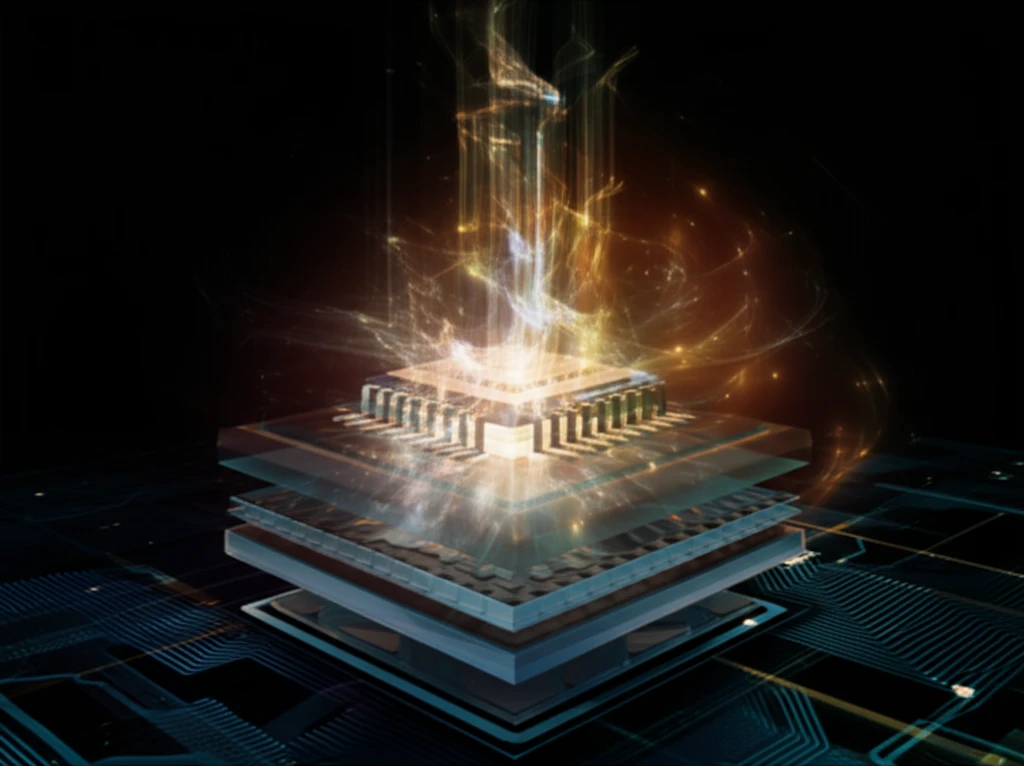
Conceptual image of gate stack engineering in semiconductors.

Smarter Semiconductors: How Gate Stack Engineering is Revolutionizing Electronics

"Discover the innovative techniques making our everyday devices faster, more efficient, and ready for the future of optoelectronics."


In our increasingly tech-dependent world, the demand for faster, more efficient electronic devices is constantly growing. Two-dimensional (2D) transition metal dichalcogenides (TMDs), like MoS2 and WSe2, are emerging as key materials to meet these demands, capturing significant attention due to their unique properties. Imagine semiconductors so thin they're only a single layer of atoms—this is the promise of 2D TMDs.

These materials maintain excellent semiconductor characteristics even at the atomic level, making them ideal for future electronic applications as silicon-based technology approaches its physical limits. Field-effect transistors (FETs) made from 2D materials are seen as critical building blocks for the next generation of electronics, paving the way for advancements in device and circuit technologies.

However, creating large, high-quality TMD films is challenging. Most FET fabrication still relies on methods like lithium-based intercalation or mechanical exfoliation—the "scotch-tape" method. Mechanical exfoliation is popular due to its simplicity and low cost, allowing researchers to obtain high-quality, single-crystal 2D flakes with minimal defects.

The Gate Stack Advantage: Enhancing Control for Superior Performance

Conceptual image of gate stack engineering in semiconductors.

Traditional methods of building back-gate devices involve taping exfoliated TMD thin flakes onto a silicon substrate covered with a layer of SiO2 or another dielectric. This approach faces difficulties, particularly in fabricating top-gate devices due to the lack of dangling bonds on the TMD surface, which hinders dielectric deposition.

A significant challenge is the thick SiO2 layer (around 270 nm) typically used in back-gate TMD FETs. While this thickness provides sufficient optical contrast for identifying TMD flakes, it leads to poor gate control, requiring high gate voltages to induce substantial current in the TMD channel. This is where gate stack engineering comes into play, offering a smarter solution.

  • Enhanced Gate Control: Improved electrostatic control over the channel leads to better device performance.
  • Optimized Optical Contrast: Facilitates easier identification and handling of TMD flakes during device fabrication.
  • Improved Performance: Results in higher photoresponsivity and reduced noise, crucial for applications like photodetectors.
Researchers have introduced an engineered Al2O3/ITO (indium tin oxide)/SiO2/Si back-gate stack with optimized thickness to enhance gate control while maintaining good optical contrast. By carefully engineering the gate stack, the electrical performance of transistors can be significantly improved. This innovative approach not only boosts gate control but also enhances the overall performance of the device, making it highly attractive for photodetector and sensing applications.

The Future of Electronics: A New Era of Innovation

In summary, carefully engineered gate stacks have been used to fabricate MoS2 back-gate FETs. The thickness of the Al2O3/ITO/SiO2/Si stack is optimized for proper optical identification of exfoliated MoS2 flakes, and excellent electrical behavior is achieved through enhanced gate control. The improved optoelectronic properties of monolayer MoS2 further enhance the back-gate FET, and the device structure aids in studying the intrinsic 1/f noise properties of MoS2 devices. This provides a strong foundation for exploring other 2D material-based FETs in a wide range of applications, promising a new era of innovation in electronic devices.

About this Article -

This article was crafted using a human-AI hybrid and collaborative approach. AI assisted our team with initial drafting, research insights, identifying key questions, and image generation. Our human editors guided topic selection, defined the angle, structured the content, ensured factual accuracy and relevance, refined the tone, and conducted thorough editing to deliver helpful, high-quality information.See our About page for more information.

This article is based on research published under:

DOI-LINK: 10.1149/08609.0051ecst, Alternate LINK

Title: Gate Stack Engineering In 2D Semiconductor Fets For Electronic Applications

Subject: General Medicine

Journal: ECS Transactions

Publisher: The Electrochemical Society

Authors: Hao Zhu, Jing Xu, Longfei He, Xinran Nie, Lin Chen, Qingqing Sun, David Wei Zhang

Published: 2018-07-20

Everything You Need To Know

1

What are 2D transition metal dichalcogenides (TMDs), and why are they important?

Two-dimensional (2D) transition metal dichalcogenides (TMDs) are materials, such as MoS2 and WSe2, that are only a single layer of atoms thick. These materials exhibit excellent semiconductor characteristics even at the atomic level, making them suitable for use in field-effect transistors (FETs) and other electronic components.

2

Why is gate stack engineering important in the context of 2D semiconductors?

Gate stack engineering is crucial because it optimizes the performance of devices using 2D semiconductors. By carefully designing the layers in the gate stack, it's possible to achieve enhanced gate control, improved optical contrast, and overall better electrical performance. This is particularly important as silicon-based technology approaches its physical limits, making alternative materials like 2D TMDs essential for future electronic advancements.

3

Why is mechanical exfoliation still used for creating TMD films?

Creating large, high-quality TMD films is challenging, which is why methods like mechanical exfoliation are still used. Mechanical exfoliation, sometimes called the "scotch-tape" method, is popular because it is simple and low cost. This allows researchers to obtain high-quality, single-crystal 2D flakes with minimal defects.

4

What challenges are associated with traditional methods of building back-gate devices, and how does gate stack engineering address these?

Traditional methods of building back-gate devices face challenges due to difficulties in fabricating top-gate devices because of the lack of dangling bonds on the TMD surface, which hinders dielectric deposition. Additionally, the thick SiO2 layer typically used in back-gate TMD FETs, while providing sufficient optical contrast for identifying TMD flakes, leads to poor gate control, requiring high gate voltages to induce substantial current in the TMD channel. Gate stack engineering provides a smarter solution to these problems.

5

How does an engineered gate stack enhance gate control in MoS2 back-gate FETs?

An engineered gate stack, such as the Al2O3/ITO/SiO2/Si back-gate stack, enhances gate control by optimizing the thickness of each layer. This optimization allows for improved electrostatic control over the channel, which leads to better device performance. The improved optoelectronic properties of monolayer MoS2 further enhance the back-gate FET, and the device structure aids in studying the intrinsic 1/f noise properties of MoS2 devices.

Newsletter Subscribe

Subscribe to get the latest articles and insights directly in your inbox.