
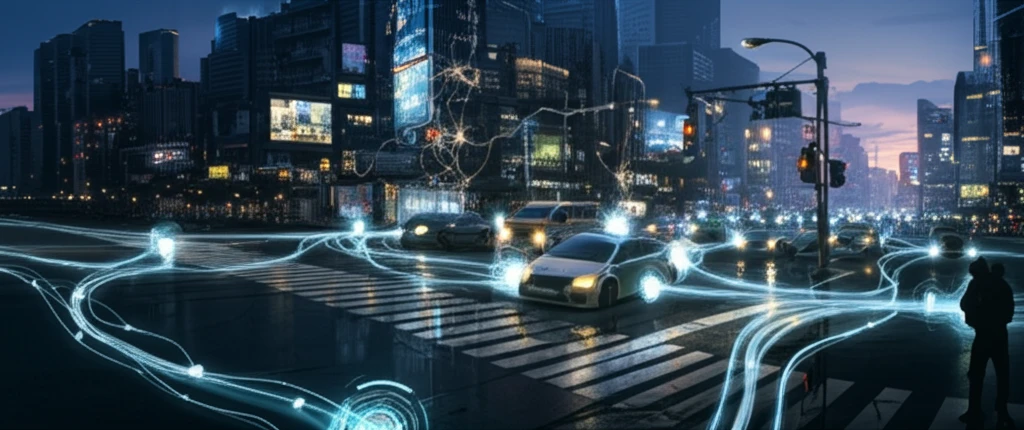
Smarter Roads Ahead: How Fuzzy Logic and AI Could Revolutionize Transportation

"Discover how cutting-edge AI is smoothing out traffic snags and making your daily commute a breeze."
Imagine a world where traffic jams are relics of the past, commutes are smooth and predictable, and transportation systems adapt in real-time to changing conditions. This isn't a scene from a sci-fi movie, but a future rapidly approaching, thanks to advancements in artificial intelligence (AI) and innovative approaches like fuzzy logic. As urban populations grow and the demands on our infrastructure intensify, the need for smarter, more responsive transportation solutions has never been greater.
For years, transportation management has relied on traditional methods, often struggling to keep pace with the complexities of modern traffic patterns. However, the rise of big data, cloud computing, and AI is paving the way for a new era of transportation intelligence. By harnessing the power of these technologies, we can create systems that not only optimize traffic flow but also enhance safety, reduce emissions, and improve the overall commuting experience.
This article delves into the fascinating world of transportation powered by AI, with a special focus on fuzzy logic and genetic algorithms. We'll explore how these concepts are being used to develop intelligent transportation systems that can handle the inherent uncertainties and complexities of real-world traffic scenarios. Get ready to discover how fuzzy logic and AI are working together to build a smarter, more efficient, and sustainable future for transportation.
Defining Intelligence in Transportation Systems
Intelligence, broadly defined, encompasses the capacity for abstraction, logic, understanding, learning, reasoning, planning, creativity, critical thinking, and problem-solving. In the context of transportation, intelligent systems are those that demonstrate success in coping with new situations and solving complex problems in real time. As dictionaries note, 'intelligent' emphasizes the ability to adapt and respond effectively to novel challenges — a trait increasingly sought in modern traffic and transit infrastructure. Understanding what constitutes intelligence in machines is a foundational step before evaluating how fuzzy logic and AI might be deployed on public roads.
Conventional Traffic Management and Its Shortcomings
Traditional traffic management systems have largely relied on fixed-timing signal plans, deterministic models, and rule-based control logic. These approaches assume predictable traffic patterns and struggle to adapt to the inherent variability and uncertainty of real-world road conditions. While they have provided a functional baseline for decades, their inability to handle ambiguous or rapidly changing inputs — such as unexpected congestion, weather events, or mixed-vehicle environments — represents a well-recognized limitation in the field.
The Concept of Intelligence as a Foundation
The Cambridge Dictionary defines 'intelligent' as the ability to learn and understand things easily — a concept that has long informed the design of adaptive systems. Historically, efforts to build intelligent machines have traced back to mid-20th-century work in artificial intelligence and cybernetics. The aspiration to create systems that can learn, reason, and respond intelligently to their environments has been a driving force behind decades of research. This foundational idea — that machines should be able to learn and comprehend — underpins the modern push toward smarter transportation networks.
What is "Fuzzy Logic" and Why is it Important for Transportation?
At its core, fuzzy logic is a problem-solving control system methodology that lends itself to implementation in systems ranging from simple, small, embedded micro-controllers to large, networked, multi-channel PC or workstation-based data acquisition and control systems. It provides a simple way to arrive at a definite conclusion based upon vague, ambiguous, imprecise, noisy, or missing input information. Fuzzy logic's approach to control problems mimics how a person would make decisions, only much faster.
- Managing Uncertainty: Fuzzy logic excels at handling the uncertainty inherent in traffic patterns, such as unpredictable driver behavior or sudden weather changes.
- Real-time Adaptability: Transportation systems powered by fuzzy logic can adapt to changing conditions in real-time, optimizing traffic flow and minimizing congestion.
- Improved Decision-Making: By considering a range of possibilities rather than relying on rigid rules, fuzzy logic enables better decision-making in complex traffic scenarios.
Emerging Work on Fuzzy Logic and AI in Transportation
Recent years have seen growing interest in applying fuzzy logic and AI techniques to transportation challenges, from adaptive signal control to autonomous vehicle decision-making. Researchers have explored how fuzzy inference systems can handle the imprecise, uncertain nature of traffic data more gracefully than classical Boolean approaches. However, without access to specific peer-reviewed findings or meta-analyses at this time, it is difficult to characterize the precise state of the latest research with full confidence. The field appears active but still in a phase of translating laboratory results into scalable, real-world deployments.
Skepticism and Known Setbacks
Any claim that fuzzy logic and AI could 'revolutionize' transportation should be met with measured skepticism. Intelligent transportation systems have faced well-documented challenges, including high implementation costs, integration difficulties with legacy infrastructure, and concerns about reliability in safety-critical scenarios. Past AI winters — periods of diminished funding and enthusiasm — serve as a reminder that technological hype can outpace practical readiness. Without concrete evidence of widespread, proven success, it remains possible that these approaches will complement rather than replace existing methods.
Fuzzy Logic vs. Traditional Approaches
Fuzzy logic offers a potential advantage over traditional deterministic methods by explicitly modeling uncertainty and partial truth — qualities inherent in real traffic environments. Where conventional systems require precise thresholds and binary decisions, fuzzy systems can weigh multiple imprecise inputs simultaneously. That said, comparative performance data specific to transportation applications is needed to determine whether these theoretical advantages translate into measurable real-world improvements. The comparison between intelligent adaptive approaches and established methods remains an open and actively studied question.
The Road Ahead: Embracing AI for a Smarter Transportation Future
As AI and fuzzy logic continue to evolve, their potential to transform transportation systems is immense. From self-driving cars to intelligent traffic management, these technologies promise a future where transportation is safer, more efficient, and more sustainable. By embracing these innovations, we can create cities that are better connected, less congested, and more livable for all.
Pulling the Threads Together
The intersection of fuzzy logic, AI, and transportation represents a promising but still-maturing area of inquiry. Experts broadly agree that intelligent systems have the potential to improve traffic flow, safety, and efficiency, but the path from concept to widespread deployment is neither simple nor guaranteed. A balanced synthesis suggests that the true value of these technologies may lie not in wholesale replacement of existing systems, but in augmenting them with adaptive, uncertainty-aware capabilities. The conversation is far from settled, and continued interdisciplinary collaboration will be essential.
What May Lie Ahead for Intelligent Roads
Looking forward, the integration of fuzzy logic with deeper AI methods — such as reinforcement learning and neural networks — could yield hybrid systems better equipped to handle the complexity of urban mobility. Advances in sensor technology, edge computing, and vehicle-to-infrastructure communication may provide the data and processing backbone these intelligent systems require. However, it is speculative at this stage to predict exactly when or how these convergences will reshape transportation at scale. The next frontier likely involves rigorous field trials, cross-sector partnerships, and iterative refinement.
Systemic Hurdles Beyond the Technology
Deploying intelligent transportation systems at scale involves far more than technical feasibility. Regulatory frameworks, funding models, public acceptance, and equity considerations all shape whether promising technologies reach the communities that might benefit most. Interoperability between different jurisdictions and legacy systems presents additional friction. These systemic challenges, while less glamorous than the algorithms themselves, may ultimately determine the pace and breadth of adoption.
How People Experience Smarter Roads
Ultimately, the impact of fuzzy logic and AI in transportation will be measured not in algorithms or papers, but in the daily experiences of commuters, pedestrians, and freight operators. If intelligent systems reduce congestion, shorten travel times, and improve safety, the human dividends could be substantial. Conversely, if implementations are poorly executed or inequitably distributed, public trust could erode. Keeping the human element at the center of design and deployment decisions will be critical to ensuring that smarter roads deliver on their promise.