
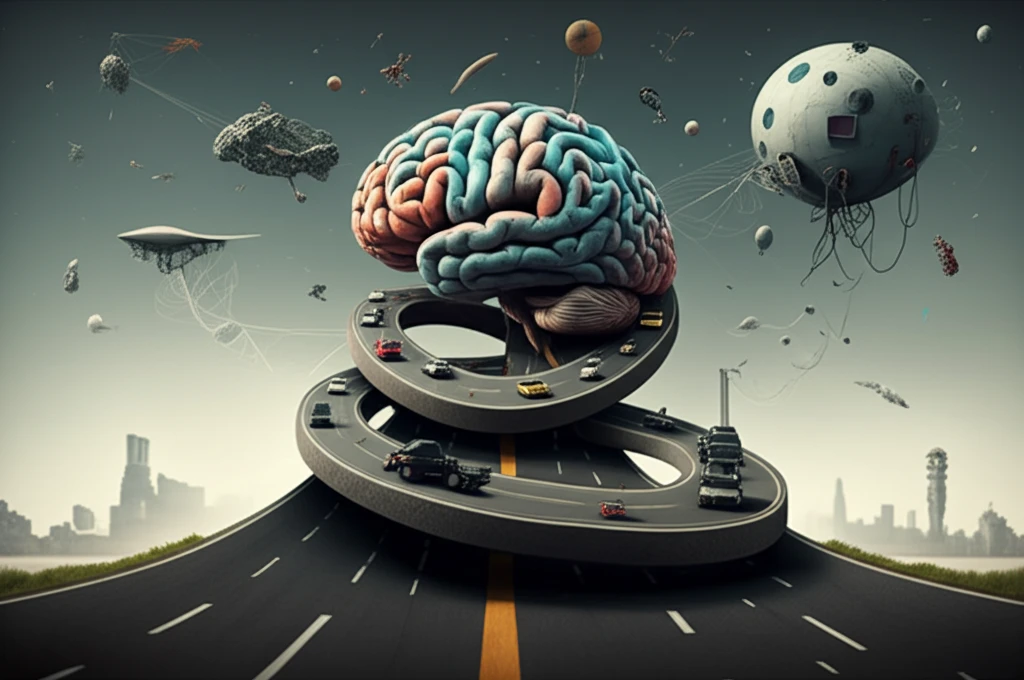
Rerouting Reality: How Bounded Rationality Shapes Your Daily Commute

"Uncover the hidden forces influencing your route choices—and what they mean for the future of traffic management"
We often assume that when we're behind the wheel, we're making perfectly logical decisions. We map out the fastest route, take real-time traffic into account, and execute accordingly, right? But what if the reality is far more nuanced? What if our decision-making is ‘bounded’ by the limits of our own rationality?
The concept of bounded rationality acknowledges that we don't always have the capacity (or even the desire) to make optimal choices. Instead, we settle for ‘good enough.’ This is especially true in complex scenarios like navigating daily traffic. Think about it: Do you really analyze every single possible route, or do you stick to familiar paths, even if there might be a quicker way?
New research is diving deep into these bounded rationalities, exploring how they impact our day-to-day rerouting decisions. The goal? To better understand—and ultimately predict—traffic patterns. And, potentially, to manage them more effectively. The key lies in distinguishing between absolute and relative bounded rationality, two concepts that could change how we think about our commutes.
Commutes and the Limits of Prediction
Urban commuting remains one of the most time-consuming daily activities for millions of people worldwide, with congestion imposing significant economic and personal costs. While exact figures vary by region and methodology, transportation researchers broadly agree that the gap between predicted and actual travel times is a persistent source of commuter frustration. The complexity of urban networks means that small disruptions can cascade into major delays, making route choice a deceptively difficult problem. Understanding how commuters actually make routing decisions — rather than how an idealized agent would — is therefore critical to improving traffic outcomes.
Bounded Rationality Models in Route Choice
Traditional traffic assignment models assume commuters are perfectly rational optimizers who always choose the shortest or fastest route. Bounded rationality models challenge this by recognizing that human decision-makers search for a satisfactory — not necessarily optimal — alternative before stopping, reflecting genuine cognitive limitations. These models are categorized into substantive and procedural approaches, with the former including both static and dynamic traffic assignment variants and the latter encompassing two-stage cognitive models and day-to-day learning models. Researchers have noted a persistent lack of a unified theory of traffic assignment that directly incorporates bounded rationality, leading to fragmented approaches including fuzzy systems theory and laboratory studies of route choice behavior.
The Origins of Bounded Rationality Thinking
The concept of bounded rationality was pioneered by Herbert Simon, who argued that human decision-making is constrained by limited information, cognitive ability, and time rather than governed by perfect optimization. This framework has since moved from its original roots in economics and cognitive science into transportation research, where it offers a more psychologically realistic account of how commuters choose routes. The progression from classical rational-agent models to bounded rationality frameworks reflects a broader shift in the social sciences toward acknowledging the gap between theoretical ideals and actual human behavior.
Absolute vs. Relative Bounded Rationality: What's the Difference?
To understand how bounded rationality affects your commute, it's crucial to differentiate between two types:
- Relative Bounded Rationality: This is more flexible. Your 'indifference band' adjusts based on the length of your trip. A 10-minute saving might be significant on a 30-minute commute, but not worth the hassle on a 2-hour drive. It's about proportional gains.
- Think of it this way: With absolute bounded rationality, you might ignore a 5-minute detour that shaves 7 minutes off your hour-long commute. With relative bounded rationality, you're more likely to take it because it’s a notable percentage of your total travel time.
The Evolving Landscape of Commuter Decision Science
Research into how bounded rationality shapes commuting decisions continues to grow, with scholars increasingly drawing on insights from cognitive psychology, behavioral economics, and traffic engineering. While the field has made strides in modeling suboptimal and noisy decision-making — particularly in mixed-traffic scenarios involving autonomous vehicles — a fully integrated theoretical framework remains elusive. The recognition that human drivers plan for short time horizons and do not behave as global optimizers is now a common thread across multiple research streams.
Where Bounded Rationality Models Fall Short
Despite their appeal, bounded rationality models face significant challenges in empirical validation and practical implementation. The heterogeneity of human decision-making makes it difficult to calibrate models that predict behavior across diverse populations and contexts. Some critics argue that bounded rationality frameworks, while descriptively richer than classical models, can become unfalsifiable if every deviation from optimality is attributed to cognitive limits. The absence of a single, widely accepted formalization means that results can be sensitive to modeling assumptions, limiting comparability across studies.
Rational vs. Bounded: What the Models Reveal
Comparisons between perfectly rational and boundedly rational traffic models suggest that the latter produce predictions more aligned with observed commuter behavior, particularly under congestion and uncertainty. However, the added complexity of bounded rationality models — requiring parameters for aspiration levels, search thresholds, and learning rates — introduces calibration challenges that simpler models avoid. The trade-off between descriptive accuracy and computational tractability remains a central tension in the field, with no universal consensus on which approach best serves different planning and operational needs.
The Road Ahead: Why Understanding Commuter Psychology Matters
The next time you’re stuck in traffic, consider the hidden psychological forces at play. Recognizing that we don’t always make perfectly rational decisions is the first step toward creating smarter, more responsive transportation systems. Whether it's through adaptive traffic signals or personalized route recommendations, the future of traffic management lies in understanding the beautifully 'bounded' ways we think on the road.
What the Evidence Tells Us So Far
The growing body of research on bounded rationality in commuting consistently shows that humans do not behave as classical optimization models predict. Decision-makers satisfice rather than optimize, relying on habits, incomplete information, and heuristic rules to navigate daily routes. While no single model has achieved consensus as the definitive framework, the collective evidence underscores that traffic management strategies ignoring cognitive limits are likely to overestimate compliance and underestimate congestion. Incorporating bounded rationality into planning tools is increasingly viewed not as optional but as necessary for realistic outcomes.
EvoQRE and the Next Generation of Traffic Models
Recent work on EvoQRE offers a principled, statistically grounded approach to modeling bounded rationality in safety-critical driving scenarios, moving beyond the assumption of perfect rationality. Research demonstrates that bounded rationality models match observed driver behavior more closely than purely rational models, particularly in high-stakes situations where human inconsistency is most pronounced. Evolutionary approaches allow diverse driving strategies to stabilize into realistic mixed patterns rather than forcing convergence on a single optimal strategy, offering a more faithful representation of real-world traffic. These advances suggest that future traffic management systems — including those leveraging eUnit-SUE frameworks — could significantly reduce congestion by accounting for how drivers actually think and decide.
Beyond Individual Routes: System-Level Implications
Bounded rationality does not just affect individual route choice — it has cascading implications for network-level traffic flow, congestion patterns, and infrastructure planning. When large numbers of commuters make satisficing decisions rather than globally optimal ones, the resulting traffic patterns can differ substantially from what equilibrium-based models predict. This means that urban planners and traffic engineers must grapple with the systemic effects of widespread cognitive shortcuts, including herding behavior, information overload from navigation apps, and delayed adaptation to changing conditions. Addressing these challenges requires interdisciplinary collaboration spanning transportation engineering, cognitive science, and public policy.
Real Commuters, Real Decisions
Ultimately, the study of bounded rationality in commuting is a study of human behavior under everyday stress and time pressure. Commuters weigh competing demands — arriving on time, minimizing fuel costs, avoiding stress, and coping with unreliable information — in ways that no single optimization function can capture. The practical payoff of this research lies in its potential to inform better traffic management systems, more intuitive navigation tools, and infrastructure designs that accommodate rather than ignore human cognitive limits. As urban populations grow and congestion intensifies, understanding the human element in route choice becomes not merely an academic exercise but a public necessity.