
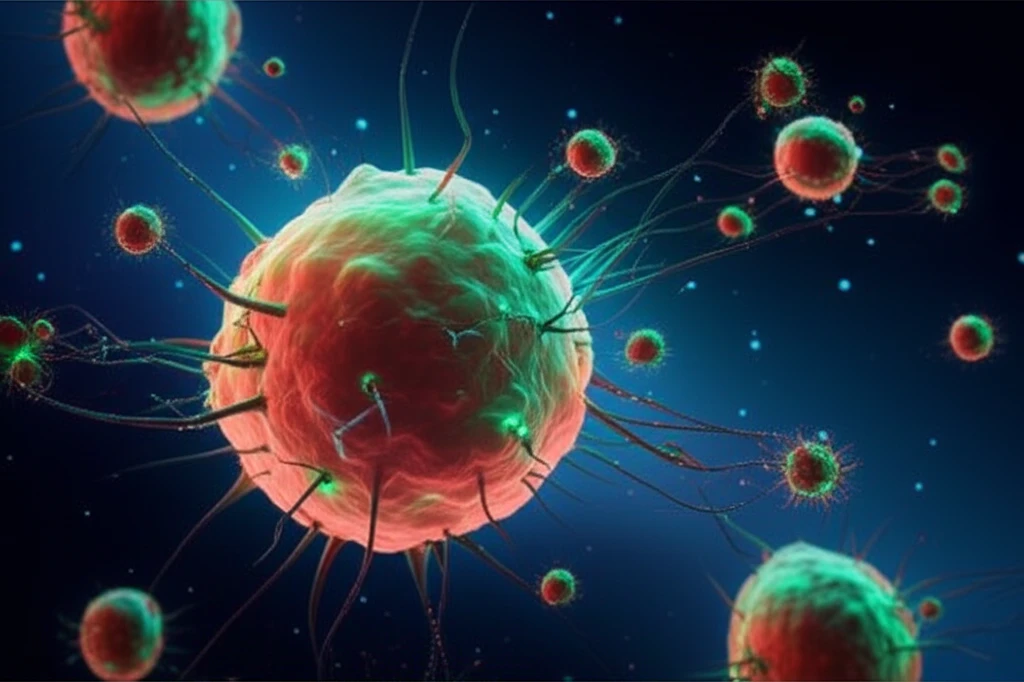
Smart Nanotech: A New Hope for Beating Cancer?

"Targeted drug delivery with prodrug copolymer micelles shows promise in preclinical studies."
Cancer treatment is a field where innovation never stops, because the stakes are incredibly high. Chemotherapy, while effective, often harms healthy cells alongside cancerous ones, leading to harsh side effects. Researchers are constantly seeking ways to improve treatment efficacy while minimizing harm to the patient.
One promising area of exploration is the use of nanotechnology to deliver drugs directly to cancer cells. Nanocarriers, tiny vehicles designed to transport drugs, can be engineered to target specific markers on cancer cells, releasing their payload only where it's needed. This approach aims to increase the concentration of the drug at the tumor site while reducing exposure to healthy tissues.
Recent research has focused on developing novel nanocarriers that not only deliver anticancer drugs but also enhance their effectiveness. One such approach involves using 'prodrugs,' inactive forms of a drug that are converted into their active form within the tumor microenvironment. This strategy, combined with the targeted delivery capabilities of nanocarriers, holds the potential to revolutionize cancer therapy.
How Targeted Nanocarriers are Changing the Game in Cancer Treatment
A groundbreaking study has explored the use of glucosylceramide synthase (GCS) inhibitor-based prodrug copolymer micelles for targeted delivery of anticancer agents. The research, led by Jieni Xu and colleagues, introduces an innovative approach to cancer therapy that combines the benefits of targeted drug delivery with the enhanced efficacy of prodrug activation.
- POEG (Poly(oligoethylene glycol): A hydrophilic (water-attracting) block that helps the nanocarrier dissolve in the bloodstream and prevents it from being quickly eliminated by the body.
- PPPMP (Prodrug of 1-phenyl-2-palmitoylamino-3-morpholino-1-propanol): A hydrophobic (water-repelling) block composed of multiple units of a prodrug. In this case, the prodrug is PPMP, an inhibitor of GCS.
Looking Ahead: The Future of Cancer Treatment with Smart Nanomaterials
This research demonstrates the potential of carefully engineered nanomaterials to improve cancer treatment. By combining a GCS inhibitor prodrug with a targeted delivery system, researchers have created a promising approach to enhance the efficacy of anticancer drugs while reducing their toxicity.
While these findings are encouraging, it's important to remember that this research is still in the early stages. Further studies are needed to evaluate the safety and effectiveness of these nanocarriers in humans. However, the results provide a strong rationale for continued investigation into the use of nanomaterials for targeted cancer therapy.
As nanotechnology continues to advance, we can expect to see even more sophisticated and effective nanocarriers emerge, offering new hope for patients battling cancer. The future of cancer treatment may well lie in the precision and power of these tiny, targeted drug delivery systems.