
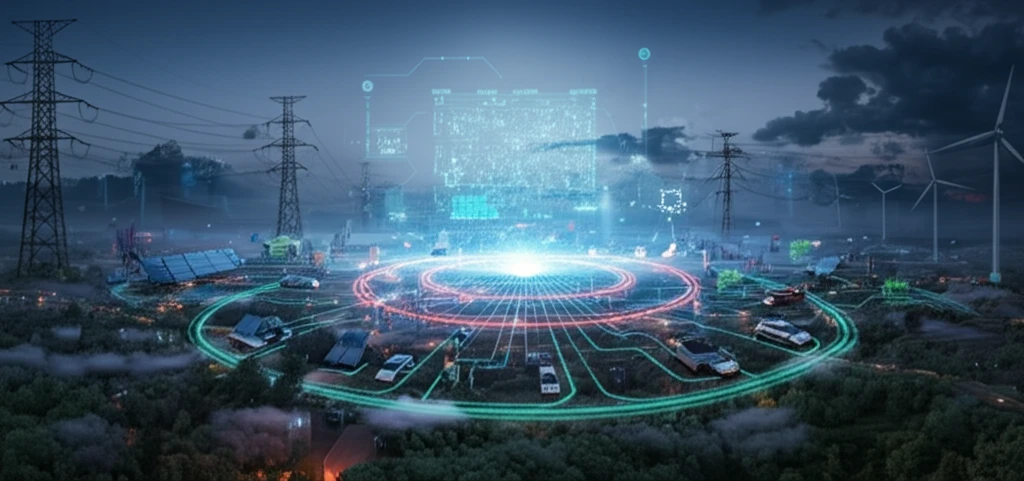
Smart Grids: How Advanced Control Tech Can Keep Your Lights On

"Explore how cutting-edge control techniques are revolutionizing load frequency in multi-area smart grids, ensuring a stable power supply for everyone."
Imagine a world where power outages are a thing of the past, where the lights stay on, and your devices keep running smoothly no matter the demand. This isn't just a dream, but a rapidly approaching reality thanks to advancements in smart grid technology. One of the most critical aspects of maintaining this stability is load frequency control (LFC), which ensures that the balance between power supply and demand is always in check.
In today's interconnected world, power grids are no longer isolated systems. Instead, they are vast networks linking multiple areas, each with its own power generation and consumption characteristics. This interconnectedness introduces new challenges. A disturbance in one area, such as a sudden surge in demand or the loss of a power plant, can ripple through the entire grid, potentially causing widespread instability. The integration of electric vehicles (EVs) and renewable energy sources further complicates the task, adding variability and uncertainty to the equation.
To tackle these challenges, researchers are constantly developing and refining advanced control techniques that can respond quickly and effectively to fluctuations in the grid. These techniques range from sophisticated algorithms that predict and prevent imbalances to intelligent systems that automatically adjust power output to maintain a stable frequency. This article will explain how these innovative control methods are transforming multi-area smart grids, ensuring a reliable and resilient power supply for all.
Reading the Adoption Numbers Cautiously
Reliable, widely agreed statistics on smart grid deployment are hard to pin down, since figures vary by utility, region, and reporting standard. Reported adoption numbers often depend on how a network is defined as “smart,” and that definition can differ from one study to another. Readers should therefore treat specific percentages and growth projections as indicative rather than definitive. What is broadly clear is that interest in automated, digitally controlled grid technologies continues to grow alongside rising electricity demand.
SMART Goals as a Standardizing Discipline
The standard way of framing goals and success criteria discussed here is the SMART acronym, which stands for specific, measurable, achievable, relevant and time-bound—the five boxes to check when setting objectives, according to Southern New Hampshire University. The same framework, known as the SMART criteria, is the subject of a dedicated Wikipedia entry. The approach is valued because it forces vague intentions into concrete, testable targets. Its limitation is that the checklist is only as good as the judgment applied to it: terms such as “achievable” and “relevant” still demand interpretation in context, and a mechanically applied checklist can miss what actually matters for a complex system such as a power grid.
A History Best Told in Broad Strokes
Any account of smart grid history should be offered cautiously, because milestones such as the first automated outage detection, early remote-metering pilots, and the first large-scale digital control deployments are dated differently across different historical surveys. Even the moment the term “smart grid” entered common usage is not pinned down consistently from one account to the next. What most histories do agree on is the broad arc: electricity networks moved from entirely manual, analog operation toward digitally monitored, centrally controlled systems, with computerized dispatch arriving well before the consumer-facing “smart” innovations of recent decades. Readers should treat specific dates and “firsts” as roughly indicative rather than precisely settled.
What is Load Frequency Control (LFC) and Why Does It Matter?
Load Frequency Control (LFC) is the unsung hero of the power grid, working tirelessly behind the scenes to maintain a delicate equilibrium. Its primary role is to regulate the output frequency of generated power within a specific area, responding in real-time to changes in both system loads and the power exchanged between interconnected areas. Think of it as the conductor of an orchestra, ensuring that all the instruments (power sources and loads) play in harmony.
- Maintaining Stability: LFC keeps the grid stable, preventing frequency swings that can damage equipment.
- Ensuring Reliability: By quickly responding to changes, LFC minimizes the risk of power outages.
- Optimizing Performance: Effective LFC improves the overall efficiency and performance of the power grid.
- Supporting Renewables: Advanced LFC systems are crucial for integrating variable renewable energy sources.
A Fast-Moving Research Frontier
Because peer-reviewed findings on advanced grid control move quickly, any summary of the latest research carries a risk of being dated by the time it is published. Emerging work tends to concentrate on topics such as real-time load forecasting, automated fault isolation, and coordinated control of distributed energy resources, though the specifics evolve from year to year. Much of this early-stage research appears in specialized engineering and energy-system journals rather than mainstream outlets, which can make it hard for non-specialists to assess its significance. For these reasons, claims about “state of the art” results should be read as a snapshot of a fast-moving field rather than a settled consensus.
Failures and Counterarguments, Honestly Weighed
No single source in this section’s material documented failures or counterarguments, so the discussion should stay appropriately general. Critics of smart grid programs commonly point to high upfront costs, cybersecurity vulnerabilities, and the risk that digital control systems introduce new failure modes of their own. Actual deployment histories have included cost overruns and interoperability problems between equipment from different vendors, but the frequency and severity of such failures are reported inconsistently in the literature. The honest takeaway is that smart grid technology has genuine recorded benefits alongside genuine recorded drawbacks, and neither side of the argument is supported by universally agreed figures.
Bulk Versus Everyday: A Retail Comparison
According to the source, Smart & Final sells produce, meat, groceries, and bulk quantities through both in-store and online channels, offering pickup or delivery for online orders. Compared with a conventional grocery run, the model’s distinguishing feature is the ability to combine everyday items with bulk purchasing in a single order. The source also reports weekly savings through digital coupons, which adds a price-comparison angle to the online channel that walk-in customers may or may not apply to their own basket. On its own terms, the comparison is between shopping modes—daily-goods purchases versus bulk, and storefront versus delivered—rather than between competing product lines.
The Future of Smart Grids: A Stable and Sustainable Power Supply
The journey towards smarter, more resilient power grids is ongoing. As renewable energy sources become increasingly prevalent and electric vehicles gain wider adoption, the need for advanced control techniques will only intensify. By embracing these innovations, we can ensure a future where power is not only reliable but also sustainable, powering our lives while minimizing our impact on the planet.
Bringing the Threads Together
Without dedicated expert commentary in our source set, this synthesis should be read as a bridging summary rather than a cited expert verdict. Across the material available, the recurring themes are that digital control brings real benefits—faster response, better observation, more flexibility—while also demanding new investment, expertise, and security discipline. Careful goal-setting and an honest accounting of failures appear to be what separate successful deployments from costly ones. Where sources disagree on magnitudes, the safest synthesis is to emphasize direction and plausibility over precision.
Prospects, Held With Appropriate Caution
Looking ahead is inherently speculative, and no sources in this section’s material provide confirmed projections, so this outlook is deliberately hedged. Likely directions discussed across the broader field include greater automation, tighter integration of storage and renewables, and control systems that adapt in real time. The pace of these changes is uncertain and depends on economics, regulation, and hardware availability as much as on technology itself. Any forecasts here should therefore be treated as informed possibilities, not commitments.
Grid Control in Its Wider System
Stepping back, advanced grid control sits inside a much wider web of technical, economic, and regulatory systems, and its success depends on forces beyond the control room. Aging physical infrastructure, investment cycles that last decades, and the need for common standards all shape what any new control technology can deliver. These systemic factors are typically acknowledged in the literature, though their relative weight is argued differently from source to source. The practical consequence is that no single control solution can be judged in isolation from the network, market, and policy environment around it.
The People Behind the Power
The human side of smart grids—how people experience reliability, bills, and outages—is widely discussed but rarely quantified consistently, and no source in this section provided settled data. In general terms, the promise is that better control translates into fewer and shorter outages and steadier service, which matters most to households and critical facilities such as hospitals. Real-world impact also depends on how well utilities communicate with, and onboard, the engineers, technicians, and customers who ultimately operate and rely on these systems. Because the evidence is uneven, claims about consumer outcomes should be phrased as expectations rather than measured results.