
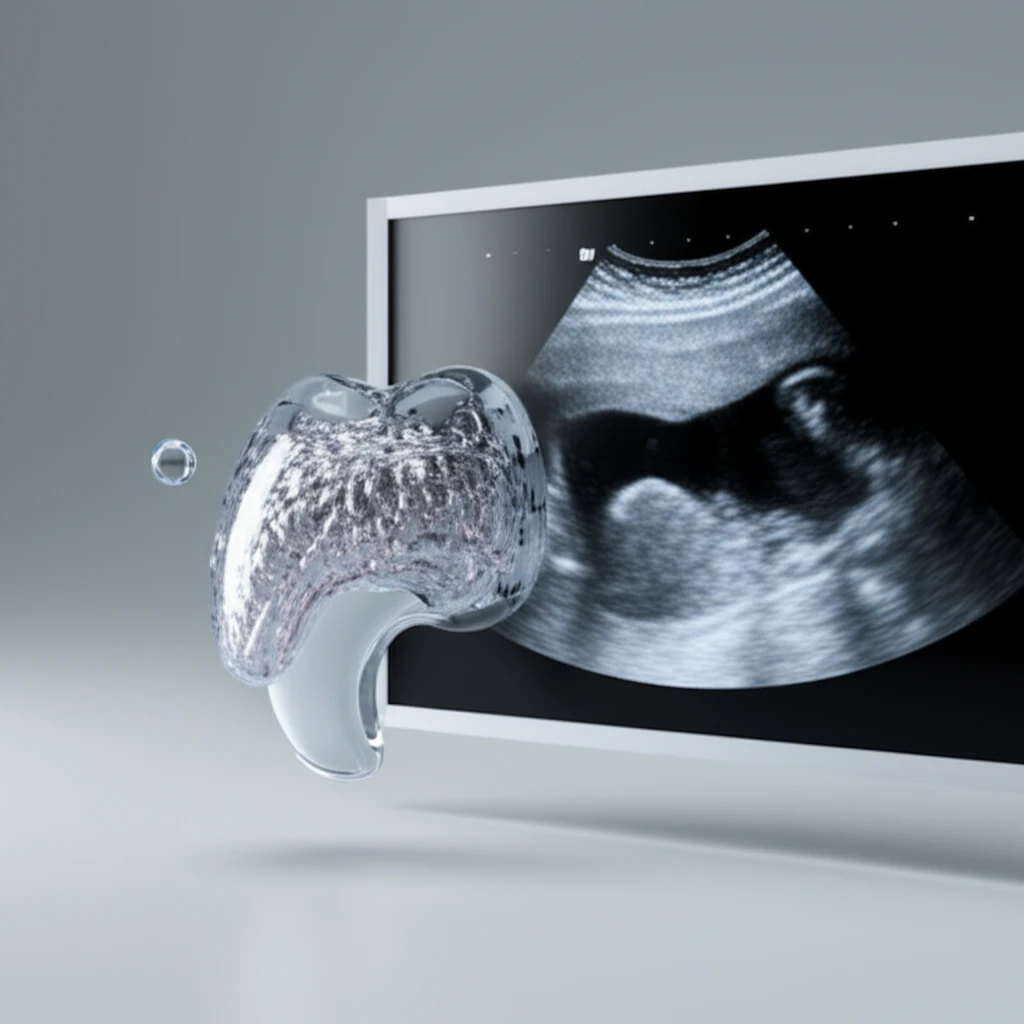
Salivary gland transforming into an ultrasound scan for Sjogren's diagnosis.

Sjogren's Syndrome: Can Ultrasound Be the Key to Earlier Diagnosis?

"New research highlights the potential of salivary gland ultrasounds in improving the accuracy and speed of diagnosing primary Sjogren's syndrome, offering hope for earlier intervention."


Primary Sjogren's syndrome (pSS) presents a significant diagnostic challenge. This autoimmune condition, characterized by dryness of the eyes and mouth, often goes undetected for years, leading to delayed treatment and increased suffering. Traditional diagnostic methods can be invasive or lack sensitivity, underscoring the urgent need for more reliable and accessible tools.

Recent research has focused on the potential of salivary gland ultrasonography (US-SG) as a non-invasive and readily available method for detecting abnormalities associated with pSS. Ultrasound offers a promising alternative for visualizing the salivary glands and identifying telltale signs of the disease.

This article delves into the findings of a study that defines specific US-SG abnormalities indicative of pSS and assesses the reliability of ultrasound as a diagnostic tool. By exploring these advancements, we aim to shed light on how ultrasound could revolutionize the diagnosis and management of Sjogren's syndrome.

Unveiling Ultrasound's Potential: Core Indicators of Sjogren's Syndrome

Salivary gland transforming into an ultrasound scan for Sjogren's diagnosis.

A collaborative study involving international experts sought to establish clear criteria for identifying pSS through US-SG. The researchers focused on defining specific echostructural abnormalities within the salivary glands that could serve as reliable indicators of the disease. These included:

The study's methodology involved a multi-stage process:

  • Consensus Meetings: Experts in SG US imaging convened to select and define key echostructural abnormalities.
  • Atlas Development: A preliminary atlas of these defined abnormalities was created to serve as a visual reference.
  • Reliability Assessment: The reliability of detecting these abnormalities was tested using both static US-SG images and real-time acquisition in pSS patients.
The study identified two key US-SG items with substantial reliability: echogenicity (the brightness of the gland tissue) and homogeneity (the uniformity of the gland's texture). These findings suggest that trained experts can consistently identify these features using ultrasound.

A Brighter Future for Sjogren's Syndrome Diagnosis

This research offers a significant step forward in improving the diagnosis of primary Sjogren's syndrome. By identifying reliable ultrasound markers and establishing a preliminary atlas, the study provides a foundation for more consistent and accurate diagnoses.

The findings suggest that trained experts can use ultrasound to identify key indicators of pSS, potentially leading to earlier intervention and improved patient outcomes. The non-invasive nature of ultrasound also makes it a more accessible and patient-friendly diagnostic option.

Further research is needed to validate these findings in larger populations and to explore the potential of ultrasound in monitoring disease progression and treatment response. However, this study provides compelling evidence that ultrasound holds great promise as a valuable tool in the fight against Sjogren's syndrome.

About this Article -

This article was crafted using a human-AI hybrid and collaborative approach. AI assisted our team with initial drafting, research insights, identifying key questions, and image generation. Our human editors guided topic selection, defined the angle, structured the content, ensured factual accuracy and relevance, refined the tone, and conducted thorough editing to deliver helpful, high-quality information.See our About page for more information.

This article is based on research published under:

DOI-LINK: 10.1136/rmdopen-2016-000364, Alternate LINK

Title: Salivary Gland Ultrasound Abnormalities In Primary Sjögren’S Syndrome: Consensual Us-Sg Core Items Definition And Reliability

Subject: Immunology

Journal: RMD Open

Publisher: BMJ

Authors: Sandrine Jousse-Joulin, Emmanuel Nowak, Divi Cornec, Jackie Brown, Andrew Carr, Marina Carotti, Benjamin Fisher, Joel Fradin, Alojzija Hocevar, Malin V Jonsson, Nicoletta Luciano, Vera Milic, John Rout, Elke Theander, Aaltje Stel, Hendrika Bootsma, Arjan Vissink, Chiara Baldini, Alan Baer, Wan Fai Ng, Simon Bowman, Zarrin Alavi, Alain Saraux, Valérie Devauchelle-Pensec

Published: 2017-06-01

Everything You Need To Know

1

What are the main characteristics and diagnostic challenges associated with primary Sjogren's syndrome?

Primary Sjogren's syndrome (pSS) is an autoimmune condition primarily characterized by dryness of the eyes and mouth. The challenge lies in its diagnosis, which often faces delays due to the limitations of traditional methods. This delay can lead to increased suffering for individuals affected by pSS.

2

How can salivary gland ultrasounds help in the diagnosis of primary Sjogren's syndrome?

Salivary gland ultrasonography (US-SG) is a non-invasive imaging technique that uses sound waves to visualize the salivary glands. It offers a readily available method for detecting abnormalities in these glands, which can be indicative of primary Sjogren's syndrome (pSS).

3

What specific indicators detectable by ultrasound were identified as reliable markers for primary Sjogren's syndrome?

The study identified echogenicity (brightness of gland tissue) and homogeneity (uniformity of the gland's texture) as two key and reliable indicators detectable via salivary gland ultrasonography (US-SG). These markers suggest that trained experts can consistently identify these features during ultrasound examinations, aiding in the diagnosis of primary Sjogren's syndrome (pSS).

4

How did the international study define reliable indicators for primary Sjogren's syndrome using ultrasound?

The international study established clear criteria for identifying primary Sjogren's syndrome (pSS) through salivary gland ultrasonography (US-SG) by defining specific echostructural abnormalities within the salivary glands. The process involved consensus meetings among experts, the development of an atlas of defined abnormalities, and reliability assessments using both static images and real-time acquisition in primary Sjogren's syndrome (pSS) patients.

5

What are the potential implications of using ultrasound for earlier diagnosis of primary Sjogren's syndrome, and what further research is needed?

The research findings offer a pathway to earlier and more accurate diagnosis of primary Sjogren's syndrome (pSS). By identifying reliable ultrasound markers like echogenicity and homogeneity, and establishing a preliminary atlas, the study provides a foundation for more consistent diagnoses. This quicker identification could lead to earlier intervention and management of the condition, but further validation is needed to assess the long-term impact on patient outcomes and the reduction of disease-related complications in primary Sjogren's syndrome (pSS).

Newsletter Subscribe

Subscribe to get the latest articles and insights directly in your inbox.