
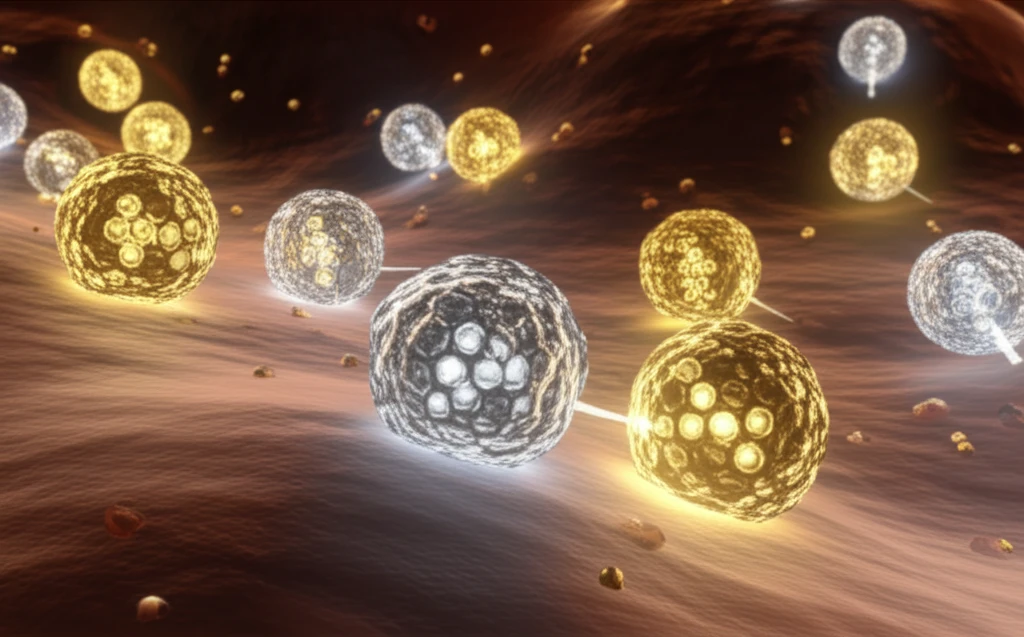
Silver & Gold Nanoparticles: A New Weapon in the Fight Against Cancer?

"Researchers explore how combining silver and gold nanoparticles can selectively target and destroy cancer cells, opening doors to less toxic cancer treatments."
Cancer treatment often feels like a balancing act – trying to eliminate cancerous cells without severely damaging the body's healthy tissues. Traditional methods like chemotherapy and radiation, while effective, can come with harsh side effects that significantly impact a patient's quality of life. This has driven researchers to explore more targeted and less toxic approaches to cancer therapy.
Nanotechnology, the manipulation of matter on an atomic and molecular scale, offers promising avenues for developing such treatments. In particular, nanoparticles – tiny particles measuring just billionths of a meter – can be engineered to interact with biological systems in unique ways. Scientists are investigating the potential of nanoparticles to deliver drugs directly to cancer cells, enhance imaging techniques, and even directly destroy tumors.
Recent research focuses on bimetallic nanoparticles (BNPs), which combine two different metals into a single nanoparticle. These BNPs can possess unique properties that are superior to those of nanoparticles made from a single metal. One promising area of research involves combining silver (Ag) and gold (Au) into BNPs to target and destroy cancer cells. This article explores how these Ag/Au BNPs work, their potential benefits, and the remaining challenges in bringing this technology to the forefront of cancer treatment.
How Ag/Au Nanoparticles Selectively Kill Cancer Cells
The study highlights that Ag/Au BNPs can be synthesized as “alloys” using a chemical reduction method involving tryptophan, an amino acid. The key is finding the right balance of silver and gold, along with the appropriate amount of tryptophan, to maximize the nanoparticles' effectiveness against cancer cells while minimizing harm to healthy cells.
- Metal Ratio: A 3:1 silver-to-gold ratio appears to be optimal for targeting cancer cells.
- Tryptophan's Role: Tryptophan helps stabilize the nanoparticles and may contribute to their selective toxicity.
- Selective Toxicity: BNPs show a preference for cancer cells over healthy cells, potentially reducing side effects.
The Future of Nanoparticle Cancer Therapy
This research provides a promising step towards developing more targeted and less toxic cancer therapies. By carefully controlling the composition and properties of Ag/Au BNPs, scientists may be able to create treatments that selectively destroy cancer cells while sparing healthy tissues.
While these findings are encouraging, further research is needed to fully understand the long-term effects and potential risks of using Ag/Au BNPs in humans. Future studies will focus on:
<ul><li><b>In vivo studies:</b> Testing the nanoparticles in living organisms to assess their efficacy and safety.</li><li><b>Targeted delivery:</b> Enhancing the nanoparticles' ability to specifically target cancer cells.</li><li><b>Personalized medicine:</b> Tailoring nanoparticle treatments to individual patients based on their cancer type and genetic makeup.</li></ul>