
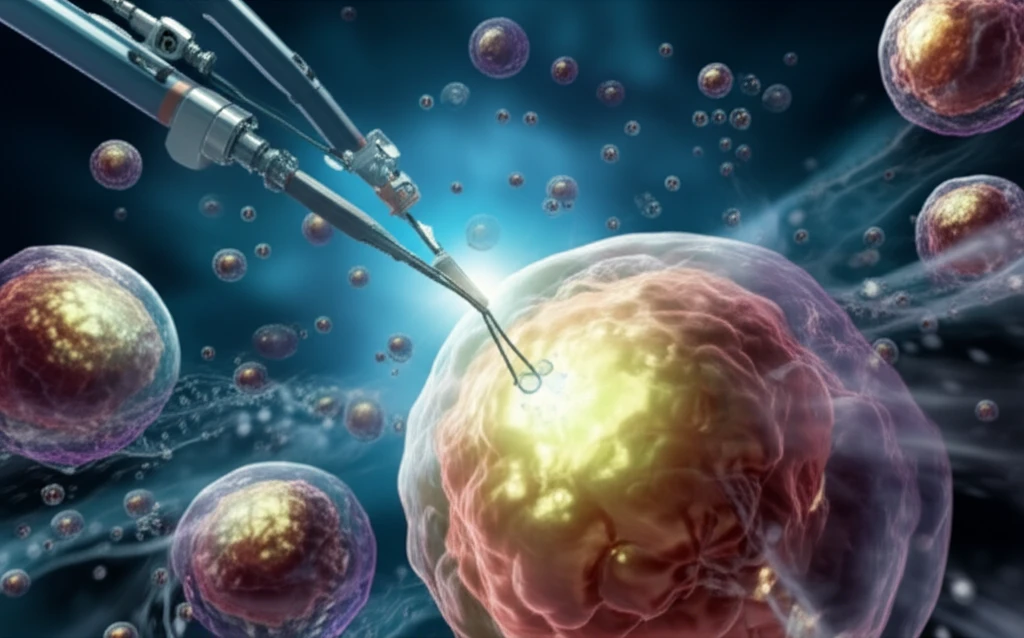
Tiny Tech Titans: How Nanoparticles Are Revolutionizing Medicine

"From cancer treatments to targeted drug delivery, explore the groundbreaking potential of nanoparticles and their impact on our health."
In the vast, intricate world of medicine, scientists are constantly seeking new ways to tackle complex diseases and improve patient outcomes. One of the most promising frontiers in this quest lies in the realm of nanotechnology, specifically with the use of nanoparticles. These microscopic particles, often smaller than a virus, are not just tiny; they are powerful tools with the potential to revolutionize healthcare as we know it.
Imagine a world where cancer treatments are more precise, side effects are minimized, and drugs are delivered directly to where they are needed most. This isn't science fiction; it's the reality that nanoparticles are helping to create. By harnessing the unique properties of these minuscule structures, researchers are developing innovative solutions to some of the most challenging medical problems. This article will dive into the exciting world of nanoparticles, exploring their diverse applications and the incredible impact they are making on the future of medicine.
From targeted drug delivery to advanced imaging techniques, nanoparticles offer unprecedented opportunities to diagnose, treat, and prevent diseases. This article will explore how these tiny tech titans are reshaping the landscape of healthcare. The paper aims to provide a comprehensive overview of the applications of nanoparticles, focusing on current breakthroughs and their potential for future development, ensuring the reader understands the profound changes that are about to happen.
A Growing Data and Market Footprint
Nanomaterials are generally defined as materials with at least one nanoscale external dimension, according to STATNANO. The STATNANO database and eNanoMapper provide structured resources for exploring nanomaterial characterization, biological, and toxicological information. A March 2026 market analysis reports that North America held 39.4% of the nanotechnology market in 2024 and generated USD 245.2 million in AI-integrated nano revenue. Market research on nanoparticles also increasingly examines market size, growth drivers, country-level insights, segmentation, and key players.
A Field Still Balancing Promise and Proof
Nanoparticle research commonly depends on carefully characterizing particle properties, evaluating biological interactions, and testing performance in relevant experimental systems. However, methods and results can vary with particle composition, size, shape, surface features, and testing conditions. These differences make comparisons difficult and mean that promising laboratory findings should be interpreted cautiously until they are supported by broader validation. Standardized characterization, safety assessment, and reproducible testing remain important for reliable medical translation.
From Early Concepts to Modern Nanomedicine
The history of nanoscience and nanotechnology includes both pre-modern and modern eras of discoveries and milestones. Although nanotechnology is a relatively recent research field, its central concepts developed over a much longer period. The emergence of nanotechnology in the 1980s followed a convergence of experimental developments and scientific ideas. Accounts of nanoparticle history describe a progression from ancient uses and observations toward modern technology and practical applications.
Unveiling the Nanoworld: What Are Nanoparticles?
To understand the impact of nanoparticles, it's essential to grasp what they are. A nanoparticle is a particle that measures between 1 and 100 nanometers. To put this in perspective, a nanometer is one billionth of a meter. To give you a better visualization, it is like comparing the size of a marble to the size of the Earth. This incredibly small size gives nanoparticles unique properties that make them incredibly useful in medical applications. These properties include a high surface area-to-volume ratio, which enhances their ability to interact with biological systems, and the ability to be engineered with specific characteristics.
- Targeted Drug Delivery: Delivering medications directly to diseased cells, reducing side effects.
- Enhanced Imaging: Improving the visibility of diseases for more accurate diagnosis.
- Cancer Therapy: Developing new treatments that can kill cancer cells with greater precision.
- Wound Healing: Creating advanced materials to promote faster and more effective healing.
A Rapidly Expanding Research Landscape
Nanoparticles are commonly described as particles below 100 nanometers in at least one dimension. Nature highlights properties including uniformity, conductance, and distinctive optical behavior, while Springer tracks new discoveries and methods from researchers across the field. A 2025 comprehensive review classifies nanoparticles as organic, inorganic, or carbon-based and examines properties such as mechanical, thermal, and magnetic behavior. These reviews show how nanoparticle research spans foundational materials science as well as potential medical and industrial applications.
Promise Does Not Eliminate Uncertainty
Nanoparticle-based medical approaches can produce encouraging results, but their effectiveness and safety may depend strongly on particle design and testing conditions. Early-stage findings do not necessarily predict clinical performance, and unresolved questions can remain about toxicity, biodistribution, manufacturing, and long-term effects. As a result, the field requires cautious interpretation rather than assuming that nanoscale delivery automatically improves treatment. Failures and limitations are part of determining which designs can be translated responsibly.
Comparing Designs and Production Methods
Nanoparticles differ from macro- and microparticles because their physicochemical properties can create advantages for applications in pharmacy and medicine. Preparation methods can influence particle size, shape, stability, and functional efficiency, making synthesis an important part of performance comparison. A 2024 review specifically compares chemical and green synthesis, including their advantages, disadvantages, and persistent problems associated with toxic nanoparticle production. Preclinical comparisons also examine drug-delivery systems prepared by high-pressure homogenization and alternative fabrication methods, including quantitative in vivo performance data.
The Future Is Nano: A Healthier Tomorrow
Nanoparticles are not just a scientific curiosity; they are the future of medicine. As research continues and technology advances, we can expect even more innovative applications of nanoparticles. The potential for improving human health is enormous, and the advancements in this field are a source of hope and excitement for patients and researchers. As we move forward, embracing the possibilities that nanoparticles offer will be crucial to creating a healthier, more advanced, and more personalized healthcare system.
Turning Materials Innovation Into Medicine
Nanoparticles bring together materials science, biology, engineering, and pharmaceutical development. Their medical value depends not only on novel nanoscale properties but also on reproducible preparation, meaningful biological testing, and evidence of safety. A balanced synthesis therefore treats nanoparticles as enabling platforms rather than universal solutions. Continued progress will require connecting laboratory advances with practical clinical requirements.
Toward Smarter and More Sustainable Nanotechnology
Recent outlooks identify advanced nanomaterials and nanodevices, energy and sustainability applications, and computational breakthroughs as major directions for nanotechnology. Other highlighted areas include nanofilms, carbon nanomaterials, and semiconductor nanodevices, alongside practical use cases and innovative startups. Forecasts for medicine emphasize innovations that could reshape healthcare, while also noting potential risks, investment opportunities, timelines, and research directions. Overcoming current obstacles is presented as necessary for nanoparticles to contribute to sustainable technological advancement.
Safety, Regulation, and Biological Complexity
Reviews of nanoparticle impacts emphasize that these materials can affect biological systems in complex ways and require effective mitigation strategies and regulatory frameworks. Nanoparticles are also being studied against microbial contamination and antimicrobial resistance, but proposed applications raise questions about toxicity, environmental impact, and regulation. Clinical translation is hindered by unpredictable biodistribution in diseased patients, partly because engineered particle properties interact with changing biological barriers. These concerns show why responsible use must address human health, environmental effects, and governance together.
Keeping People at the Center
The practical value of nanoparticle medicine ultimately depends on whether it can improve health safely and reliably for patients. Researchers must weigh potential therapeutic benefits against uncertainty about biological behavior, toxicity, environmental effects, and regulation. Real-world impact also depends on translating controlled laboratory results into treatments that work across diverse patients and healthcare settings. A patient-centered approach therefore requires both innovation and careful evaluation of risks.