
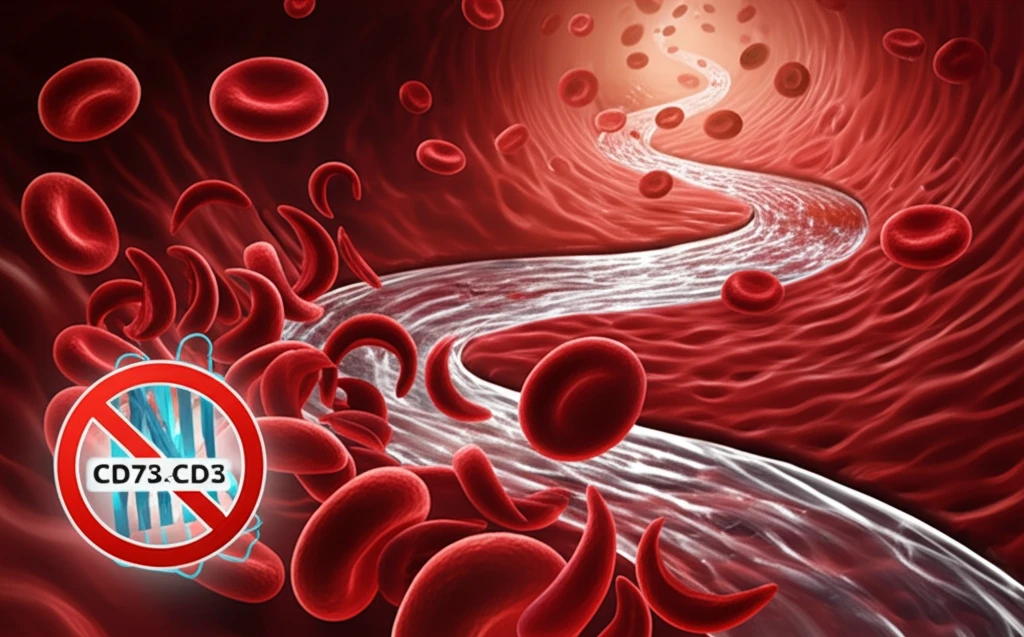
Illustration of healthy and sickled red blood cells with CD73 inhibition symbol

Sickle Cell Breakthrough: New Hope Through Ecto-5'-Nucleotidase Inhibition

"Targeting CD73 offers a novel therapeutic strategy for sickle cell disease, reducing sickling and improving overall health"


Sickle cell disease (SCD) is a devastating genetic disorder affecting millions worldwide, causing chronic pain, organ damage, and reduced life expectancy. Despite advancements in medical science, effective treatments remain limited. The disease stems from a mutation in hemoglobin, leading to sickled red blood cells that obstruct blood flow, causing immense suffering and complications.

A groundbreaking study has uncovered a new piece of the puzzle: the enzyme ecto-5'-nucleotidase, or CD73. This enzyme, responsible for producing adenosine, appears to play a significant role in the progression of SCD. Elevated levels of CD73 activity worsen the condition, suggesting that targeting CD73 could offer a novel therapeutic approach.

This article breaks down the findings of this critical research, explaining how CD73 contributes to the pathology of SCD and how inhibiting its activity shows promise in preclinical models. We'll explore the potential for new treatments and what this means for individuals and families affected by this challenging condition.

How Does CD73 Contribute to Sickle Cell Disease?

Illustration of healthy and sickled red blood cells with CD73 inhibition symbol

The study reveals that soluble CD73, an enzyme that produces adenosine outside of cells, is significantly elevated in a mouse model of SCD. This increase correlates with higher levels of adenosine in the blood plasma. Adenosine, while having some beneficial functions in the body, can be detrimental in excess. The research demonstrates that CD73 activity actively promotes sickling, hemolysis (destruction of red blood cells), multiorgan damage, and overall disease progression.

The mechanism behind this involves a cascade of events:

  • AMPK Activation: Adenosine triggers the activation of adenosine monophosphate-activated protein kinase (AMPK) within red blood cells.
  • 2,3-BPG Production: AMPK then regulates the production of 2,3-bisphosphoglycerate (2,3-BPG), a molecule that reduces hemoglobin's affinity for oxygen.
  • Increased Sickling: Lower oxygen affinity promotes the formation of deoxyhemoglobin S (HbS), the mutated form that causes red blood cells to sickle.
In essence, CD73-mediated adenosine production exacerbates the very problem at the heart of SCD: the propensity of red blood cells to sickle and cause blockages.

Looking Ahead: CD73 Inhibitors as a Potential Therapy

This research opens exciting new avenues for treating SCD. By identifying CD73 as a key player in the disease process, scientists can now focus on developing specific CD73 inhibitors. Preclinical studies in mice using a CD73 inhibitor called a,ß-methylene adenosine 5′-diphosphate (APCP) have shown promising results, significantly reducing sickling, hemolysis, and organ damage. While further research is needed, these findings offer a beacon of hope for more effective and targeted therapies for sickle cell disease.

About this Article -

This article was crafted using a human-AI hybrid and collaborative approach. AI assisted our team with initial drafting, research insights, identifying key questions, and image generation. Our human editors guided topic selection, defined the angle, structured the content, ensured factual accuracy and relevance, refined the tone, and conducted thorough editing to deliver helpful, high-quality information.See our About page for more information.

This article is based on research published under:

DOI-LINK: 10.1182/bloodadvances.2018015784, Alternate LINK

Title: Elevated Ecto-5′-Nucleotidase: A Missing Pathogenic Factor And New Therapeutic Target For Sickle Cell Disease

Subject: Hematology

Journal: Blood Advances

Publisher: American Society of Hematology

Authors: Hong Liu, Morayo Adebiyi, Rong Rong Liu, Anren Song, Jeanne Manalo, Yuan Edward Wen, Alexander Q. Wen, Tingting Weng, Junsuk Ko, Modupe Idowu, Rodney E. Kellems, Holger K. Eltzschig, Michael R. Blackburn, Harinder S. Juneja, Yang Xia

Published: 2018-08-10

Everything You Need To Know

1

What is the role of CD73 in sickle cell disease?

CD73, also known as ecto-5'-nucleotidase, is an enzyme identified as a key factor in sickle cell disease (SCD). It produces adenosine, and elevated levels of CD73 activity worsen the condition by promoting sickling, hemolysis (red blood cell destruction), and multiorgan damage. This makes CD73 a critical target for potential therapies in SCD.

2

How does inhibiting CD73 help in sickle cell disease?

Inhibiting CD73 reduces the detrimental effects associated with sickle cell disease. Blocking CD73's activity with inhibitors, such as a,ß-methylene adenosine 5′-diphosphate (APCP) in preclinical studies, leads to reduced sickling of red blood cells, decreased hemolysis, and less organ damage. These positive outcomes suggest that CD73 inhibitors could offer a new approach for treating SCD.

3

Can you explain the mechanism by which CD73 worsens sickle cell disease?

The mechanism involves a chain of events starting with CD73 producing adenosine. This excess adenosine activates adenosine monophosphate-activated protein kinase (AMPK) within red blood cells. AMPK then boosts the production of 2,3-bisphosphoglycerate (2,3-BPG), which lowers hemoglobin's affinity for oxygen. This, in turn, encourages the formation of deoxyhemoglobin S (HbS), the mutated form of hemoglobin that causes red blood cells to sickle, leading to the progression of SCD.

4

What are the current treatment options for sickle cell disease, and how does the CD73 research offer a new perspective?

Current treatments for sickle cell disease are limited and often focus on managing symptoms, such as pain, and preventing complications. They may include blood transfusions and hydroxyurea. The CD73 research presents a novel therapeutic strategy by targeting the enzyme CD73 directly. This approach aims to reduce sickling, hemolysis, and organ damage, offering a potential for more effective and targeted therapies compared to existing options.

5

What are the next steps in the research on CD73 inhibitors for sickle cell disease?

The research on CD73 inhibitors is in its early stages, primarily involving preclinical studies using models, such as a mouse model of SCD. The next steps will likely include further investigation into the safety and efficacy of CD73 inhibitors. This will involve conducting more comprehensive preclinical studies to refine the therapeutic strategies and prepare for clinical trials to evaluate their effectiveness in humans with sickle cell disease.

Newsletter Subscribe

Subscribe to get the latest articles and insights directly in your inbox.