
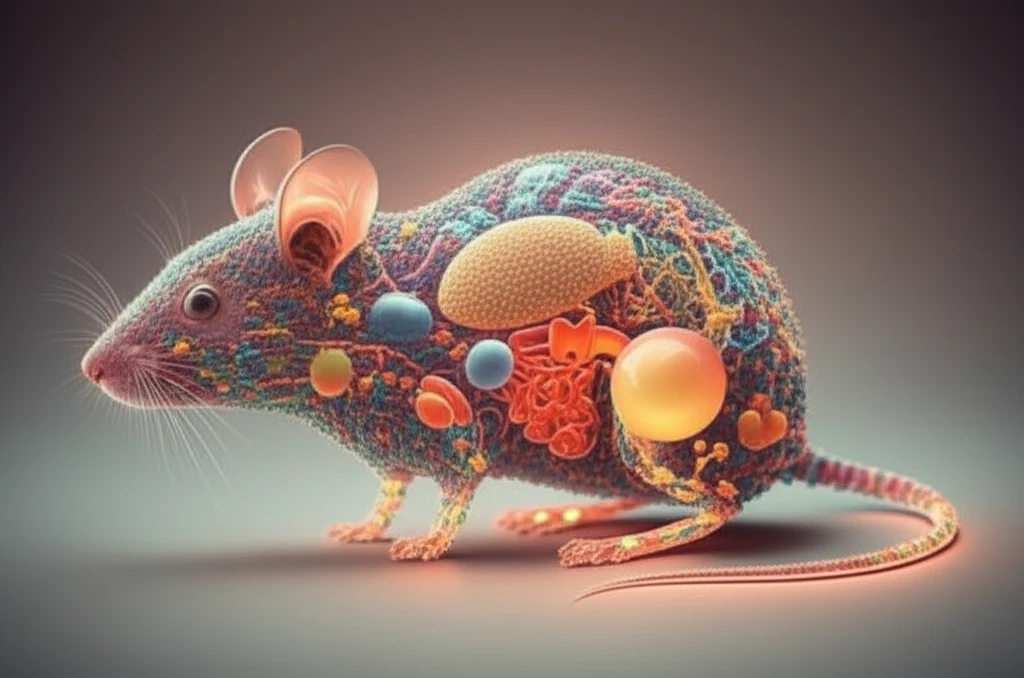
See Clearer: New Algorithm Enhances Molecular Imaging

"A breakthrough in Fluorescence Molecular Tomography promises more accurate and faster results for small animal imaging, offering new hope for disease detection and drug development."
Fluorescence Molecular Tomography (FMT) is rapidly becoming an essential tool in biomedical research, offering a non-invasive way to visualize and understand biological processes at a molecular level. Imagine being able to track the effectiveness of a new cancer drug in real-time or pinpoint the exact location of a tumor before it's visible on traditional scans. That's the promise of FMT.
However, like any technology, FMT faces challenges. One of the biggest hurdles is the 'ill-posedness' of the reconstruction problem. This means that getting a clear, accurate image from the data collected is incredibly difficult, often requiring complex algorithms to overcome.
Now, researchers have introduced a new algorithm called the Half Thresholding Pursuit Algorithm (HTPA) that tackles this challenge head-on. By combining smart mathematical techniques with an efficient computational approach, HTPA promises to deliver more accurate FMT images, faster than ever before.
Decoding HTPA: How Does It Work?
At its core, HTPA is designed to solve a specific type of mathematical problem that arises in FMT image reconstruction. This problem involves what's known as l1/2-norm regularization. In simple terms, this technique encourages the reconstructed image to be sparse, meaning it contains only a few non-zero values. This is particularly useful in FMT because the fluorescent probes being imaged are often concentrated in specific areas.
- Half Thresholding Iteration: An efficient method to solve the l1/2-norm model, refining the image with each iteration.
- Pursuit Strategy: Accelerates the iteration process, allowing for faster results.
- Parameter Optimization: A scheme designed to automatically find the best parameters for the algorithm, making it more robust and reliable.
The Future of Molecular Visualization
The results of the study are compelling. In both simulated and real-world experiments, HTPA outperformed existing algorithms in terms of accuracy, speed, and robustness. This means that HTPA can produce clearer FMT images, identify the location of fluorescent probes more precisely, and do it all in less time.
While the current research focuses on small animal imaging, the implications for human health are significant. As FMT technology continues to evolve, algorithms like HTPA will play a crucial role in improving disease detection, drug development, and personalized medicine.
Further research will focus on refining HTPA and exploring its potential in other areas of biomedical imaging. The ability to visualize molecular processes with greater clarity and speed opens up exciting new possibilities for understanding and treating disease.