
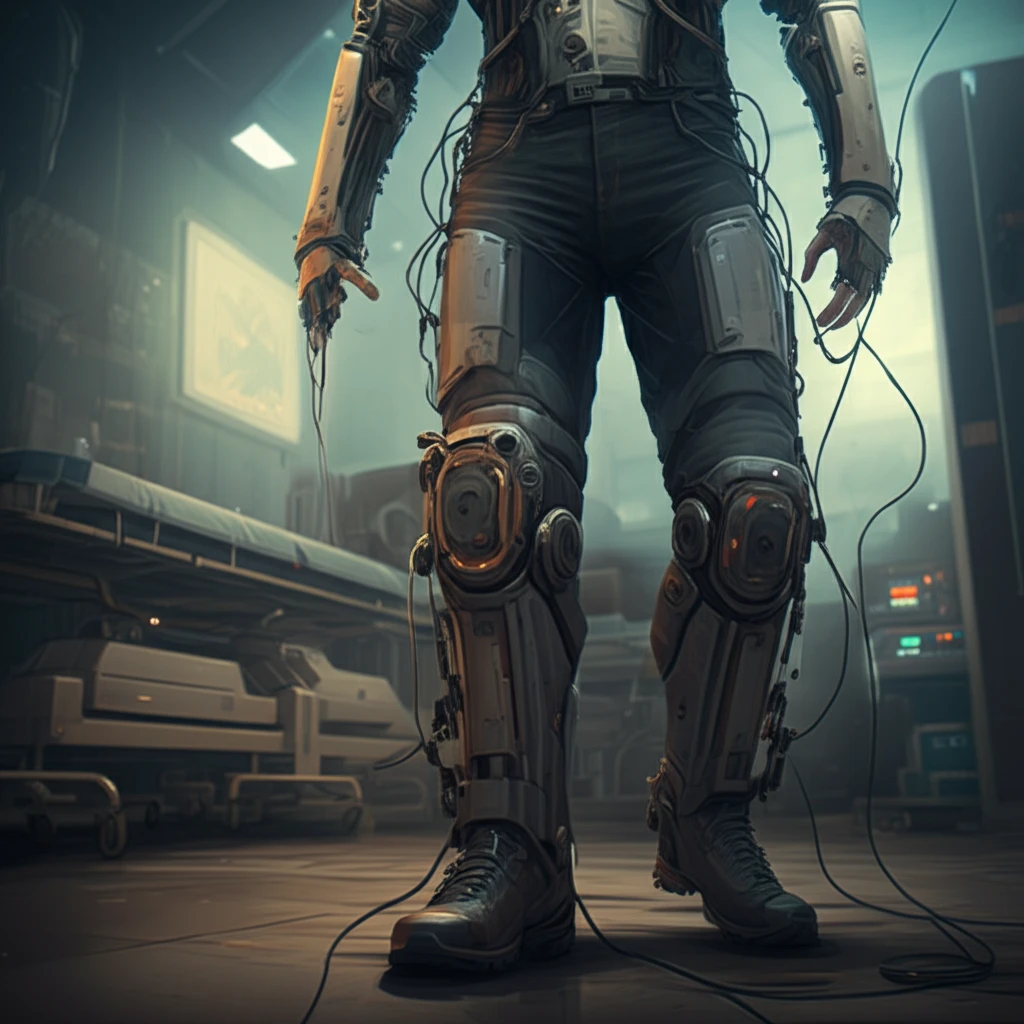
Robotic Exoskeletons: The Future of Knee Rehabilitation and Recovery

"Discover how cutting-edge robotic exoskeletons are revolutionizing lower limb rehabilitation, offering new hope and improved outcomes for patients with knee joint impairments."
Stroke stands as a leading cause of permanent disability worldwide, often resulting in partial paralysis that significantly impacts daily living. While rehabilitation therapy aims to restore lost abilities, traditional methods can be labor-intensive and challenging, both for patients and therapists.
Enter robotic exoskeletons: a technological advancement poised to transform lower limb rehabilitation. By integrating robotics into the recovery process, we can enhance the effectiveness of therapy, making it easier for therapists to assist patients in regaining mobility and independence.
This article delves into the exciting world of robotic exoskeletons for knee joint rehabilitation. We'll explore the control strategies that power these devices and discuss their potential to revolutionize the recovery journey for individuals with knee joint impairments.
A Rapidly Expanding Market
The robotic exoskeletons industry is experiencing explosive growth, with projections showing the market expanding from USD 2.94 billion in 2025 to USD 85.05 billion by 2035 at a compound annual growth rate of 40.0%. This surge is driven by increasing incidence of stroke, spinal cord injuries, and age-related mobility impairments—conditions that often result in partial or complete loss of limb function. Exoskeletons, defined as biomechatronic wearable robots attached to a person's body, represent a transformative solution for these widespread health challenges.
Current Standards and Practical Barriers
Public awareness of robotic exoskeletons remains limited, even as some devices are already in use to assist people with physical disabilities or to augment the strength of first responders. Developing safety standards for exoskeletons presents unique challenges, including ensuring user comfort, enabling free movement while augmenting physical abilities, and limiting extremes of movement to prevent awkward postures. Clinicians working with exoskeletons for locomotor training following spinal cord injury have also highlighted the need for improved user interfaces and intuitive design to support real-world clinical adoption.
From Hardiman to Modern Wearable Robotics
The development of robotic exoskeletons began in the second half of the 20th century, with General Electric starting work on the Hardiman around 1965—a large full-body exoskeleton designed to augment the user's strength for lifting heavy objects. Since the 1960s, research has expanded across medical, military, and industrial fields, with ongoing efforts to improve exoskeleton speed and reduce the clumsiness and weight of early designs. Recent milestones include NIH-supported research on robotic leg exoskeletons that provide personalized walking assistance under real-world conditions, signaling a shift toward practical, user-centered rehabilitation devices.
Exoskeletons: A New Era in Rehabilitation
Robotic exoskeletons represent a significant leap forward in rehabilitation technology. These assistive robots are designed to either compensate for lost function or actively aid in the recovery process. Unlike traditional methods, exoskeletons offer the potential for:
- Consistency and Precision: Robotic assistance ensures that exercises are performed accurately and consistently, maximizing their therapeutic benefit.
- Customized Therapy: Exoskeletons can be programmed to deliver personalized rehabilitation programs tailored to each patient's specific needs and goals.
- Objective Monitoring: Sensors within the exoskeleton can track patient progress objectively, providing valuable data for therapists to optimize treatment plans.
- Reduced Therapist Burden: Exoskeletons alleviate the physical demands on therapists, allowing them to focus on patient motivation and overall well-being.
Neurorehabilitation and Control Strategy Advances
Since the late 1990s, there has been a burst of research on robotic devices for post-stroke rehabilitation, with robot-mediated therapy encouraging the design of exoskeletons targeting multiple degrees of freedom at the joint level. Upper-limb robotic exoskeletons for neurorehabilitation have been a major focus, with studies reviewing increasingly sophisticated control strategies to improve therapeutic outcomes. This body of research reflects a maturing field moving from proof-of-concept devices toward clinically informed designs that address real patient needs.
Cost Barriers and Limited Clinical Evidence
Despite their promise as rehabilitation tools that may ameliorate health-related consequences after spinal cord injury, robotic exoskeletons face a significant gap in clinical evidence to fully support widespread application. A major obstacle is their prohibitive cost, which limits accessibility for many patients and healthcare systems. While the field is recognized as promising and potentially profitable, considerable challenges in research and development must be addressed before exoskeletons can become standard rehabilitation equipment.
Gait Balance and Exoskeleton Performance
Limited information has been available on how robotic exoskeletons affect gait characteristics, but emerging research is examining their impact on temporospatial parameters, kinematics, and muscle activity during walking. A key area of analysis compares statically versus dynamically balanced gait when wearing a robotic exoskeleton versus unassisted human walking. Understanding these differences is essential for optimizing exoskeleton design to produce natural, efficient movement patterns in rehabilitation settings.
The Path Forward
Robotic exoskeletons represent a promising avenue for improving knee rehabilitation and restoring mobility to individuals with impairments. As research continues to refine control strategies and optimize exoskeleton design, we can expect even greater advancements in this field, leading to more effective and personalized rehabilitation experiences. The future of knee rehabilitation is here, and it's powered by robotics.
Market Consolidation and Growth Trajectory
The global robotic exoskeletons market continues to attract significant investment and analytical attention, with industry reports tracking market size and compound annual growth rates through 2033. Multiple research firms are monitoring the sector's expansion, reflecting confidence in the technology's trajectory despite ongoing challenges. This sustained market interest underscores the broader consensus that exoskeletons are transitioning from experimental devices to viable commercial products in the rehabilitation space.
Divergent Forecasts and Growth Drivers
Market projections for robotic exoskeletons vary considerably across research firms, reflecting the early and evolving nature of the industry. One report valued the market at USD 1.4 billion in 2024, while another projected growth from USD 757.64 million in 2025 to USD 1,791.28 million by 2032 at a CAGR of 13.08%, and yet another forecast a 17.9% CAGR from 2025 to 2035 driven by rehabilitation and military demand. Despite these differing figures, all sources agree that continuous innovation in ergonomics and design is needed to improve user experience, and that healthcare, defense, and industrial applications will remain key growth sectors.
Manufacturing Precision and Material Demands
Robotic exoskeletons demand specialized CNC machining to meet the rigorous performance requirements of wearable devices. Wearable joints must withstand sudden impact loads from falls or accidental collisions, necessitating materials like 17-4PH stainless steel for high-stress shafts and gears due to their high fatigue limits. These engineering constraints highlight that the path to mainstream exoskeleton adoption depends not only on software and control advances but also on precision manufacturing and material science breakthroughs.
Speed, Balance, and Real-World Application
Research published in Science Robotics demonstrated that an ankle exoskeleton must react faster than the human body's own neuromuscular responses to effectively improve balance—participants did not recover more quickly when the device delayed applying power to match natural muscle activation timing. Beyond clinical rehabilitation, powered exoskeletons, passive exosuits, and powered clothing are bringing wearable robotics out of laboratories and into everyday life, with applications ranging from mobility assistance to recreational and sports use. These developments signal a future where exoskeletons may become as common as other wearable health technologies.