
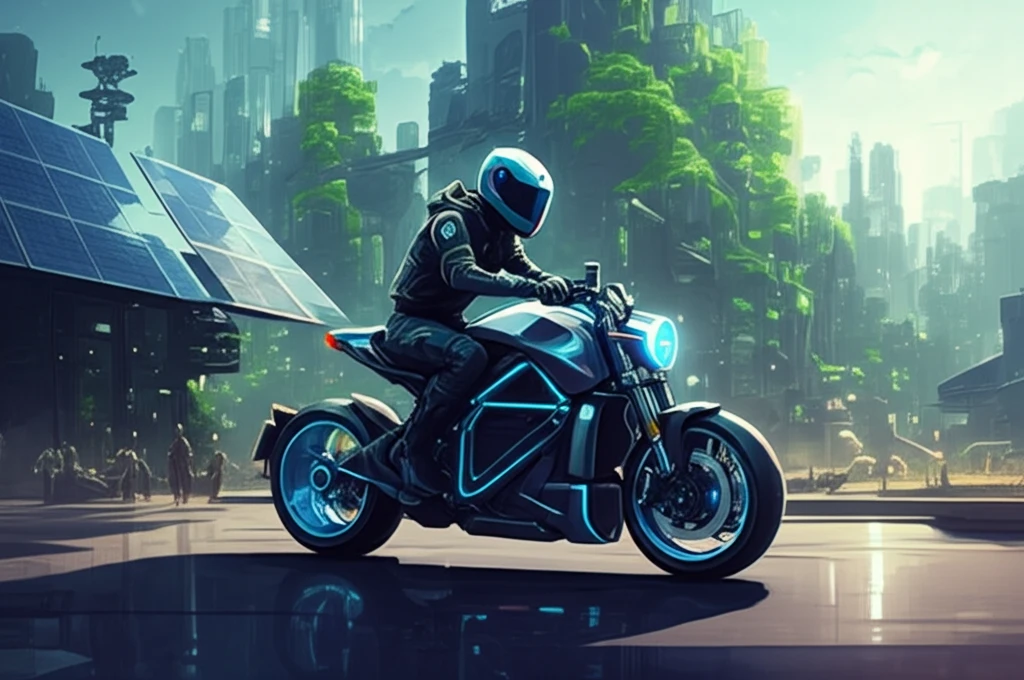
Revolutionizing Urban Mobility: How Electric Motorcycles are Shaping the Future of Business

"Discover the innovative electric motor technology driving a new era of efficient and sustainable business transportation."
The rise of electric vehicles (EVs) isn't just a trend; it's a necessary shift toward sustainability, especially in densely populated urban environments. As concerns about CO2 emissions grow, innovative solutions are needed to reduce our carbon footprint. Electric motorcycles are emerging as a promising answer, offering a cleaner, more efficient way to navigate city streets. The focus has expanded from personal use to business applications, signaling a significant change in how companies approach transportation logistics.
Since the initial mass production of electric scooters in 1994, continuous research has propelled the technology of electric motorcycles forward. Building on conventional techniques, a new electric motorcycle suitable for business applications was developed. This new model incorporates a high-power lithium-ion battery, enabling a quick charge operation, reaching 80% SOC in just 20 minutes. It also maintains consistent driving and charging power even in temperatures as low as -10°C.
Performance-wise, this electric motorcycle rivals a 50 cm³ gasoline-fueled scooter. It can handle a 12-degree uphill slope with a 30 kg load, ensuring reliable operation in various conditions. The motor at the heart of this vehicle was developed with these specific performance targets in mind, and this paper discusses the techniques and achievements that made it possible.
A Market in Rapid Growth
The electric motorcycle and scooter market is valued at USD 39.83 billion in 2025, according to Precedence Research, which projects the segment will grow to USD 61.73 billion as adoption accelerates. Statista similarly tracks a projected market-size trajectory from 2023 out to 2032, underscoring expectations of sustained expansion through the next decade. The growth is attracting the industry's largest players: Honda introduced its new QC1 electric scooter in 2025, equipped with a digital speedometer and instrument cluster for on-the-go data display. At its simplest, the category describes a two- or three-wheeled motor vehicle steered by a handlebar from a saddle-style seat.
Standard Design and Regulatory Requirements
The conventional approach pairs a rechargeable battery and electric motor with the familiar motorcycle layout, and manufacturers increasingly bundle supporting technology such as smart TFT displays and CAN communication. The Velimotor VMX10S standard version illustrates the current baseline: EU EEC/COC certification, a Type 2 charging port, and a one-button battery case with a quick-removable battery for easy swaps. Operating an electric motorcycle also carries a specific regulatory floor, with California law, for example, requiring a helmet at all times, leaving noise limits to local governments, and mandating headlights, taillights, and reflectors meeting state standards for night riding. Rider education remains a limitation of the status quo, as novices still rely on tutorial series that explain, in simple terms, what each electrical component does and what can go wrong.
The Battery-Powered Branch of a Century-Old Family
Electric motorcycles and scooters are plug-in electric vehicles with two or three wheels, powered by rechargeable batteries that drive one or more electric motors, as Wikipedia documents. The category is now emerging as what The New York Times calls a crucial indicator of change driven by energy economics: in poorer countries, where people are most vulnerable to energy-price shocks, two-wheelers are far more common than cars. Electric models typically cost more to buy than their gasoline-powered counterparts, a premium that shapes adoption in these markets. These conditions frame the historical moment for a category still establishing its place alongside the century-old internal-combustion motorcycle.
Advanced Motor Technology and Design
At the core of this electric motorcycle is a newly developed DC brushless motor. Its compact design allows it to be mounted close to the transmission's driveshaft, minimizing friction within the drivetrain. By integrating the Power Drive Unit (PDU) on the wheel side through reduction gears, the motor's torque requirements are reduced, enabling further downsizing and integration of drive system components into a single, efficient unit.
- IPM Structure: An Interior Permanent Magnet (IPM) structure handles high motor rotation, ensuring robust performance.
- Concentrated Winding: A concentrated winding stator coil contributes to the motor's compact size.
- Optimized Rotor Design: Magnets are strategically placed in sections, and the yoke shapes are improved to achieve higher rotation speeds and increased power.
- Performance Metrics: The motor achieves a maximum power of 2.8 kW, a maximum torque of 11 Nm, a practical efficiency of 75%, and a maximum motor speed of 9000 r/min, meeting the demanding specifications of motorcycle drive trains.
Reviewers Crown City Commuting a Sweet Spot
Recent coverage consistently positions electric motorcycles as a near-ideal urban solution, with reviewers describing them as economical, easy to operate, and exceptionally low in running costs. Model roundups reflect a maturing market spanning adventure machines to daily commuters; HiConsumption, for instance, highlights the Energica Experia Green Tourer, a street-legal electric enduro slated to hit the market in October 2023 with an 80-mile range and a 75-mph top speed. Dedicated outlets such as Motorcyclist publish a steady stream of exclusive reviews, in-depth analysis, action photos, and news tracking the category as it evolves, while research-focused platforms report on the latest engineering and technology advances in electric two-wheelers.
The Hurdles That Temper the Hype
Critics of the electric transition point to the fundamental trade-offs that come with replacing a gasoline engine with a rechargeable battery and electric motor, including meaningful differences in range, charging, maintenance, and riding experience. Pricing remains a practical barrier in many markets, with price, model, and dealer comparisons a core concern for prospective buyers shopping the category. Premium brands counter the narrative directly: LiveWire, built from the lineage of Harley-Davidson, pitches all-EV motorbikes designed for the urban experience, with the power and range to take riders beyond the city. The tension between these convenience and cost arguments, rather than raw performance, is what most commonly shapes purchase decisions.
Comparing Power, Range, and Pedigree
Comparative coverage of electric motorcycles centers on speed, battery power, range, design, and advanced EV technology, themes on display in head-to-head analyses of high-performance models from markets such as India and Pakistan. Dedicated platforms like Versus offer side-by-side specification comparisons, filters, and clear data visualizations across more than 100 categories, while specialist outlets such as 1000PS deliver motorbike comparisons, news, and insights from industry experts. The field's roots run through pioneering American manufacturers such as Zero Motorcycles, founded in 2006 in Santa Cruz, California, by former NASA engineer Neal Saiki and originally named Electricross.
Future Implications and Conclusion
The development of this electric motorcycle marks a significant step forward in sustainable urban transportation. By combining advanced motor technology with efficient design, it offers a practical and eco-friendly solution for businesses. As electric vehicle technology continues to evolve, we can expect even more innovative solutions that further reduce our reliance on fossil fuels and create cleaner, more livable cities.
Experts Split Between Praise and Caution
Expert opinion on electric motorcycles is sharply divided. Enthusiast roundups celebrate the breadth of the category, with Man of Many's cut of the 18 best electric motorcycles featuring premium picks from Harley-Davidson and Vespa. Critics push back with point-by-point counterarguments; one widely read commentary argues that electric motorcycles are a bad idea and raises concerns such as electric motor life relative to internal-combustion counterparts. For prospective buyers, the takeaway is that the category now offers genuinely compelling machines, but informed decision-making still requires weighing enthusiast enthusiasm against the skeptics' practical objections.
Electric Dominance Meets Market Uncertainty
Motorbike trend forecasts for 2025 point squarely at electric dominance, paired with smart connectivity and retro-modern styling that blends classic looks with new technology. Yet the commercial outlook remains genuinely uncertain: LiveWire, the Harley-Davidson spinoff, revised its full-year 2024 guidance to just 600 to 1,000 electric motorcycle units, underscoring the gap between projected growth and actual sales. That tension between bullish trend forecasts and cautious near-term guidance will likely define the next phase of the market, as manufacturers figure out which segments of riders are willing to make the switch today.
A Wider Ecosystem of Buyers and Racers
Electric motorcycles now flow through the same established channels as their gas-powered counterparts, appearing alongside Harley-Davidson, Kawasaki, Yamaha, Honda, and Suzuki listings on major new-and-used marketplaces like Cycle Trader. At the performance end, machines such as the Stark VARG MX 1.2 are building the category's credibility as a racing tool, offering customizable power from 10 to 80 HP, emission-free operation, and low maintenance. Together these channels show that electrification is reaching every corner of the motorcycle market, from commuter fleets to competition paddocks, even as the supporting infrastructure and parts ecosystem continue to lag behind combustion bikes.
What Riders Actually Care About
For riders, the electric debate has shifted decisively from peak power figures to practical realities: in 2026, real-world range, charging time, battery durability, and total ownership cost matter far more than headline performance numbers. Battery technology is the crux of that experience, and manufacturers are responding, with Verge Motorcycles introducing what it calls the first solid-state battery in motorcycling, available in 20.2 kWh or 33.3 kWh packs for up to 217 or 370 miles of range. The result is a market where real-world capability, not spec-sheet theatrics, will decide how quickly riders embrace electric two-wheelers.