
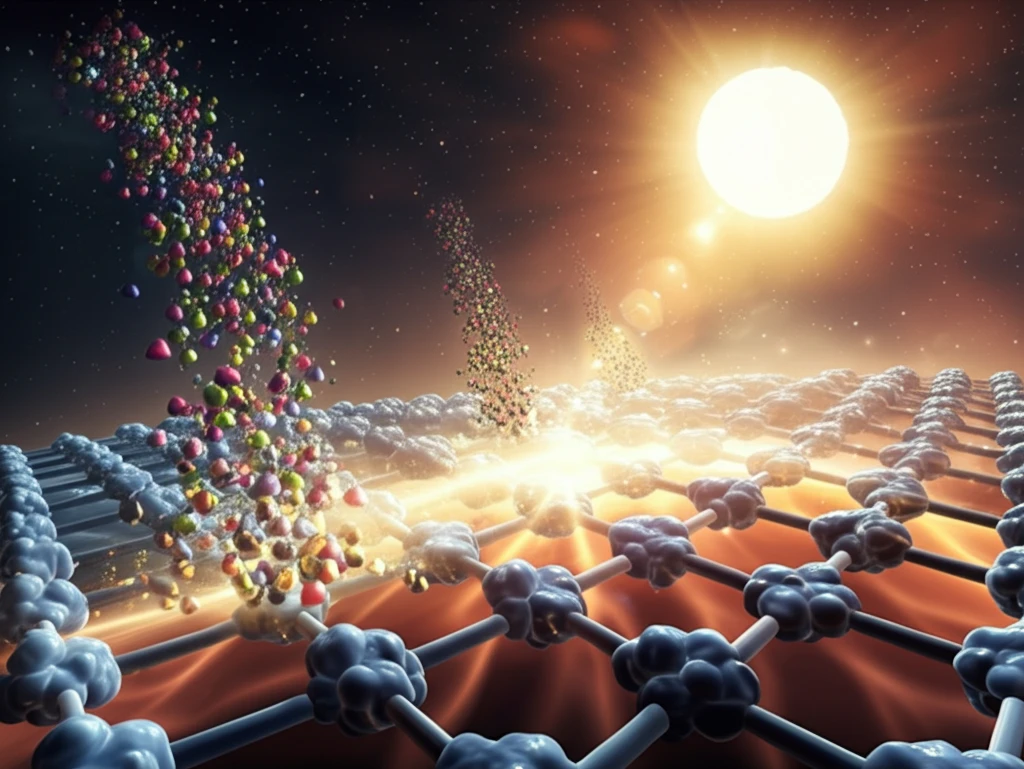
Revolutionizing Solar Energy: How Nanotechnology is Boosting Efficiency

"Discover the groundbreaking role of La2CdSnTiO4-WSe2 perovskite nanoparticles in enhancing dye-sensitized solar cells."
In an era defined by the urgent need for sustainable energy, solar power stands out as a beacon of hope. Dye-sensitized solar cells (DSSCs) are gaining traction as a promising alternative to traditional silicon-based solar cells. DSSCs offer advantages like lower manufacturing costs and environmental friendliness, making them an attractive option for widespread adoption.
However, improving the efficiency of DSSCs is critical to making them a competitive energy source. Researchers are constantly exploring new materials and methods to enhance their performance. One promising area of innovation involves nanotechnology, specifically the use of novel nanomaterials to optimize the functionality of DSSCs.
Recent research has highlighted the potential of La2CdSnTiO4-WSe2 perovskite nanoparticles in significantly boosting the efficiency of DSSCs. By integrating these nanoparticles with graphene oxide, scientists have created a synergistic effect that enhances the overall performance of solar cells, marking a significant step forward in renewable energy technology.
A Growing Market for Dye-Sensitized Cells
Dye-sensitized solar cells convert light into electricity using photosensitizers adsorbed on the surface of nanocrystalline mesoporous titanium dioxide (TiO2) films, paired with electrolytes or solid charge-transport materials. Described as a third-generation solar cell, the technology can draw natural dyes from leaf extracts to absorb sunlight and generate electricity. Electron transport in these devices has been studied using electrochemical impedance spectroscopy, with the resulting electron transport parameters used to explain solar cell performance at varying sensitizer concentrations. The current market outlook for DSSCs indicates a promising growth trajectory, reflecting growing commercial interest.
Simplicity, Cost, and the Silicon Gap
Standard dye-sensitized solar cells utilize platinum as a catalyst layer in their construction. The cells can be fabricated with relative simplicity and cost-efficiency, but their effectiveness has not been on par with high-performance silicon solar cells. Aqueous-electrolyte DSSCs have been proposed as an environmentally friendly, low-cost alternative to standard DSSCs and typical solar cells. Overall, the technology remains a promising alternative in the development of next-generation photovoltaics.
From Sustainability Promise to Portable Devices
Dye-sensitized solar cells have appeared as one of the most promising photovoltaic technologies due to their sustainability in economic and environmental terms. Research has documented their working principle and construction process, positioning DSSCs as a good alternative means of producing photovoltaic cells. Educational comparisons highlight how the cells differ from conventional solar technology. By the time portable cells that could charge mobile phones and other USB devices were developed, the technology had begun moving from the laboratory toward everyday consumer applications.
The Science Behind the Innovation
The core of this breakthrough lies in the unique properties of La2CdSnTiO4-WSe2 perovskite nanoparticles. Perovskites, a class of materials with a specific crystal structure, have shown remarkable potential in solar energy applications due to their excellent light-absorbing capabilities and efficient charge transport. When combined with graphene oxide, these nanoparticles create a composite material with enhanced electrocatalytic activity.
- Enhanced light absorption
- Improved electron transport
- Increased electrocatalytic activity
- Higher energy conversion efficiency
Diversifying the Sensitizer Palette
DSSCs have become a topic of significant research over the last two decades because of their scientific importance in energy conversion, and current cells use inorganic ruthenium-based dyes, metal-free organic dyes, and quantum-dot sensitizers. Intensive research is now focused on integrating natural pigments as an alternative to ruthenium dye as a photosensitizer. Titanium dioxide remains the cornerstone semiconductor for DSSC nanostructured electrodes, with recent work reporting the biosynthesis of TiO2 nanoparticles for this application. The technology's aesthetic appeal and flexibility suit it for applications ranging from building-integrated photovoltaics to portable devices.
Output Limits and Stability Concerns
A key limitation is that factors in the DSSC design constrain current generation: while a traditional silicon-based cell offers about 35 mA/cm2, current DSSCs offer about 20 mA/cm2. Liquid-electrolyte-based DSSCs also face long-term stability challenges, prompting exploration of quasi-solid-state electrolytes, though these have comparatively low ionic conductivities and device performances. On the other hand, DSSCs operate with the much cheaper semiconductor titanium dioxide, and because light is absorbed by a dye rather than the bulk semiconductor, they are more versatile than silicon-based cells. Their design mimics photosynthesis, using a photosensitive dye to capture sunlight rather than a conventional p-n junction.
Thin-Film Strengths and Electrode Options
DSSCs belong to the group of thin-film solar cells that have been under extensive research for more than two decades due to their low cost, simple preparation methodology, low toxicity, and ease of production. They are thin-film, low-cost solar cells based on a semiconductor formed between a photosensitized anode and an electrolyte. Within this family, ZnO-based DSSCs are regarded as among the best materials for photoanodes because of their large surface area and effective light-dispersing centers.
The Future of Solar Energy is Bright
The development of La2CdSnTiO4-WSe2 perovskite nanoparticles represents a significant advancement in solar energy technology. By harnessing the power of nanotechnology and synergistic material combinations, researchers are paving the way for more efficient, cost-effective, and environmentally friendly solar cells. As the demand for renewable energy continues to grow, innovations like these will play a crucial role in shaping a sustainable future.
Refining Molecules and Mapping the Field
Expert commentary points to continued refinement of organic sensitizers, including theoretical analysis of how π-spacers affect triphenylamine-based dyes and their light-harvesting efficiency. Systematic technology opportunities analysis applied to DSSCs pairs R&D analysis—defining the technical structure of the technology, extracting and classifying keywords, and performing technology component analysis—with competitive analysis such as assignee-technology analysis. These analytical tools help researchers and policymakers map the technology's component structure and understand its competitive landscape.
Natural Sensitizers and Indoor Niches
A comprehensive assessment of natural photosensitizers provides insights into future research directions and the practical feasibility of natural sensitizers in next-generation DSSC technology. Research continues to advance novel concepts, materials, and state-of-the-art performances in the field. Commercially, indoor dye-sensitized solar cells are emerging as a distinct market segment, with the North American market characterized by advanced technological infrastructure, a strong emphasis on innovation, and supportive regulatory environments.
The Sensitizer Problem and the Natural-Dye Answer
Reviews of fabrication methodologies and their impacts on performance identify major challenges for these solar cells, notably their reliance on non-vegetal, noxious, and extreme sensitizers. These challenges span materials selection, fabrication, and long-term viability. The application of natural dyes plays a significant role in this field, addressing the broader systemic push toward sustainable and less hazardous materials. In this way, DSSC development is framed as both a materials-science problem and an environmental one.
From 1991 Discovery to Living-Space Integration
Previous research has shown DSSCs to have excellent applicability for building exterior materials and windows, because their visible light transmittance and color can be controlled, offering good design variability. The technology's real-world journey dates to 1991, when O'Regan and Grätzel first introduced the dye-sensitized solar cell based on dye-sensitized colloidal TiO2 films. From that foundational device, DSSCs have progressed toward applications embedded in the spaces where people live and work.