
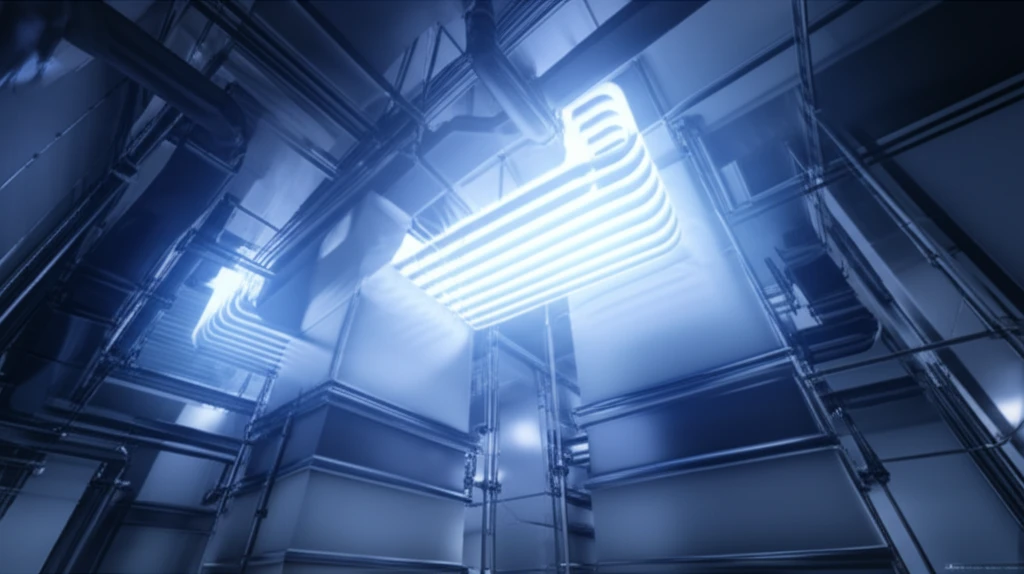
Surreal illustration of a serpentine heat pipe in a building's HVAC system, symbolizing energy savings.

Revolutionizing HVAC: Can This Innovative Heat Pipe Slash Energy Bills?

"Explore the potential of n-pentane oscillating heat pipes for efficient waste heat recovery in ventilation systems, paving the way for sustainable building practices."


In an era defined by escalating energy demands and a pressing need for sustainable solutions, the building sector stands out as a significant area for improvement. Heating, ventilation, and air conditioning (HVAC) systems, while essential for maintaining comfortable indoor environments, account for approximately 60% of the world's total building energy consumption. As populations grow and prosperity increases, this percentage is projected to rise, underscoring the urgent need for innovative technologies that enhance HVAC efficiency.

Recognizing this challenge, researchers and engineers are continuously seeking cost-effective methods to improve HVAC systems, with a particular focus on waste heat recovery. A recent study reported to the U.S. Department of Energy indicates that utilizing available energy recovery/management technologies could potentially slash a building's energy consumption by up to 50%. Advanced waste heat recovery and ventilation technologies play a crucial role by tapping into the often-overlooked temperature differences between cold and hot air streams within HVAC duct systems.

One promising technology in this arena is the oscillating heat pipe (OHP). Unlike traditional HVAC systems that simply exhaust waste heat, OHPs offer a passive and efficient way to capture and reuse this energy. This article delves into experimental research exploring the potential of n-pentane oscillating heat pipes for waste heat recovery in ventilation systems, offering insights into a technology that could significantly reduce building energy consumption.

How Oscillating Heat Pipes are set to Redefine HVAC Efficiency

Surreal illustration of a serpentine heat pipe in a building's HVAC system, symbolizing energy savings.

Oscillating heat pipes (OHPs) represent a paradigm shift in heat transfer technology. Unlike conventional heat pipes that rely on wicking structures and have inherent operational limitations, OHPs offer a simpler, more versatile approach. An OHP consists of a closed-loop, serpentine-arranged capillary tube partially filled with a working fluid. The fluid, in this case, n-pentane, naturally forms a liquid-vapor/slug-plug system due to the capillary scale of the tube.

The magic of OHP lies in its oscillatory motion. As the serpentine tube meanders through hot and cold sections, the working fluid repeatedly evaporates and condenses, creating thermally unstable vapor plugs. These plugs, driven by combative vapor pressures, generate an oscillatory, two-phase flow field that efficiently transports thermal energy. This process leverages both sensible and latent heat transfer, resulting in high effective thermal conductivities.

  • Passive Operation: OHPs operate without any external power, making them energy-efficient and cost-effective.
  • Versatile Orientation: Unlike conventional heat pipes with strict orientation requirements, OHPs can operate in various orientations.
  • Simple Construction: The absence of a wicking structure simplifies manufacturing, reducing production costs.
  • High Thermal Conductivity: OHPs can achieve effective thermal conductivities on the order of 10,000 W/m-K.
While previous research has largely focused on electronics cooling applications with constant heat flux or temperature conditions, recent studies are exploring the potential of OHPs in HVAC and energy-related systems. These systems often involve forced convection with air on either side, presenting unique heating/cooling configurations. This article will provide insights on research conducted by Govinda Mahajan, Scott M. Thompson and Heejin Cho to characterize a large form factor OHP with a novel, environmentally-friendly working fluid, n-pentane. The results of the study provide a better understanding of the OHP's adaptability to waste heat recovery applications.

The Future of Sustainable HVAC is Here

The experimental characterization of the n-pentane oscillating heat pipe demonstrates its potential as a viable solution for waste heat recovery in HVAC systems. Its ability to operate with a long form factor and in air-to-air convection mode makes it suitable for integration into existing ductwork. The OHP's passive operation, combined with its high thermal conductivity, offers a cost-effective way to pre-heat or pre-cool air, reducing the energy consumption of buildings. While further optimization is needed, the OHP holds promise for revolutionizing HVAC systems and paving the way for a more sustainable future.

About this Article -

This article was crafted using a human-AI hybrid and collaborative approach. AI assisted our team with initial drafting, research insights, identifying key questions, and image generation. Our human editors guided topic selection, defined the angle, structured the content, ensured factual accuracy and relevance, refined the tone, and conducted thorough editing to deliver helpful, high-quality information.See our About page for more information.

Everything You Need To Know

1

What is an oscillating heat pipe (OHP) and how does it work in the context of HVAC systems?

An oscillating heat pipe (OHP) is a closed-loop, serpentine-arranged capillary tube partially filled with a working fluid, in this case, n-pentane. The OHP operates without external power, making it energy-efficient. The working fluid naturally forms a liquid-vapor/slug-plug system due to the capillary scale of the tube. As the tube meanders through hot and cold sections, the working fluid evaporates and condenses, creating thermally unstable vapor plugs. These plugs, driven by combative vapor pressures, generate an oscillatory, two-phase flow field that efficiently transports thermal energy, leveraging both sensible and latent heat transfer. This process is key for waste heat recovery in HVAC by transferring heat from one air stream to another without external energy input.

2

How does the use of n-pentane in oscillating heat pipes (OHPs) contribute to sustainable building practices?

The utilization of n-pentane as a working fluid in oscillating heat pipes (OHPs) promotes sustainable building practices by enabling efficient waste heat recovery in HVAC systems. By recovering and reusing waste heat, OHPs reduce the overall energy consumption of buildings, which accounts for a significant portion of global energy use. The passive nature of OHPs, which means they don't require external power, further enhances their sustainability profile, leading to lower energy bills and reduced reliance on traditional energy sources. This contributes to a decrease in carbon emissions and a move toward a more environmentally friendly HVAC solution.

3

What are the key advantages of using oscillating heat pipes (OHPs) over traditional HVAC systems for waste heat recovery?

Oscillating heat pipes (OHPs) offer several advantages over traditional HVAC systems, primarily due to their innovative design. OHPs are passive systems, meaning they operate without external power, thus saving energy and reducing operational costs. They can operate in various orientations, unlike conventional heat pipes. OHPs have a simple construction without wicking structures, which simplifies manufacturing and reduces production costs. Furthermore, OHPs can achieve high effective thermal conductivities on the order of 10,000 W/m-K, ensuring efficient heat transfer. These features allow them to capture and reuse waste heat, offering a cost-effective way to pre-heat or pre-cool air within HVAC duct systems, ultimately reducing the overall energy consumption of buildings.

4

What were the key findings of the research on n-pentane oscillating heat pipes (OHPs) conducted by Govinda Mahajan, Scott M. Thompson, and Heejin Cho?

The research by Govinda Mahajan, Scott M. Thompson, and Heejin Cho focused on characterizing a large form factor n-pentane oscillating heat pipe (OHP). The primary finding was the demonstration of the OHP's potential as a viable solution for waste heat recovery in HVAC systems. The study highlighted the OHP's ability to operate with a long form factor and in air-to-air convection mode, making it suitable for integration into existing ductwork. The results provided a better understanding of the OHP's adaptability to waste heat recovery applications, and its passive operation and high thermal conductivity offer a cost-effective way to pre-heat or pre-cool air, ultimately reducing building energy consumption.

5

In what ways can oscillating heat pipes (OHPs) contribute to the reduction of energy consumption in buildings?

Oscillating heat pipes (OHPs) can significantly reduce energy consumption in buildings by facilitating efficient waste heat recovery within HVAC systems. OHPs capture and reuse waste heat, utilizing the temperature differences between hot and cold air streams within HVAC duct systems. This passive method of heat transfer reduces the energy demands of the HVAC system, specifically by pre-heating or pre-cooling air. Their high thermal conductivity enhances the efficiency of heat transfer, and the lack of external power further improves their energy efficiency. By reducing the overall energy consumption of HVAC systems, OHPs contribute to a decrease in energy bills and a reduction in the environmental impact associated with building operations.

Newsletter Subscribe

Subscribe to get the latest articles and insights directly in your inbox.