
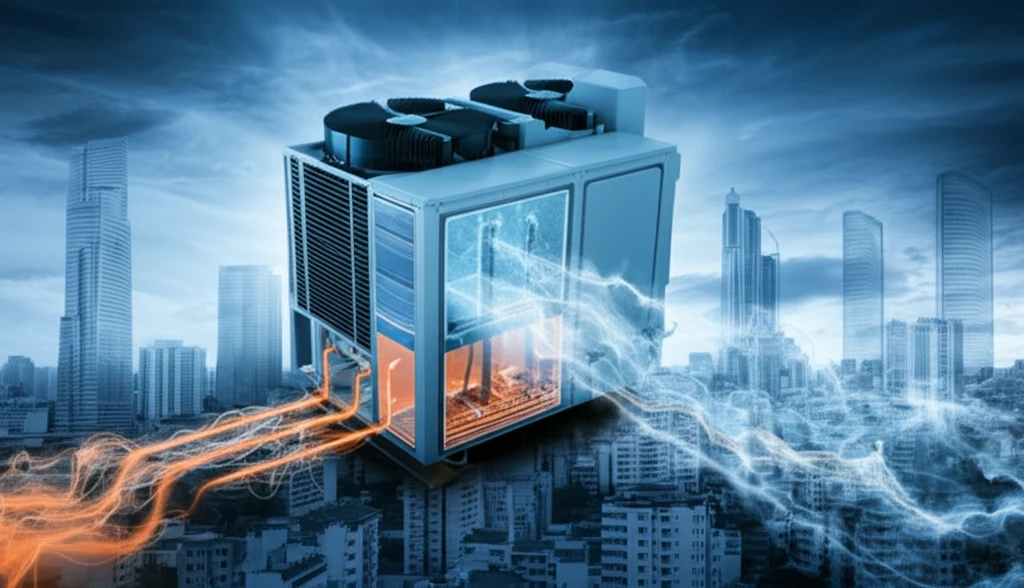
Cooling Without Guilt: How Absorption Chillers Can Save the Planet

"Dive into the world of sustainable cooling with absorption chillers, the technology using waste heat to keep us comfortable and combat climate change."
In our ever-warming world, the demand for cooling is skyrocketing. Traditional air conditioning systems, while effective, guzzle electricity and release harmful greenhouse gases, exacerbating the very problem they're meant to alleviate. But what if we could cool our homes and businesses in a way that's both energy-efficient and environmentally friendly? Enter absorption chillers, a promising technology that's changing the way we think about cooling.
Absorption chillers are hardly a new invention, but renewed interest in sustainable solutions has propelled them back into the spotlight. Unlike conventional compression chillers that rely on mechanical energy, absorption chillers use heat as their primary energy source. This opens the door to utilizing waste heat from industrial processes, solar thermal energy, and even geothermal sources – turning potential pollutants into a valuable resource.
This article explores the ins and outs of absorption chillers, comparing different system configurations, examining their environmental and economic benefits, and considering their potential role in a more sustainable future.
A Quietly Growing Market for Heat-Powered Cooling
Absorption refrigerators and chillers use heat to drive the cooling process, drawing on sources such as solar energy, waste heat from factories, district heating systems, or burning oil. Manufacturers such as YORK offer absorption chillers across small, modular, and large systems, with a variety of driving heat sources that broaden application diversity. Market forecasts show steady growth, though analysts differ on base figures: Fortune Business Insights projects the market at $3.07 billion in 2026 rising to $4.74 billion by 2034 (5.61% CAGR), while Coherent Market Insights values it at $1.58 billion in 2026 growing to $2.30 billion by 2033. Both sources nonetheless agree on a compound annual growth rate of roughly 5.5%.
Heat-Driven Cycles: The Standard Approach
Vapor absorption machines produce chilled water using heat sources such as steam, hot water, gas, and oil, achieving cooling by applying heat rather than mechanical work. The most common cycles are the water-lithium bromide (H2O-LiBr) and ammonia-water (NH3-H2O) pairs, which have served as standards for comparison in developing new cycles and refrigerant-absorbent combinations. Absorption machines are widely known for their durability, though a common objection is that they are less efficient than compression chillers, which industry practitioners argue is misleading because direct comparisons ignore the different energy inputs involved. Manufacturers such as LG continue to develop these products, revising specifications and designs as the technology evolves.
From Trigeneration Roots to Absorption Cooling
Absorption chiller technology is rooted in the history of trigeneration, in which a single energy source is used for power generation alongside heating and cooling applications. According to the historical account from Bridgestone Associates, some absorption chillers can simultaneously produce both hot and chilled water, a capability central to their role in combined energy systems. The same source provides an accessible explanation of how absorption chillers work, situating them as a long-established technology within power generation and cogeneration.
The Magic of Absorption: How It Works
At the heart of an absorption chiller lies a clever thermodynamic process. Instead of a compressor, these systems use an absorbent and a refrigerant. Common pairings include lithium bromide and water (LiBr-H2O) for air conditioning and ammonia and water (NH3-H2O) for refrigeration. The cycle begins with refrigerant vapor being absorbed by the absorbent, creating a solution. This solution is then heated, releasing the refrigerant vapor, which is subsequently condensed, providing cooling. Finally, the refrigerant is evaporated, restarts the absorption process.
- Single-Effect: Suitable for lower generator temperature and its energy coefficient of performance (COP) is very low.
- Double-Effect: Improve system performance with tremendously.
- Triple-Effect: Relatively high operating temperatures with higher COP.
Small-Capacity and Solar-Driven Systems Lead Research
Recent research has increasingly concentrated on small-capacity absorption machines, with reviews examining past achievements, working-fluid options, and the potential and future directions of absorption technology. This small-scale focus is evident in a standalone, compact ammonia-water absorption chiller designed to deliver 10.5 kW of cooling at ambient temperatures above 40 °C for residential use. Solar-driven development is another active front: a solar-assisted single-double-effect absorption chiller study, cited 66 times in Scopus, notes that tropical regions enjoy year-round solar energy and that the latest absorption chiller developments are well suited to exploiting it. Other recent work explores multi-service systems, including a natural-gas-based scheme to meet the electricity, freshwater, and cooling needs of a residential building in Bandar Abbas.
Maintenance Burdens Test the Technology
Absorption chillers present operational challenges that temper their environmental appeal. Air leakage into an absorption chiller can produce serious problems, including corrosion, contamination of the absorbent solution, and reductions in efficiency and capacity, according to HVAC industry guidance. The same source notes that the condenser and absorber heat exchanger tubes must be cleaned annually. These upkeep demands have driven improvements in machine monitoring, with LG introducing a 15-inch touch screen controller for its absorption chillers that supports functions such as run history, system information, scheduling, and reporting.
Absorption vs. Compression: Different Economics, Same Job
Compared with vapor compression systems, absorption chillers produce chilled water centrally and distribute it thermally, with no compressor to fail, maintain, or replace. When a 264 kW absorption chiller and a 264 kW screw compression chiller are compared, the economics hinge on the availability of free waste heat for the absorption unit. Absorption chillers also demonstrate superior coefficients of performance relative to other solar cooling technologies, typically ranging from 0.6 to 0.8 for single-stage units and from 0.9 to 1.3 for two-stage units. In the adjacent adsorption technology, vendors report that adsorption chillers can achieve a 99% reduction in a chiller's electrical usage, illustrating how thermally driven alternatives compete for the same waste-heat applications.
A Cool Future
Absorption chillers represent a compelling solution for sustainable cooling. By harnessing waste heat and renewable energy sources, these systems reduce our reliance on fossil fuels, lower greenhouse gas emissions, and improve energy efficiency. As the demand for cooling continues to grow, absorption chillers offer a pathway to a cooler, greener future.
Theory Meets Practice Across Working Fluids
Expert analysis of absorption chilling spans validated modeling and new working-fluid development. An experimental investigation validated a theoretical model using a single-stage, water-lithium bromide absorption chiller of 2 tons rated capacity, tested in a water-cooled chiller facility that required no external heating or cooling. In parallel work, an energetic analysis of a prototype NH3/LiNO3 absorption chiller built on thermodynamic modeling showed good agreement between model predictions and published experimental data. Commercially, manufacturers such as Hitachi now offer portfolios spanning air-cooled, water-cooled, centrifugal, and absorption chillers, with a modular air-cooled series that can connect up to 16 units across a capacity range of roughly 65 kW to 2,064 kW.
Double-Effect Systems on a Growth Trajectory
The future outlook for absorption chillers points to expansion driven by technology advances and shifting demand, with double-effect absorption chillers serving residential, commercial, and industrial segments. Market analyst Future Market Insights values the absorption chiller market at $1.80 billion in 2025 and $1.88 billion in 2026, projecting $2.98 billion by 2036 at a 4.7% CAGR, with growth attributed to waste-heat utilization and district-cooling adoption. The double-effect segment specifically is expected to see strong expansion, with market analyses tracking key segments and regional trends across applications.
Regulation, Deployment, and Sizing at Scale
Absorption chillers offer businesses a route to lower operating costs and a reduced carbon footprint by converting waste heat from industrial processes, power generation, or solar energy into cooling with significantly lower electricity consumption. BROAD reports more than 35,000 absorption chiller systems operating in over 80 countries, describing its non-electric chillers as providing cooling with fuel while saving multiple energy-conversion steps. Regulation shapes the market: the Montreal Protocol, the Kyoto Protocol, and national and regional energy efficiency standards and building codes all influence absorption chiller system adoption. Sizing is a systemic challenge in its own right, since a 500 TR single-effect steam absorption machine requires roughly 8-9 tons/hour of steam at 0.5-1.0 kg/cm², and underestimating capacity can leave the steam supply inadequate.
Real Systems, Real Dependencies
Real-world installations illustrate both the promise and the constraints of absorption cooling. A case study from the University of Malaya investigates a hybrid solar system using Al2O3 nanofluid and pure water as heat-transfer fluids to operate a single-effect lithium bromide absorption chiller. Another experimental study uses a prototype ammonia-water absorption chiller to examine falling-film absorber behavior under real operating conditions, combining a macro study of the absorber with local temperature measurements along the film. Practical experience also highlights a key dependency: conventional absorption chillers rely on a constant fuel-fired heat source, tying cooling costs to gas prices and underscoring why solar-assisted designs matter to end users.