
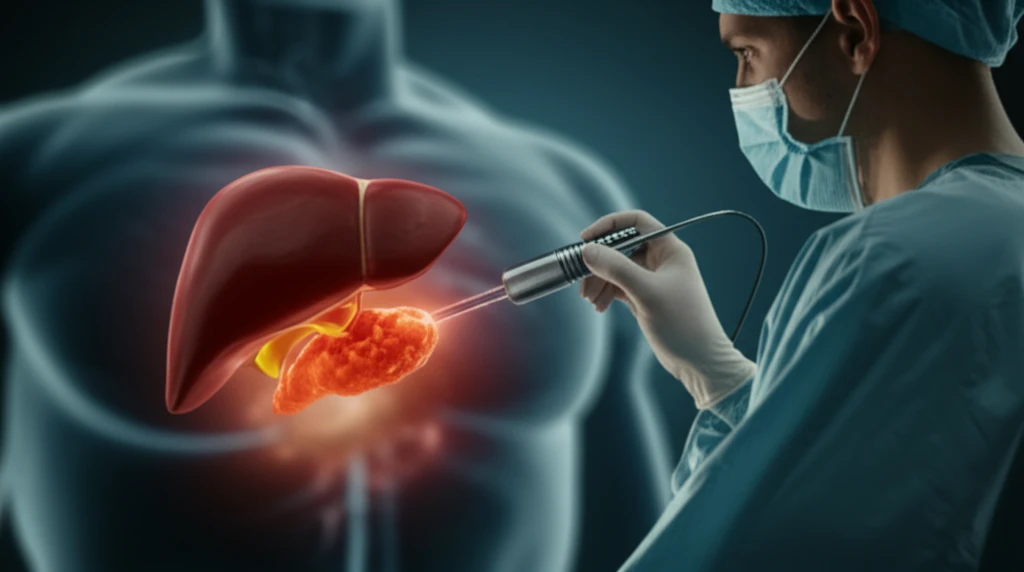
Illustration of radiofrequency ablation treatment on a liver with a gastric cancer cell in the background.

Revolutionizing Cancer Care: How a New Treatment is Changing the Game for Liver Tumors

"Promising Breakthrough: Radiofrequency Ablation Shows Superiority in Treating Metastatic Liver Tumors of Gastric Origin"


Cancer remains a formidable adversary, with metastatic liver tumors posing significant challenges in treatment. Gastric cancer, a prevalent form of the disease, often leads to liver metastasis, complicating patient care and outcomes. However, recent advancements in medical technology have paved the way for innovative treatment options that offer renewed hope. One such breakthrough is radiofrequency ablation (RFA), a minimally invasive procedure showing promising results in the fight against liver tumors.

The study, published in the Annals of Oncology, delves into the efficacy of RFA in treating metastatic liver tumors originating from gastric cancer. This research provides crucial insights into the effectiveness of RFA compared to conventional chemotherapy, offering a beacon of hope for patients battling this challenging condition. This article provides an overview of the study's methodology, results, and implications for cancer treatment.

This article explores the intricacies of RFA, its application in treating liver tumors, and the implications of the recent study. It aims to provide readers with a comprehensive understanding of the treatment, its effectiveness, and the potential it holds for revolutionizing cancer care.

Understanding Radiofrequency Ablation (RFA) and Its Role in Cancer Treatment

Illustration of radiofrequency ablation treatment on a liver with a gastric cancer cell in the background.

Radiofrequency ablation (RFA) is a cutting-edge therapeutic technique used to treat various types of cancer, including liver tumors. RFA involves using radiofrequency energy to generate heat, which then destroys the cancerous cells. This minimally invasive procedure offers several advantages over traditional treatments like chemotherapy, including fewer side effects and a faster recovery time. RFA is particularly effective for patients with liver tumors that are not suitable for surgical removal.

The study compared the effectiveness of RFA with conventional chemotherapy in treating metastatic liver tumors of gastric origin. The research involved 43 patients with metastatic lesions, with the number of lesions limited to less than 5 and sizes smaller than 5 cm. Patients were randomly assigned to receive either RFA and chemotherapy (Group A) or chemotherapy alone (Group B). The study assessed changes in tumor size and contrast enhancement using MRI scans to evaluate the treatment outcomes.

  • Radiofrequency ablation (RFA) is a minimally invasive technique that uses radiofrequency energy to destroy cancer cells.
  • RFA is often used to treat liver tumors that are not suitable for surgical removal.
  • The study compared RFA with chemotherapy in patients with metastatic liver tumors from gastric cancer.
  • Patients receiving RFA showed significant improvements in tumor size and contrast enhancement.
  • The results suggest that RFA is a safe and effective treatment option for liver cancer.
The outcomes of the study were compelling. Patients treated with RFA and chemotherapy (Group A) demonstrated superior results compared to those treated with chemotherapy alone (Group B). The study revealed that RFA, when combined with chemotherapy, led to a significant reduction in tumor size and improved contrast enhancement in MRI scans. Furthermore, the study indicated that RFA was particularly effective in patients with smaller lesions, suggesting that early intervention with RFA could yield better outcomes.

The Future of Cancer Care

The research on RFA for treating metastatic liver tumors represents a significant stride forward in cancer care. The findings underscore the potential of RFA as a safe and effective treatment option, particularly when combined with chemotherapy. As medical science continues to advance, innovative approaches like RFA offer new hope for patients and demonstrate that there is always more to explore in the fight against cancer.

About this Article -

This article was crafted using a human-AI hybrid and collaborative approach. AI assisted our team with initial drafting, research insights, identifying key questions, and image generation. Our human editors guided topic selection, defined the angle, structured the content, ensured factual accuracy and relevance, refined the tone, and conducted thorough editing to deliver helpful, high-quality information.See our About page for more information.

Everything You Need To Know

1

What is radiofrequency ablation (RFA), and how does it work to treat cancer, specifically liver tumors?

Radiofrequency ablation (RFA) is a minimally invasive technique that utilizes radiofrequency energy to generate heat and destroy cancerous cells within tumors. In the context of liver tumors, RFA is often employed when the tumors are not suitable for surgical removal due to their location or the patient's overall health. The procedure involves inserting a needle electrode into the tumor, through which radiofrequency energy is delivered, causing the targeted cells to be ablated. This contrasts with systemic treatments like chemotherapy, where drugs are administered to affect the entire body, potentially leading to more widespread side effects. While effective for localized treatment, RFA may not address cancer cells that have spread beyond the treated area, making it crucial to assess the extent of the disease before considering RFA.

2

How effective is radiofrequency ablation (RFA) compared to chemotherapy in treating metastatic liver tumors originating from gastric cancer?

The research indicates that radiofrequency ablation (RFA), when combined with chemotherapy, demonstrates superior results compared to chemotherapy alone in treating metastatic liver tumors originating from gastric cancer. Specifically, patients treated with both RFA and chemotherapy experienced a significant reduction in tumor size and improved contrast enhancement in MRI scans, suggesting a greater response to treatment. The study also highlighted that RFA was particularly effective for patients with smaller lesions, implying that early intervention with RFA may lead to more favorable outcomes. However, the benefits of RFA might not be as pronounced in cases with larger or more widespread tumors, where a more comprehensive approach, potentially involving systemic therapies or surgical resection, may be necessary.

3

What were the main findings of the study examining radiofrequency ablation (RFA) for metastatic liver tumors, and what implications do these findings have for cancer treatment strategies?

The study's primary findings indicated that patients receiving radiofrequency ablation (RFA) in conjunction with chemotherapy showed significant improvements in tumor size reduction and enhanced contrast on MRI scans compared to those treated with chemotherapy alone. This suggests that RFA can be a safe and effective treatment option, especially when combined with chemotherapy. These findings imply that integrating RFA into treatment strategies, particularly for metastatic liver tumors from gastric cancer, could lead to better patient outcomes. However, the study also implies the importance of early intervention, as RFA appeared more effective in patients with smaller lesions. The study didn't explore the long-term survival rates or quality of life, indicating areas for further research to fully understand the long-term benefits of RFA.

4

What are the advantages of using radiofrequency ablation (RFA) over traditional treatments like chemotherapy for liver tumors, and are there any limitations?

Radiofrequency ablation (RFA) offers several advantages over traditional treatments like chemotherapy, primarily due to its minimally invasive nature. RFA typically results in fewer side effects and a faster recovery time compared to chemotherapy, as it targets only the cancerous cells while sparing surrounding healthy tissue. This localized approach is particularly beneficial for patients with liver tumors that are not suitable for surgical removal. However, RFA has limitations. It is most effective for smaller tumors (less than 5 cm) and a limited number of lesions (less than 5). It is not effective for treating widespread metastasis. Chemotherapy, on the other hand, can target cancer cells throughout the body but comes with systemic side effects.

5

How does the size and number of metastatic liver tumors affect the suitability and success of radiofrequency ablation (RFA) as a treatment option?

The size and number of metastatic liver tumors significantly impact the suitability and success of radiofrequency ablation (RFA). RFA is most effective for smaller lesions, ideally less than 5 cm in diameter, and when the number of tumors is limited, typically less than 5. Larger tumors may require multiple ablations to ensure complete destruction of cancerous cells, potentially increasing the risk of complications. When there are many tumors spread throughout the liver, RFA becomes less practical due to the time required to treat each lesion and the potential for damaging healthy liver tissue. In such cases, systemic treatments like chemotherapy or other locoregional therapies might be more appropriate. The study also did not address the suitability of RFA for tumors located near major blood vessels or bile ducts, which could pose additional challenges and risks during the procedure.

Newsletter Subscribe

Subscribe to get the latest articles and insights directly in your inbox.