
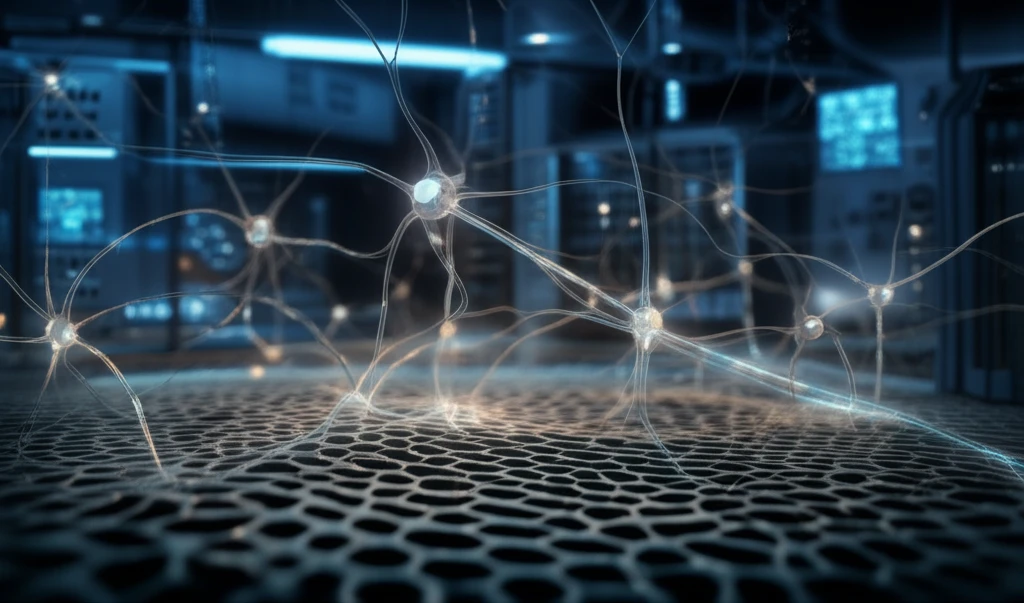
3D cell culture with neurons growing on a nylon micro-mesh scaffold.

Rethinking Cell Culture: The Rise of 3D Scaffolds in Biomedical Research

"Discover how innovative 3D cell culture techniques are transforming biomedical research, offering new insights into cell behavior and tissue engineering."


For decades, scientists have primarily relied on two-dimensional (2D) cell culture methods to study cells. While these methods have provided valuable insights, they often fail to mimic the complex, three-dimensional (3D) environment in which cells naturally exist within the body. This discrepancy can significantly impact cell behavior, differentiation, and response to treatments.

Recently, there has been a surge of interest in 3D cell culture platforms, as they offer a more realistic representation of the in vivo environment. Cells cultured in 3D exhibit different characteristics compared to their 2D counterparts, leading to more accurate and relevant research outcomes. This shift towards 3D culture is particularly important in fields like drug discovery, tissue engineering, and regenerative medicine.

One promising approach in 3D cell culture involves the use of scaffolds, which provide a structural support for cells to grow and organize in three dimensions. Researchers are exploring various materials and designs for these scaffolds, aiming to create environments that closely resemble the natural extracellular matrix (ECM). This article delves into a novel approach using a nylon micro-mesh (NMM) as a cell culture scaffold, highlighting its simplicity, versatility, and potential for advancing biomedical research.

Why 3D Cell Culture Matters: Mimicking the Body's Complexity

3D cell culture with neurons growing on a nylon micro-mesh scaffold.

Traditional 2D cell cultures involve growing cells on flat surfaces like glass or plastic dishes. While convenient, this method oversimplifies the natural cellular environment, where cells interact with each other and the surrounding matrix in three dimensions. This lack of 3D context can lead to inaccurate results and limit the translatability of research findings to real-world applications.

Cells in 3D cultures behave differently because they can form more complex interactions, similar to those found in tissues and organs. These interactions influence gene expression, cell signaling, and overall cell function. By culturing cells in 3D, researchers can:

  • Study Cell Behavior More Accurately: Observe how cells interact with each other and their environment in a more realistic context.
  • Improve Drug Discovery: Test drug efficacy and toxicity in a setting that better mimics the body's response.
  • Advance Tissue Engineering: Create functional tissues and organs for transplantation and regenerative medicine.
  • Gain Insights into Disease Mechanisms: Understand how diseases develop and progress in a 3D environment.
The shift towards 3D cell culture is driven by the need for more physiologically relevant models that can bridge the gap between in vitro experiments and in vivo outcomes. As technology advances, we can expect to see even more sophisticated 3D culture systems emerge, further revolutionizing biomedical research.

The Future of 3D Cell Culture: Innovation and Application

The development of NMM as a cell culture opens new possibilities for biomedical research and tissue engineering. Its simplicity and versatility make it a valuable tool for studying cell behavior, developing new therapies, and creating functional tissues. As research continues, we can expect to see even more innovative applications of 3D cell culture technologies, ultimately leading to improved healthcare outcomes.

About this Article -

This article was crafted using a human-AI hybrid and collaborative approach. AI assisted our team with initial drafting, research insights, identifying key questions, and image generation. Our human editors guided topic selection, defined the angle, structured the content, ensured factual accuracy and relevance, refined the tone, and conducted thorough editing to deliver helpful, high-quality information.See our About page for more information.

This article is based on research published under:

DOI-LINK: 10.5607/en.2011.20.2.110, Alternate LINK

Title: Simple And Novel Three Dimensional Neuronal Cell Culture Using A Micro Mesh Scaffold

Subject: Cellular and Molecular Neuroscience

Journal: Experimental Neurobiology

Publisher: The Korean Society for Brain and Neural Science

Authors: Sang Jin Yoo, Jongmin Kim, Chang-Soo Lee, Yoonkey Nam

Published: 2011-06-30

Everything You Need To Know

1

What are the key differences between traditional 2D cell cultures and the more recent 3D cell culture methods, and why is there a shift towards the latter?

Traditional 2D cell cultures grow cells on flat surfaces, lacking the complex, three-dimensional environment found in the body. This oversimplification impacts cell behavior, differentiation, and treatment response. 3D cell cultures, particularly those using scaffolds like nylon micro-mesh (NMM), offer a more realistic in vivo representation, enabling cells to form complex interactions, influencing gene expression, cell signaling, and overall cell function more accurately. The shift is driven by the need for physiologically relevant models in drug discovery, tissue engineering, and regenerative medicine, bridging the gap between in vitro experiments and in vivo outcomes.

2

How does culturing cells in a three-dimensional (3D) environment, specifically using scaffolds such as nylon micro-mesh (NMM), enhance drug discovery and tissue engineering, and what are the benefits?

Culturing cells in 3D environments using scaffolds, such as nylon micro-mesh (NMM), enhances drug discovery by allowing researchers to test drug efficacy and toxicity in settings that better mimic the body's response. In tissue engineering, 3D cultures facilitate the creation of functional tissues and organs for transplantation and regenerative medicine. The benefits include studying cell behavior more accurately, improved drug discovery processes, advancements in tissue engineering, and deeper insights into disease mechanisms due to the realistic context they provide.

3

What is nylon micro-mesh (NMM) and how does it contribute to the advancement of biomedical research and tissue engineering?

Nylon micro-mesh (NMM) is a material used as a cell culture scaffold in 3D cell culture. It provides structural support for cells to grow and organize in three dimensions, closely resembling the natural extracellular matrix (ECM). NMM's simplicity and versatility make it valuable for studying cell behavior, developing new therapies, and creating functional tissues, opening new possibilities for biomedical research and tissue engineering. Its advantages include ease of use and adaptability for various applications.

4

In what specific ways does the use of 3D cell cultures, particularly with scaffolds like nylon micro-mesh (NMM), allow for a better understanding of disease mechanisms compared to traditional 2D methods?

3D cell cultures, especially when using scaffolds like nylon micro-mesh (NMM), allow for a superior understanding of disease mechanisms by providing a more realistic representation of the in vivo environment. This enables researchers to observe how diseases develop and progress in a 3D context, taking into account complex cell interactions, gene expression, and cell signaling that are absent in 2D cultures. The use of NMM facilitates the creation of environments that closely mimic the natural extracellular matrix (ECM), offering more accurate and relevant research outcomes.

5

What are the potential future innovations and applications we can expect to see in 3D cell culture technologies, and how might these advancements lead to improved healthcare outcomes?

Future innovations in 3D cell culture technologies, especially with materials like nylon micro-mesh (NMM), include the development of more sophisticated 3D culture systems that further mimic the body's complexity. These advancements are expected to lead to improved healthcare outcomes through more accurate drug testing, enhanced tissue engineering for regenerative medicine, and a deeper understanding of disease mechanisms. As research continues, we can anticipate innovative applications that will revolutionize biomedical research and contribute to more effective therapies and treatments. Further exploration of different materials and designs for scaffolds will also play a key role.

Newsletter Subscribe

Subscribe to get the latest articles and insights directly in your inbox.