
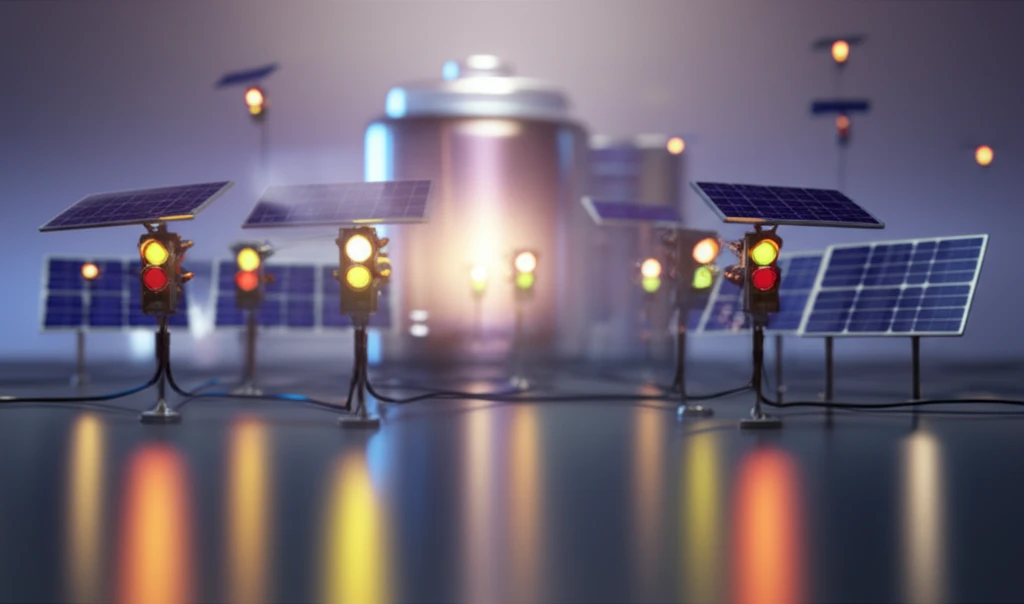
Solar traffic lights powered by solar panels and battery backup.

Powering Tomorrow: How Solar Traffic Lights with Battery Backup are Revolutionizing Urban Infrastructure

"Discover how DC-DC boost converter technology enhances the efficiency and reliability of solar-powered traffic lights, ensuring safer and more sustainable cities."


As the world increasingly shifts towards renewable energy, solar power stands out as a readily available and abundant resource, especially in sun-rich countries like India. With traditional energy sources dwindling, solar power presents a viable and eco-friendly alternative. The climatic conditions in many regions offer a significant opportunity for harnessing solar energy, paving the way for long-term, sustainable energy solutions.

Solar panels, comprising interconnected photovoltaic cells, form the backbone of solar energy systems. These panels can be integrated into larger systems to generate and supply electricity for both commercial and residential use. While a single solar panel's power output is limited, its ability to convert sunlight into electricity through the photovoltaic effect is invaluable.

This article delves into the application of a DC-DC boost converter in solar-powered traffic lights, enhanced with battery backup. This system ensures high performance and adaptability, making it ideal for efficiently tracking solar array power in dynamic environments. By utilizing a 12V solar panel as its primary input, this technology promises a cost-effective and reliable solution for managing urban traffic.

The Core of the System: DC-DC Boost Converters Explained

Solar traffic lights powered by solar panels and battery backup.

At the heart of this innovative system is the DC-DC boost converter, which elevates the voltage obtained from the solar panel. This boosted voltage is essential for efficiently charging the battery, which requires a higher potential than the solar panel can provide on its own. This conversion process is crucial for optimizing the system's performance and ensuring a consistent power supply.

The system intelligently manages power usage through a light-dependent resistor (LDR), which controls the interaction between the solar panel and the battery. During daylight hours, the solar panel not only powers the LED traffic lights but also charges the battery. At night, the system seamlessly switches to battery power, ensuring uninterrupted operation of the traffic lights.

  • Daytime Operation: Solar panel charges the battery and powers the LED load.
  • Nighttime Operation: Battery directly supplies power to the LED load, with the solar panel and boost converter isolated.
  • Voltage Boosting: DC-DC boost converter increases voltage from the solar panel to charge the battery efficiently.
  • Intelligent Control: Light-dependent resistor manages the switching between solar panel and battery power.
To optimize the efficiency of the boost converter, careful design and simulation are essential. Operating at a frequency of 31250 Hz, the inductance and capacitance values are calculated to ensure optimal performance. The duty cycle, which determines the converter's operation, is also precisely managed to maximize energy conversion.

The Future is Bright: Embracing Sustainable Traffic Solutions

This model demonstrates the viability of solar-powered traffic lights in areas with abundant sunlight, utilizing a highly efficient solar array. Controlled by a microcontroller, the system exemplifies an efficient and sustainable approach to traffic management.

The proposed system can be further enhanced by integrating two solar panels: one dedicated to powering the traffic lights directly and another for charging the battery. This dual-panel setup, managed by a light-dependent resistor and microcontroller, optimizes energy use and ensures consistent performance.

With ongoing simulations and future implementations, this innovative solution promises to pave the way for more sustainable and energy-efficient urban infrastructures. By reducing reliance on traditional energy sources and embracing renewable solutions, cities can move towards a greener and more sustainable future.

About this Article -

This article was crafted using a human-AI hybrid and collaborative approach. AI assisted our team with initial drafting, research insights, identifying key questions, and image generation. Our human editors guided topic selection, defined the angle, structured the content, ensured factual accuracy and relevance, refined the tone, and conducted thorough editing to deliver helpful, high-quality information.See our About page for more information.

This article is based on research published under:

DOI-LINK: 10.17485/ijst/2015/v8i32/84408, Alternate LINK

Title: Application Of Dc-Dc Boost Converter For Solar Powered Traffic Light With Battery Backup

Subject: Multidisciplinary

Journal: Indian Journal of Science and Technology

Publisher: Indian Society for Education and Environment

Authors: T. S. Anandhi

Published: 2015-01-20

Everything You Need To Know

1

What is a DC-DC boost converter and what does it do in this system?

A DC-DC boost converter is a crucial component within solar-powered traffic light systems. It elevates the voltage from the 12V solar panel, which is essential for efficiently charging the battery. This ensures the battery receives the necessary voltage to store energy effectively. Without the DC-DC boost converter, the battery would not be charged efficiently, or at all, leading to potential power supply issues. The converter's operation at 31250 Hz optimizes energy conversion.

2

What is the role of solar panels in solar-powered traffic lights?

Solar panels are fundamental in solar-powered traffic light systems. Composed of interconnected photovoltaic cells, they convert sunlight directly into electricity through the photovoltaic effect. This electricity is used to power the LED traffic lights during the day and charge the battery. Their significance lies in their ability to harness renewable energy, reducing reliance on traditional sources and providing a sustainable solution for urban infrastructure. The 12V solar panel is the primary input to the system.

3

How does a light-dependent resistor (LDR) function within this system?

The role of a light-dependent resistor (LDR) is to intelligently manage the power flow between the solar panel and the battery. During daylight hours, the LDR ensures that the solar panel powers both the LED traffic lights and charges the battery. At night, the LDR switches the system to battery power, guaranteeing continuous operation of the traffic lights. This intelligent control is vital for optimizing the system's efficiency and ensuring a consistent power supply.

4

Why is battery backup important in this context?

Battery backup is critical for the uninterrupted operation of solar-powered traffic lights, especially during nighttime or periods of low sunlight. The battery stores the electrical energy generated by the solar panel during the day. At night, the system seamlessly switches to battery power to operate the LED traffic lights, ensuring they remain functional regardless of solar availability. This guarantees consistent traffic management and enhances safety on the roads.

5

Why is this technology considered significant for urban infrastructure?

This technology is significant because it offers a sustainable and efficient solution for urban traffic management. By utilizing a 12V solar panel, DC-DC boost converter, battery backup, and intelligent control via a light-dependent resistor, the system minimizes reliance on traditional energy sources. This sustainable approach reduces the environmental impact and enhances the overall efficiency of traffic management, particularly in regions with abundant sunlight. The system's design optimizes energy conversion for reliable performance.

Newsletter Subscribe

Subscribe to get the latest articles and insights directly in your inbox.