
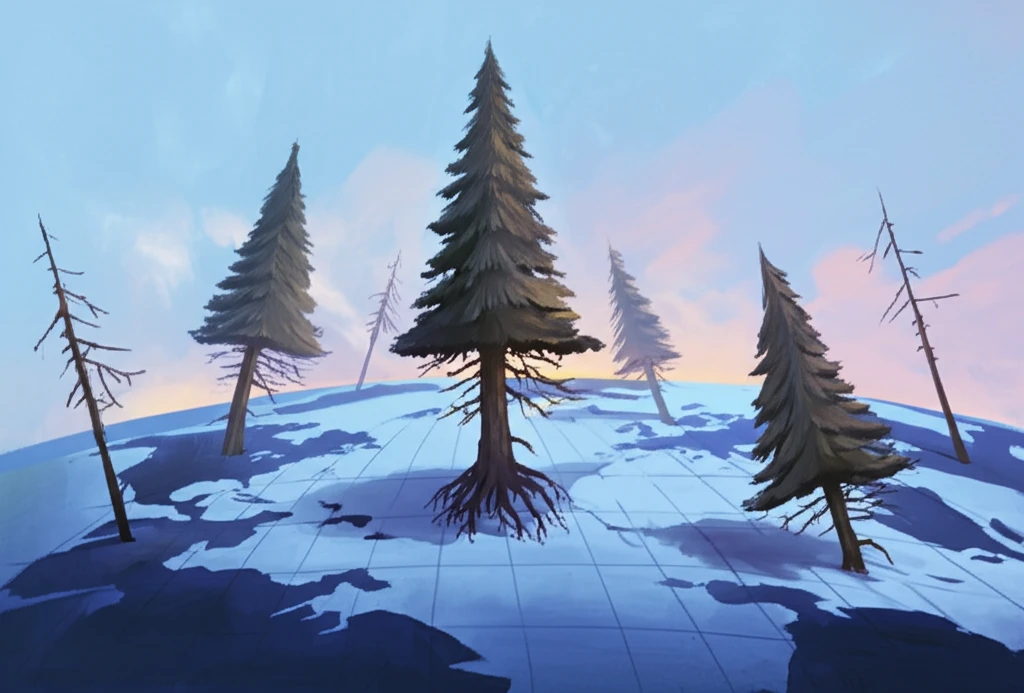
Pine Trees Are Moving: What It Means for Your Backyard & Beyond

"New research reveals how pine trees are adapting to climate change by expanding into unexpected territories. Discover the implications for biodiversity and conservation efforts."
For years, scientists have relied on species distribution models (SDMs) and ecological niche models (ENMs) to predict where different plants and animals can survive and thrive. These models are essential tools, helping us understand everything from the risk of species extinction under climate change to how to best plan conservation efforts. However, these models operate on a fundamental assumption: that species exist in equilibrium with their native climate. In other words, they only grow where the climate conditions are suitable. But what happens when species start showing up in places we wouldn't expect?
Increasingly, research is demonstrating that this assumption of climatic equilibrium is being violated. Species are popping up in new locations with climates that don't match their traditional 'comfort zones.' This phenomenon, known as climatic disequilibrium, challenges the core of how we predict species distributions and raises some important questions. Why are species able to survive and even thrive in these unexpected climates? What does this mean for the accuracy of our ecological models? And how should we adapt our conservation strategies in light of this new reality?
A groundbreaking study on pine trees is shedding light on these questions. The research reveals that many pine species are not only surviving but actively expanding into new climatic territories, defying the long-held assumptions of ecological modeling. Understanding this shift is crucial for anyone interested in the future of our forests and the broader implications for biodiversity.
The Data Behind the Warming Trend
Tracking global warming rests on a large statistical infrastructure. The United Nations Statistics Division opened a Global Consultation on a draft Global Set of Climate Change Statistics and Indicators on 21 May 2021, consulting agencies for their expertise in climate statistics. In parallel, agencies maintain continuous temperature records, with NOAA's National Centers for Environmental Information supplying the data behind widely cited global temperature graphs. NASA likewise maintains current news and data streams about global warming to keep the public informed. At the same time, some commentators challenge how this information is framed, arguing that a look at the data does not support treating climate change as an apocalypse.
Accepted Methods and Where They Fall Short
Every standard approach to climate change, whether behavioral, technical, or political, carries built-in limitations. The psychological stages-of-change model, long used to help people shift long-standing behaviors, shows just how hard sustained transformation can be. Technically, downscaling methods are fundamentally limited by the quality and uncertainties of the global climate models they rely on, as well as by steep data requirements. On the response side, a New York Times opinion column argues that pretending climate change can be solved with emissions cuts alone is a dangerous fantasy, and that approaches like carbon removal and geoengineering are the only way to reduce the long-term climate risks that remain once net emissions reach zero. Political avoidance carries its own costs, with reporting warning that sidestepping climate action could have dire consequences even where administrations pursue climate-beneficial technologies such as nuclear energy and carbon capture.
Five Centuries of Human-Driven Change
The association of climate change with industrialization is well known, but environmental historian Sunil Amrith argues in The Burning Earth that what is less understood is the connection between global warming and environmental shifts over the last 500 years. That longer view reframes climate change as a centuries-deep process rather than a purely modern development. Meanwhile, groups such as Ontario Nature track the issue through milestones, noting that climate change is imperiling water, food, biodiversity, and the natural systems people rely on, with Ontarians experiencing those impacts daily. Cultural history is part of the record too, as art collections increasingly feature works that highlight climate change.
The Great Pine Tree Migration: Unveiling Climatic Disequilibrium
A team of researchers delved into the climatic niches of 106 pine species, including 25 that have successfully naturalized (established self-sustaining populations) outside their native ranges. By building climatic niche models, they were able to map out the specific climate conditions where each pine species could survive. This allowed them to measure the extent of climate space occupied exclusively by these naturalized populations. The findings were surprising: most of the naturalized pine species (23 out of 25) were thriving in climate conditions outside of their 'native niche'. This means they were growing in areas with temperatures, rainfall patterns, or seasonal variations different from what they typically experience in their original habitats. One species, Pinus radiata, even expanded its niche to encompass almost 10% of the entire global climate space!
- Pine trees are showing up in places we wouldn't expect.
- Pine species with smaller native ranges were more likely to exhibit a larger expansion into new climatic conditions.
- Naturalized pine species were thriving in climate conditions outside of their 'native niche'.
- A large effect that naturalized data had on range filling estimates was dependent on AN.
Abrupt Shifts, Attribution, and Emerging Research
Recent research highlights how quickly the climate system can change. Carbon Brief's explainer describes abrupt climate change as occurring when the climate system is forced to cross some threshold, triggering a transition to a new state at a rate determined by the climate system itself and faster than the cause, and outlines nine potential tipping points. Attribution science is advancing in parallel: reporting on Europe's 2026 heatwave concludes the event was virtually impossible 50 years ago and is driven by climate change rather than El Nino. Proposed responses are also being stress-tested, with scientists examining solar geoengineering ideas such as dimming the sun, coverage of which frames the work as a fact-check of an extremely controversial and potentially catastrophic method. Research-sharing platforms such as ResearchGate, which now connect millions of researchers across 160 million-plus publication pages, accelerate the pace of review and collaboration.
Debating Priorities, Market Failure, and Modeling Gaps
Not everyone agrees that climate change is the single most urgent problem of our time, a debate that surfaces even in IELTS writing tasks asking whether other issues deserve more attention. Critics also flag the limitations of existing frameworks: the Global Footprint Network argues that climate change, deforestation, overgrazing, fisheries collapse, food insecurity, and rapid species extinction are all part of one overarching problem, humanity demanding more from the Earth than it can provide. Economist Nicholas Stern framed the failure differently, calling climate change the result of the greatest market failure the world has seen, because those who damage others by emitting greenhouse gases generally do not pay. Failures appear in prediction as well, with President Obama noting in 2013 that Arctic ice had shrunk to its smallest size on record, faster than most models had predicted, even while stressing that no single weather event is caused solely by climate change.
Uneven Exposure, Unequal Resources
Comparisons across regions show that climate change hits hardest where the capacity to cope is lowest. Harvard International Review reports that the people of Mozambique are disproportionately exposed to the dangerous effects of climate change and have far fewer resources to prepare and recover than people in more developed countries. The energy debate reveals a different kind of imbalance, with reporting on the oil-versus-alternatives argument noting that no side trusts the other and that climate advocates pin their hopes on visions that cannot possibly be realized in the timeframes they need. Mainstream channels popularize these contrasts, as comparison platforms rank categories side-by-side and short-form videos with captions such as 'Sadly the sea really is rising' bring sea-level change to mass audiences.
The Future of Forests: Adapting to a Changing World
This pine tree study carries some far-reaching implications. The traditional methods for predicting where species can survive may be inaccurate, especially for species with limited native ranges. Conservation efforts need to consider the potential for species to thrive in unexpected climates, and management strategies should be flexible enough to adapt to these shifting distributions. By acknowledging and understanding climatic disequilibrium, we can improve our ability to protect vulnerable species and maintain healthy ecosystems in a rapidly changing world. There are large gaps in our understanding of where, when and how species occupy their fundamental niche space. Ultimately, our findings emphasize that there are large gaps in our understanding of where, when and how species occupy their fundamental niche space.
Expertise Under Fire: The Climate Paradox
Expert synthesis of the climate problem keeps running into a paradox: climate change demands expertise, and faith in it, at precisely the moment when public confidence in expertise is collapsing, as The New York Times put it. Researchers studying public opinion describe the same tension, building mathematical models of cognitive resistance to explain the gap between recorded meteorological anomalies and shifting public sentiment. Expert assessment itself is rarely uniform, with commentary on Arctic sea ice status deliberately surveying researchers holding various points of view. Aggregations of 2026 warnings report intensifying alarms over rising global temperatures, extreme weather, and critical environmental shifts.
Plausible Futures and the 1.5C Question
The Hamburg Climate Futures Outlook represents the first systematic attempt to assess which climate futures are actually plausible, combining multidisciplinary assessments rather than relying on modeling projections alone. Its 2023 edition found no plausible pathway toward limiting global warming to 1.5C, judging that the social changes required are not sufficiently in place. That conclusion sits uneasily alongside persistent questions about forecasting reliability, with critics pointing to failed seasonal outlooks such as NOAA's winter forecast that predicted warmer-than-normal temperatures to argue that computer models cannot be trusted to project conditions out to 2100.
A Systemic Challenge with Many Fronts
Climate change is increasingly understood as a systemic challenge rather than an isolated environmental problem. European Environment Agency reporting notes that it does not happen in isolation but interacts with socio-economic factors, whose regional and global trends add an extra dynamic. The links extend into health systems, with a scoping review mapping pathways connecting climate change to cardiovascular diseases and identifying both health-system challenges and the policies addressing climate-related cardiovascular risks. Food systems are another node, as agroecology researchers describe an inextricable link between food systems and accelerated climate change, with far-reaching impacts running in both directions.
Human Stakes, Unevenly Distributed
The human costs of climate change are felt very unevenly. A role-play exercise from the Zinn Education Project introduces students to 24 individuals around the world, each affected differently, with some threatened with being forced to leave their land and others seeing a business opportunity. Attribution work by World Weather Attribution examined the climate change contribution to the Los Angeles wildfires, finding that dynamical effects can be as large as the thermodynamic effects behind fire risk. Yet individuals struggle to grasp their own role, as coverage notes that people dramatically misjudge the climate impacts of their actions, in part because it is effectively impossible to measure the real-world impact of, say, one additional person attending a climate march. Educational simulations reinforce the stakes, using climate models to investigate why scientists push to decrease global emissions and what happens if we do not.