
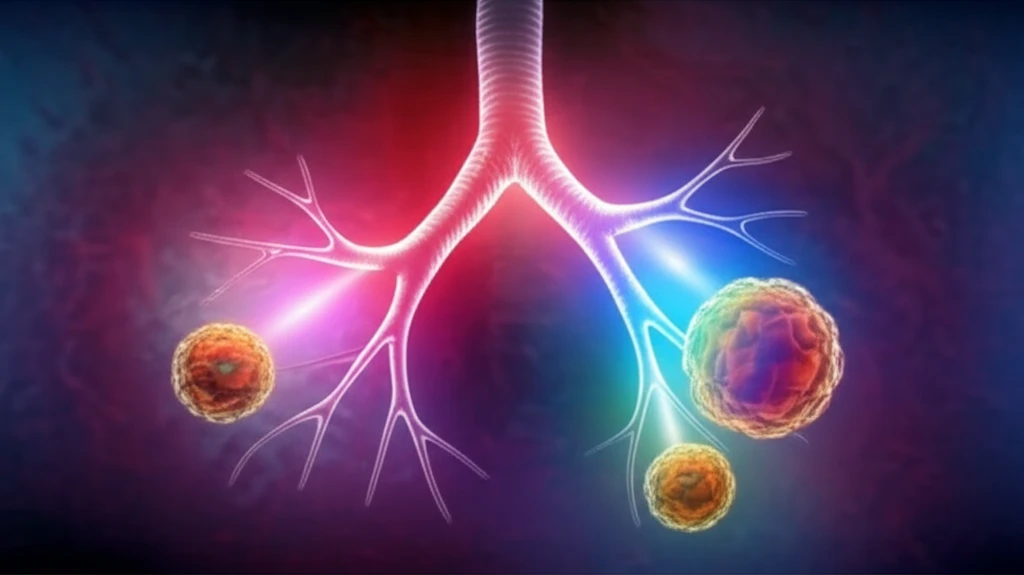
Photodynamic therapy targeting lung cancer cells.

Photodynamic Therapy: A Ray of Hope for Lung Cancer Treatment?

"Explore how photodynamic therapy (PDT) is revolutionizing lung cancer treatment, offering new hope for early and advanced stages."


The battle against lung cancer has seen significant advancements, especially with the introduction of the fiberoptic bronchoscope in 1965. This innovation paved the way for photodynamic medicine, harnessing light and photosensitizers to combat cancer. Now, with over three decades of experience, PDT is emerging as a promising solution.

This article explores the role of photodynamic diagnosis in lung cancers, including optical coherence tomography and the curative, palliative, and neoadjuvant applications of photodynamic therapy for both early and advanced stages of lung cancer. We will also look at how PDM (photodynamic medicine) is being used to treat peripheral early-stage lung tumors.

Early detection and precise localization of small lung tumors are key to improving treatment outcomes. Photodynamic therapy (PDT) offers a minimally invasive approach to treating these tumors. The goal of PDT is to provide curative treatment for superficial early-stage tumors, palliative care for advanced tumors, and neoadjuvant therapy to reduce the size of tumors before resection.

Fluorescence Bronchoscopy: Illuminating Lung Cancer Diagnosis

Photodynamic therapy targeting lung cancer cells.

The fiberoptic bronchoscope significantly enhanced lung cancer diagnosis in 1965. However, early-stage superficial carcinomas often went undetected. In 1978, efforts began to develop a fluorescent bronchoscope to improve detection.

By combining a hematoporphyrin derivative (a mixture of porphyrin compounds with an increased affinity for malignant tissue) with laser photoradiation, clinicians were able to localize tumors. Tumors were irradiated 48 hours after intravenous injection, and fluorescence was observed in 13 cases.

  • Early clinical experience with PDD (photodynamic diagnosis) as an endobronchial tumor indicator was published in the 1980s and 1990s.
  • Fluorescence imaging, using a hematoporphyrin derivative or Photofrin II (porfimer sodium) as a tumor marker, facilitated the bronchoscopic localization of early squamous cell carcinoma of the central tracheobronchial tree.
After years of research, the Pentax System became commercially available in 2005. This system allows for precise localization of early lung tumors. Additionally, PDD can be applied to localize invisible lesions, aid in preoperative assessment for surgical incision, and estimate response to PDT.

The Future of PDT: Emerging Strategies and Hope

PDT is a promising alternative for patients with advanced lung cancer. PDT can improve symptoms, maintain quality of life, decrease airway obstruction, and tumor stenosis, leading to better respiratory function. It can also resolve acute hemoptysis, poststenotic pneumonia, and enhance performance status.

The incidence of adenocarcinoma and multiple primary lung cancers has increased over the past two decades. Adequate diagnostic and noninvasive therapeutic modalities are needed to manage them. CT screening for early detection of peripheral lung cancer has spread, and tiny cancers can be detected frequently.

PDT represents a promising treatment modality for patients with lung cancer. It serves as a definitive monotherapy for early-stage, centrally located non-small cell lung cancer and an effective palliative measure for improving many symptoms of advanced lung cancer. Emerging strategies for using PDT to treat early-stage peripheral lung cancer appear promising but require further study.

About this Article -

This article was crafted using a human-AI hybrid and collaborative approach. AI assisted our team with initial drafting, research insights, identifying key questions, and image generation. Our human editors guided topic selection, defined the angle, structured the content, ensured factual accuracy and relevance, refined the tone, and conducted thorough editing to deliver helpful, high-quality information.See our About page for more information.

This article is based on research published under:

DOI-LINK: 10.6004/jnccn.2012.0170, Alternate LINK

Title: Our Experience With Photodynamic Diagnosis And Photodynamic Therapy For Lung Cancer

Subject: Oncology

Journal: Journal of the National Comprehensive Cancer Network

Publisher: Harborside Press, LLC

Authors: Harubumi Kato

Published: 2012-10-01

Everything You Need To Know

1

What exactly is Photodynamic Therapy (PDT), and how does it work in the context of lung cancer treatment?

Photodynamic Therapy (PDT) is a treatment for lung cancer that uses light and photosensitizers to target and destroy cancer cells. The photosensitizer is administered to the patient and accumulates in the cancerous tissue. When the tissue is exposed to a specific wavelength of light, the photosensitizer becomes activated and produces a form of oxygen that kills the cancer cells. This method is significant because it offers a minimally invasive approach that can be used in various stages of lung cancer.

2

How does Photodynamic Diagnosis (PDD) work, and why is it important for detecting lung cancer?

Photodynamic Diagnosis (PDD) is a technique using fluorescence to improve the detection of early-stage lung tumors. In this process, a photosensitizer such as a hematoporphyrin derivative or Photofrin II is used. When the photosensitizer accumulates in cancerous tissues, it fluoresces under specific light wavelengths, aiding in the localization of tumors. PDD is crucial in enhancing early detection, which is critical for improved treatment outcomes, especially since the fiberoptic bronchoscope, which aided early diagnosis, often missed early-stage superficial carcinomas.

3

How did the development of the fiberoptic bronchoscope and subsequent technologies, such as the Pentax System, impact lung cancer treatment?

The fiberoptic bronchoscope, introduced in 1965, was a major advancement in lung cancer diagnosis. It allowed for direct visualization of the airways. However, it often missed early-stage superficial carcinomas. To address this, efforts were made to develop fluorescent bronchoscopes, which led to Photodynamic Diagnosis (PDD). The Pentax System, commercially available in 2005, further enhanced precision in localizing early lung tumors. This system is a critical improvement for early detection and better patient outcomes.

4

What are the different ways Photodynamic Therapy (PDT) can be used to treat lung cancer?

Photodynamic Therapy (PDT) can be used in three main ways: curative treatment for early-stage tumors, palliative care for advanced tumors, and neoadjuvant therapy. In early stages, PDT aims to eliminate the tumor. For advanced stages, it focuses on improving symptoms and quality of life. Neoadjuvant therapy uses PDT to reduce tumor size before surgery. These applications highlight PDT's versatility and its ability to address different needs across the spectrum of lung cancer treatment.

5

How can Photodynamic Therapy (PDT) improve the lives of individuals with advanced lung cancer?

PDT plays a significant role in improving the quality of life for individuals with advanced lung cancer by improving symptoms, maintaining quality of life, decreasing airway obstruction and tumor stenosis, and improving respiratory function. It can also resolve acute hemoptysis and poststenotic pneumonia. These benefits are crucial as they offer a chance for better respiratory function. This makes it an important option for managing the disease and improving patient well-being.

Newsletter Subscribe

Subscribe to get the latest articles and insights directly in your inbox.