
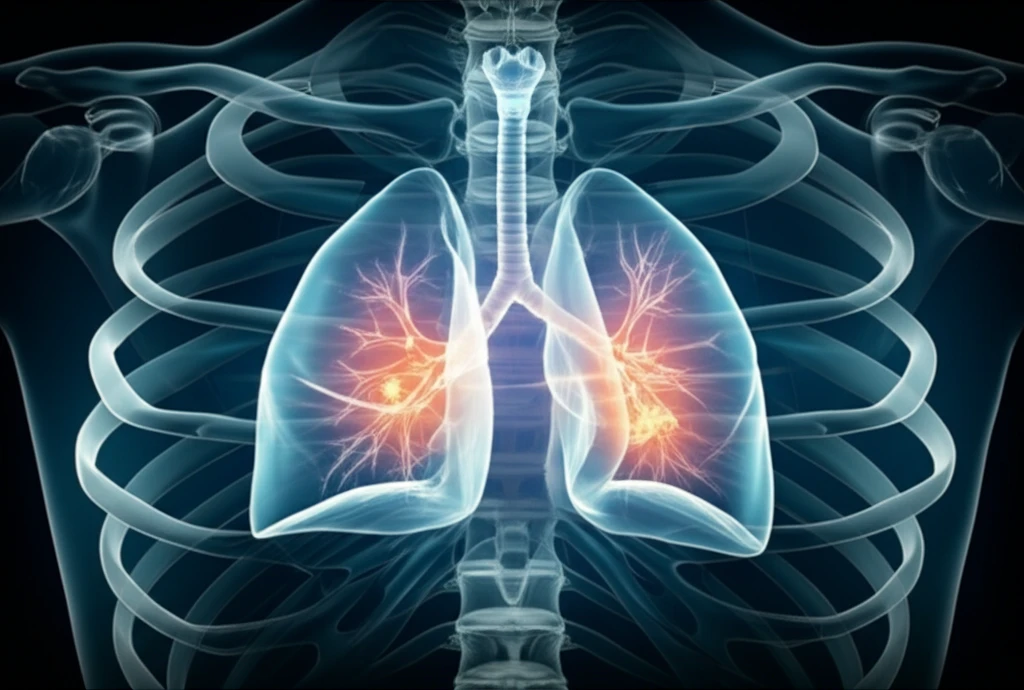
Breathe Easier: How Advanced Imaging Can Improve Lung Motion Tracking

"Discover how range imaging and sophisticated modeling are revolutionizing respiratory motion estimation, leading to more precise cancer treatments."
Radiation therapy stands as a crucial method in treating thoracic and abdominal tumors. Yet, a significant challenge arises: respiratory motion. The movement of our lungs as we breathe can complicate the precision of radiation delivery, potentially impacting the effectiveness of the treatment. This is where innovative solutions for motion compensation come into play, designed to ensure that the radiation targets the tumor accurately, regardless of lung movement.
Traditionally, motion compensation relies on low-dimensional breathing signals, such as those obtained from spirometry. These signals, combined with patient-specific models, help estimate internal motion based on external measurements. However, these methods often fall short in capturing the complexity of respiratory patterns, leading to inaccuracies in treatment planning and delivery. The future of radiation therapy lies in embracing more sophisticated techniques that can provide a comprehensive understanding of lung motion.
The advent of range imaging offers a promising avenue for improvement. By using multidimensional signals derived from range images of the skin surface, researchers can better account for complex motion patterns. These advanced imaging techniques provide detailed insights into respiratory dynamics, opening the door to more precise and effective cancer treatments. In a recent study, researchers investigated the motion estimation accuracy of such multidimensional signals, focusing on the influence of noise, signal dimensionality, and different sampling patterns to optimize these methods.
Respiratory Motion and Treatment Impact
Respiratory motion can affect both target-volume assessment and lung-dose evaluation in patients treated with stereotactic body radiotherapy (SBRT). A May 1, 2025 study assessed target-volume reduction and lung-dose reduction by comparing active and non-active respiratory motion management approaches. A 2025 review likewise emphasizes patient-specific motion management, linking improved tumor targeting with reduced toxicity.
What Makes Range Imaging a Game-Changer for Respiratory Motion Estimation?
Range imaging offers a detailed view of the moving skin surface, providing a wealth of data that can be used to track respiratory motion. Unlike traditional methods that rely on single-point measurements or simple breathing signals, range imaging captures the complex interplay of movements across the chest and abdomen. This multidimensional approach holds the potential to significantly improve the accuracy of motion estimation, leading to more precise and effective radiation therapy.
- Noise Influence: The study examined how noise in range images affects the accuracy of motion estimation. Noise can arise from various sources, including sensor limitations and environmental factors, and can distort the signals used to track respiratory motion.
- Signal Dimensionality: Researchers investigated the impact of using different numbers of data points from range images. Higher dimensionality can capture more complex motion patterns but may also introduce redundancy and computational challenges.
- Sampling Patterns: The study explored different ways of sampling data from range images, including points, lines, and regions. The choice of sampling pattern can influence the accuracy and efficiency of motion estimation.
Recent Motion-Management Research
Recent research continues to treat respiratory-induced tumor motion as a major obstacle to precise lung SBRT delivery. The 2026 signal-aware deep learning study reports that unaccounted motion can produce imaging artifacts and biased dose distributions, compromising image-guided radiotherapy. A 2025 review similarly associates motion with geometric uncertainty, insufficient tumor coverage, and toxicities including pneumonitis, esophagitis, and rib fractures.
Limits and Unresolved Challenges
More detailed motion signals can improve motion-estimation accuracy, but the Crossref-indexed results report that accuracy remains highly affected by noise. Independent work also states that no consensus exists on the optimal techniques for reducing respiratory-motion image blurring and artifacts in lung-lesion PET/CT while limiting dosimetric errors. These limitations mean that image guidance and motion-management strategies improve assessment without eliminating uncertainty.
Tracking Approaches in Dynamic Scenes
The camera-and-laser-scanner method described in the source combines 3D motion models with object appearance to manage occluded regions in crowded scenes. A separate study frames visual object tracking as a central topic in computer vision and uses SIFT with a Kalman filter for tracking in occluded and non-occluded environments. Together, these examples show that tracking systems may combine scene modeling, appearance information, feature extraction, and state estimation to handle difficult visual conditions.
The Future of Lung Cancer Treatment
The insights gained from this study highlight the potential of range imaging for improving respiratory motion estimation in radiation therapy. By carefully considering the influence of noise, signal dimensionality, and sampling patterns, researchers can optimize these techniques to deliver more precise and effective cancer treatments. As technology advances and data processing capabilities increase, we can expect range imaging to play an increasingly important role in the fight against lung cancer.
Predictive and AI-Assisted Tracking
One future direction is artificial-intelligence-based respiratory motion prediction, whose stated aim is to derive future motion information from current data and compensate for system latency in real time. The 2026 signal-aware deep learning research positions AI within a broader effort to address inaccurate tumor targeting, imaging artifacts, and biased dose distributions. These sources support continued development of predictive and signal-aware methods, while also indicating that respiratory motion management remains a significant clinical challenge.