
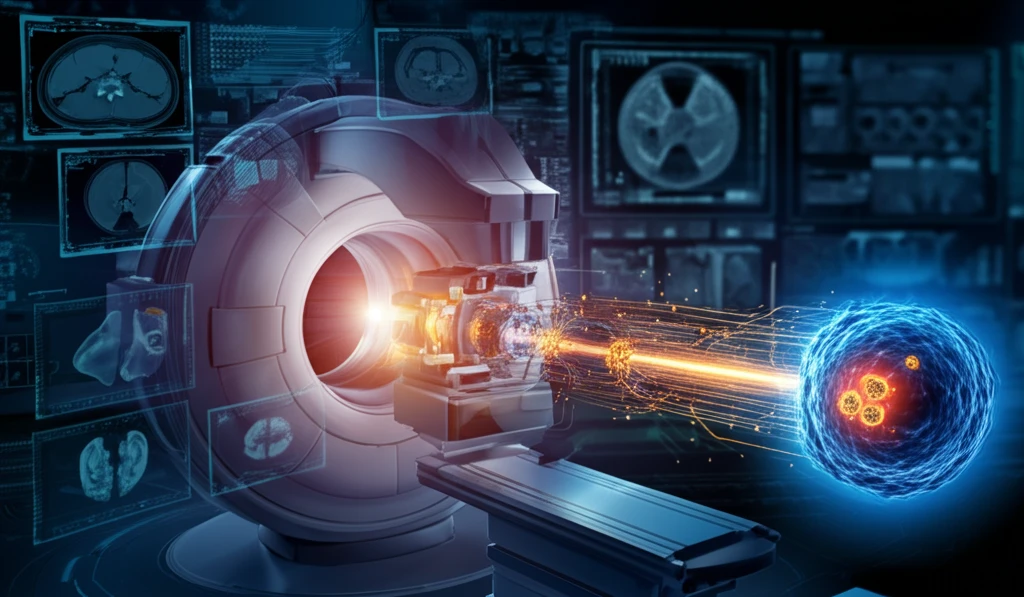
Precision in Radiation Therapy: How Advanced Simulations are Enhancing Cancer Treatment

"Explore how cutting-edge Geant4 simulations, powered by DICOM files, are refining absorbed dose calculations for safer, more effective cancer treatments."
Radiation therapy stands as a crucial pillar in cancer treatment, demanding utmost precision to target malignant cells while sparing healthy tissues. The challenge lies in accurately calculating the absorbed dose within the human body, considering the complex anatomical structures and varying tissue densities. Traditionally, anthropomorphic phantoms—physical models mimicking the human body—have been utilized for simulating internal organs in dose calculation methods.
However, recent advancements have shifted towards leveraging actual patient data through CT DICOM (Digital Imaging and Communications in Medicine) files. These files contain detailed anatomical information that, when integrated with Monte Carlo simulation techniques like Geant4, allow for highly accurate dose calculations. This approach enables the creation of personalized treatment plans that precisely replicate the patient's unique anatomical structure, optimizing the therapeutic effect while minimizing harm to surrounding tissues.
The integration of DICOM files with Geant4 simulations marks a significant leap forward, promising enhanced accuracy and personalization in radiation therapy. This method not only refines dose calculations but also holds the potential to revolutionize treatment planning by providing detailed, patient-specific insights into radiation absorption. By comparing simulated dose distributions with measured doses using Gafchromic EBT2 films, researchers are validating the effectiveness and reliability of this advanced simulation technique.
A Multi-Domain Simulation Toolkit
Geant4 is a free toolkit for simulating the passage of particles through matter, with areas of application that include high-energy, nuclear and accelerator physics as well as medical and space science. Its medical reach is illustrated by a fast Monte Carlo total body irradiation simulation built on the DICOM example provided with the framework, modeling the treatment geometry, image set and flattening filter. In space applications, astronaut dose coefficients have been calculated using GEANT4, where differential cross sections are described as the most important physics data and the toolkit's built-in statistical tool is used for absorbed dose. The same infrastructure supports experiment design, as in SuperCDMS background simulations where detector, cryostat, shielding and structural components are contaminated according to known radioactive impurities from screening measurements. Together these examples show one toolkit supporting radiation therapy planning, dosimetry and instrument design across disciplines.
From Standard Physics to Custom Cutoffs
A standard step in Geant4 work is choosing how electromagnetic energy losses of hadrons and leptons are handled, with models defined as either standard or low energy; the low-energy models extend particle cutoff energies below those available in the standard approach. Validation against published data is also routine, as in a study where simulated differential muon intensities agreed well with intensities in the literature. That study capped its simulations at a depth of 10,000 m.w.e. because at greater depths neutrino-induced muons begin to dominate the muon intensity. These examples reflect the accepted workflow: select appropriate physics models and geometry, run the simulation, and benchmark the output against established measurements.
From Detector Physics to Treatment Planning
Geant4 began as a free software package whose tools accurately simulate the passage of particles through matter, with all aspects of the simulation process included in the toolkit. Over time it has been extended into medicine and radiobiology: Geant4 and Geant4-DNA have been used to simulate the additional spread of 220Rn in DaRT and to study its impact on particle and relative biological effectiveness (RBE) weighted dose distributions, with implications for accurate treatment planning. The same framework has supported detector design, such as detailed simulations of the C6D6 setup at n_TOF from which the origin and time structure of the neutron background were derived. It has also enabled imaging studies, including a Geant4-based Monte Carlo study of a benchtop multi-pinhole X-ray fluorescence computed tomography system, illustrating the toolkit's evolution from particle physics into radiobiology and imaging.
Geant4 Simulations and DICOM Files: A New Era in Dose Calculation
The Monte Carlo method is recognized as the gold standard for calculating absorbed dose in the human body due to its ability to simulate particle interactions with high precision. The use of Geant4, a Monte Carlo simulation toolkit developed by CERN (European Organization for Nuclear Research), allows researchers to model complex geometries and particle physics, making it an ideal tool for radiation therapy planning.
- Enhanced Accuracy: Simulating radiation interactions in the human body with high precision.
- Personalized Treatment Plans: Tailoring treatments to the patient's unique anatomy.
- Comprehensive Analysis: Providing detailed dose information for each voxel (3D pixel) in the simulation.
Pushing the Toolkit's Physics Limits
Recent work has manually modified Geant4's implementation of thermal motion for neutron capture simulations in gadolinium-loaded water, producing results that align with calculations based on evaluated nuclear data and show good agreement with observables derived from SK-Gd data. Separately, a peer-reviewed article has presented a technique for simulating dark bremsstrahlung for electrons and muons in GEANT4. Both efforts show the toolkit continuing to be extended beyond its default models, either to match specialized experimental data or to cover newly considered physics processes.
Known Limitations and Ongoing Fixes
Geant4 implements a condensed (integrated) model for elastic scattering, a choice motivated by the fact that a step-by-step simulation is rather CPU expensive, and this model is based on the Lewis theory, described as quite complete and accurate. Simulating high-energy electromagnetic interactions of muons, which can be produced in electromagnetic or weak interactions, likewise requires careful attention to the physics configuration. In response to these limitations, new approaches are being developed, including ways to simulate radiation damage for silicon vertex detectors and to configure multiple scattering per detector region. Interface improvements for low-energy physics and the Geant4-DNA project are also being reused for LHC simulation optimisation.
Benchmarking Against Published Results
In practice, users validate Geant4 against published results, and discrepancies sometimes emerge. In one reported case, a user found differences between a Geant4 neutron-monitor simulation and results in the literature, running a fixed number of primary particles with a fixed energy and normal incidence on the detector surface for each run. The response was then plotted as a function of primary-particle energy and compared with the reference data. Such exercises underscore how sensitive simulation output can be to setup choices when benchmarked against published measurements.
The Future of Personalized Radiation Therapy
The integration of Geant4 simulations with DICOM files represents a significant advancement in radiation therapy, offering the potential for more accurate, personalized treatment plans. By leveraging the power of Monte Carlo simulations and detailed patient-specific data, clinicians can optimize radiation delivery to maximize the therapeutic effect while minimizing harm to healthy tissues. This approach paves the way for a new era of precision medicine in cancer treatment, promising improved outcomes and quality of life for patients.
A Shared Toolkit for a Global Community
The European Federation of Organisations for Medical Physics convenes developers and users of the Geant4 toolkit, along with users of Geant4-based tools such as GAMOS, GATE, TOPAS and TOPAS-nBio, for a three-day international user conference. In clinical practice, Geant4 Monte Carlo simulations have been used to study proton beam transport through a carbon wedge degrader at the Center of Proton Therapy of the Paul Scherrer Institute, informing clinical beamline design. On the dosimetry side, simulations of a bare TLD LiF:Mg,Cu,P chip have been used to determine the optimum number of events that minimizes computational time while capturing the chip's energy response. Together these examples show a single toolkit underpinning clinical beamline design, dosimeter response studies and a large collaborative user ecosystem.
Next Frontiers in Simulation
Presentations planned for the fourth Geant4 International User Conference sketch the toolkit's next frontiers. Geant4 for FLASH radiotherapy is a headline topic, with a session on its current status and challenges. Geant4-DNA modeling of early biological damage and repair reflects a push beyond dose toward biological effect, while dedicated work on hadronics aspects addresses the nuclear interactions relevant to therapy and detector applications. Recent electromagnetic improvements in Geant4 round out the programme, indicating that refinement of the underlying physics remains central to the roadmap.
One Toolkit, Many Domains and Benchmarks
Geant4 is used by a large number of experiments and projects across application domains including high-energy physics, astrophysics and space science, medical physics and radiation protection. That breadth creates a constant need for cross-validation: a study of the full-energy-peak efficiency of a broad-energy germanium detector benchmarked GEANT4 against the FLUKA code, while an early comparison of experimental data taken at the H8 beam line with Geant4 simulation investigated secondary particle production by muons and its impact on track segment reconstruction. The same toolkit is being applied to compact, lightweight radiation monitors proposed for future space mission payloads. These examples show a general-purpose code operating simultaneously as a medical physics tool, a detector design aid and a validation target.
From Synthetic Scans to Safer Cargo Screening
Geant4 is helping close the gap between simulation and real-world security scanning. In a maritime cargo anomaly detection study, IBC scenes are assembled from a mesh library and material palette, and each randomized scene is simulated in Geant4 and reconstructed into a scattering-density volume to yield a synthetic dataset. That dataset is then partitioned into benign and anomalous samples, allowing anomaly-detection models to be trained on realistic synthetic data before being applied to real scans. The approach illustrates a concrete pipeline from simulation to real scans for improving detection in real-world settings.