
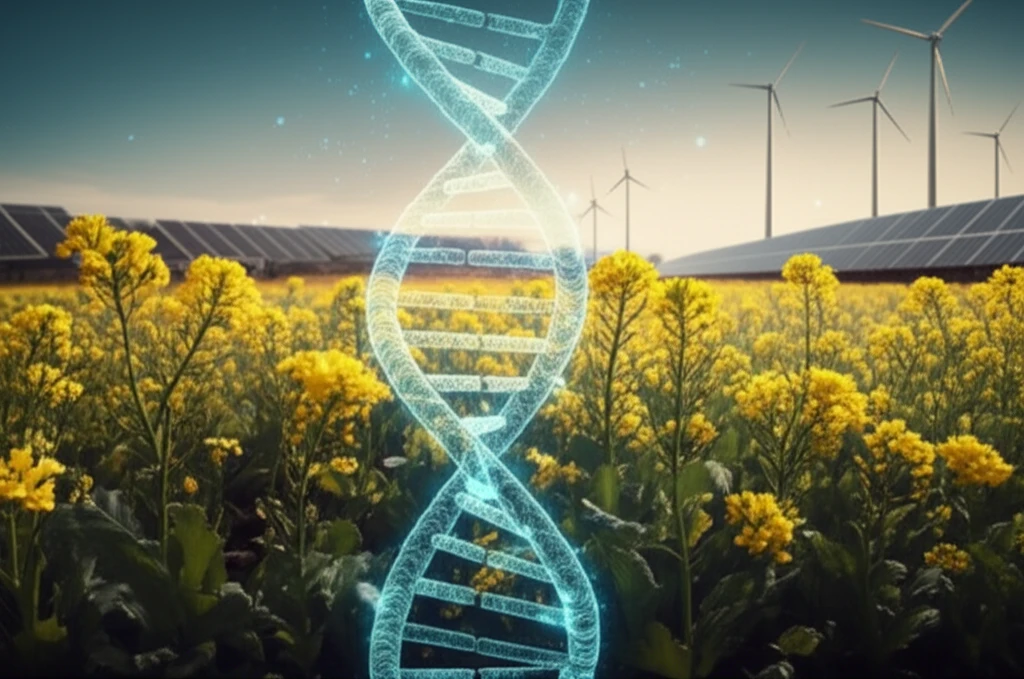
Pennycress field with DNA helix, symbolizing sustainable agriculture and genomics.

Pennycress: The Next Big Thing in Sustainable Biofuel and Agriculture?

"How translational genomics is unlocking the potential of pennycress, turning it into a valuable crop and model for sustainable agriculture."


In the quest for sustainable solutions, pennycress (Thlaspi arvense) is emerging as a promising contender in both agriculture and biofuel production. Pennycress, a winter annual cover crop, is being domesticated as a new oilseed cash crop. It can be grown during the fallow period between traditional summer crops, reducing nutrient leaching, soil erosion, and the growth of spring weeds. Pennycress also presents economic opportunities for rural communities.

What makes pennycress particularly exciting is its close relationship to Arabidopsis thaliana, a widely studied model plant. The extensive research on Arabidopsis is now being leveraged to accelerate pennycress domestication through translational genomics, which is the application of discoveries made in basic research to practical applications. Translational genomics allows researchers to quickly identify and characterize genes of interest in pennycress, paving the way for improved varieties and enhanced agronomic traits.

Recent genome-scale comparisons have revealed that pennycress and Arabidopsis share similar gene duplication patterns, suggesting that mutants with Arabidopsis-like traits can be isolated in pennycress. This has spurred forward genetic screens to identify floral and vegetative mutants in pennycress that mirror those found in Arabidopsis. By understanding the genetic basis of these traits, scientists can unlock the full potential of pennycress as a sustainable crop.

Decoding Pennycress: What Genetic Insights Reveal?

Pennycress field with DNA helix, symbolizing sustainable agriculture and genomics.

Researchers have been diligently mapping the genetic landscape of pennycress, drawing parallels with Arabidopsis to pinpoint genes responsible for key traits. Comparative genomics confirms extensive synteny—the conservation of gene order—between Arabidopsis and pennycress genomes. This means that for many Arabidopsis genes, a single, highly similar candidate orthologous gene exists in pennycress. These findings led to the hypothesis that the same spectrum of mutants found in Arabidopsis could be isolated in pennycress.

To test this idea, pennycress seeds were treated with mutagens, substances that increase the rate of genetic mutations. Forward genetic screens of these mutagenized populations identified vegetative, floral, and seed coat mutants closely resembling those in Arabidopsis. Whether through analyzing single candidate genes or whole-genome sequencing (WGS), the most likely causative mutations were identified in these mutants. All in all, 95 EMS lines (lines treated with ethyl methane sulfonate, a chemical mutagen) were subjected to WGS, revealing a mutation rate of 4.09 mutations per megabase. This wealth of data allowed for the creation of a mutant gene index, enabling reverse genetic approaches to identify pennycress mutants of interest.

  • Forward Genetics: Identifying mutants with desired traits by screening mutagenized populations.
  • Reverse Genetics: Using a mutant gene index to pinpoint specific mutations responsible for particular phenotypes.
  • Whole-Genome Sequencing (WGS): Mapping the entire genome to identify mutations and understand their effects.
As a proof of concept, researchers identified a Ta-max3-like dwarf mutant and Ta-kcs5/cer60-like wax mutants deficient in long-chain fatty acid biosynthesis. The discovery of these mutants demonstrates that translational genomics can effectively promote the domestication of pennycress. Furthermore, the ease with which important findings can be made makes pennycress a promising new model for crop improvement.

The Future of Pennycress: A Sustainable Vision

Pennycress shares many key features with Arabidopsis, including a relatively small genome, ploidy level, ease of growth, and self-fertility. Both species exhibit similar levels of gene duplication and a predominant one-to-one correspondence between Arabidopsis genes and putative pennycress orthologs. The ability to induce Arabidopsis-like pennycress mutants through classical mutagenesis makes pennycress an attractive system for crop improvement.

About this Article -

This article was crafted using a human-AI hybrid and collaborative approach. AI assisted our team with initial drafting, research insights, identifying key questions, and image generation. Our human editors guided topic selection, defined the angle, structured the content, ensured factual accuracy and relevance, refined the tone, and conducted thorough editing to deliver helpful, high-quality information.See our About page for more information.

This article is based on research published under:

DOI-LINK: 10.1111/tpj.14147, Alternate LINK

Title: Translational Genomics Using Arabidopsis As A Model Enables The Characterization Of Pennycress Genes Through Forward And Reverse Genetics

Subject: Cell Biology

Journal: The Plant Journal

Publisher: Wiley

Authors: Ratan Chopra, Evan B. Johnson, Erin Daniels, Michaela Mcginn, Kevin M. Dorn, Maliheh Esfahanian, Nicole Folstad, Kirk Amundson, Kayla Altendorf, Kevin Betts, Katherine Frels, James A. Anderson, Donald L. Wyse, John C. Sedbrook, M. David Marks

Published: 2018-12-01

Everything You Need To Know

1

What is pennycress, and why is it important?

Pennycress (Thlaspi arvense) is a winter annual cover crop being developed as a new oilseed cash crop. Its significance lies in its potential to contribute to sustainable agriculture and biofuel production. By growing pennycress during the fallow period between traditional crops, it can reduce nutrient leaching, soil erosion, and weed growth. This also provides economic opportunities for rural communities.

2

What is translational genomics, and how is it being used in the context of pennycress?

Translational genomics is the application of discoveries made in basic research to practical applications, and it is being used to accelerate pennycress domestication. This approach leverages the extensive research on Arabidopsis thaliana, a model plant, to identify and characterize genes of interest in pennycress. This allows researchers to develop improved pennycress varieties with enhanced agronomic traits.

3

What is the role of Arabidopsis in pennycress research?

Arabidopsis thaliana is a widely studied model plant that shares many similarities with pennycress. Both species have similar gene duplication patterns, which enables researchers to apply knowledge gained from Arabidopsis to pennycress. This includes using Arabidopsis research to identify genes in pennycress that control key traits. The use of Arabidopsis as a model significantly speeds up the process of improving pennycress.

4

What are forward genetics, reverse genetics, and whole-genome sequencing, and how are they used in the context of pennycress?

Forward genetics involves identifying mutants with desired traits by screening mutagenized populations, such as those treated with EMS. Reverse genetics uses a mutant gene index to identify specific mutations. Whole-Genome Sequencing (WGS) is mapping the entire genome to identify mutations and understand their effects. These tools allow scientists to understand the genetic basis of traits in pennycress and unlock its full potential.

5

What specific examples demonstrate the success of translational genomics in pennycress research?

The discovery of Ta-max3-like dwarf mutants and Ta-kcs5/cer60-like wax mutants shows that translational genomics can effectively promote the domestication of pennycress. These mutants help researchers understand specific gene functions, which can be applied to crop improvement. Due to its many similarities to Arabidopsis, pennycress provides a good model for these studies.

Newsletter Subscribe

Subscribe to get the latest articles and insights directly in your inbox.